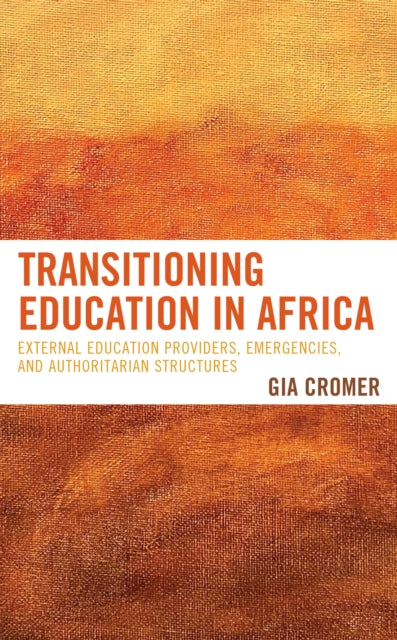
Gia Cromer
Transitioning Education in Africa: External Education Providers, Emergencies, and Authoritarian Structures
Transitioning Education in Africa: External Education Providers, Emergencies, and Authoritarian Structures
💎 Earn 398 Points (£3.98) on this item.
We can order this item for you. Delivery usually takes about 4 to 6 weeks.
This item is not held in our immediate stock. We will order it for you after checkout.
Estimated delivery: About 4 to 6 weeks
- Condition: Brand new
- UK Delivery times: Usually arrives within 2 - 3 working days
- UK Shipping: Fee starts at £2.39. Subject to product weight & dimension
Bulk ordering. Want 15 or more copies? Get a personalised quote and bigger discounts. Learn more about bulk orders.
Couldn't load pickup availability
- More about Transitioning Education in Africa: External Education Providers, Emergencies, and Authoritarian Structures
Transitioning Education in Africa: External Education Providers, Emergencies, and Authoritarian Structures examines the challenges of transitioning from emergency to post-conflict education systems in authoritarian contexts, highlighting the need for government capability improvement and decolonizing education for self-determination.
Format: Hardback
Length: 188 pages
Publication date: 15 September 2023
Publisher: Lexington Books
In the realm of education in Africa, the transition from emergency to post-conflict education systems is a complex and multifaceted process that requires careful planning and management at the national level. This is particularly true when it comes to providing education to refugees, who often find themselves in urgent or crisis situations, relying on external education providers (EEPs) in authoritarian contexts. While the international community has expressed its commitment to enhancing government capabilities in education provision, particularly for refugees, the reality on the ground has yet to reflect these aspirations, especially at the national level.
In her book titled "Transitioning Education in Africa: External Education Providers, Emergencies, and Authoritarian Structures," Gia Cromer delves into the intricacies of this transition. Through a comprehensive analysis that encompasses historical education policies, appreciative inquiry surveys, and semi-structured interviews, Cromer argues that despite the stated goals of the international community, neither EEPs nor refugee-hosting countries have successfully implemented changes to enhance government capacity in education provision, particularly at the national level.
This book offers valuable insights into both historical norms and authoritarian organizational philosophies and structures that may be contributing to this failure. It provides one of the few analyses of the challenges in education provision for displaced people, asylum seekers, and refugees in 11 African countries. The analysis concludes with education policy recommendations aimed at decolonizing education for the self-determination of future education structures in Africa.
One of the key findings of the book is that the historical norms and structures prevalent in Africa have played a significant role in shaping the current education landscape. The colonial era, with its emphasis on Western-style education, has left a lasting impact on African education systems, perpetuating inequalities and marginalizing certain groups. Authoritarian organizational philosophies and structures, on the other hand, have often reinforced these inequalities and limited the autonomy of education providers.
To address these challenges, Cromer proposes several education policy recommendations for national-level education administrators. These recommendations include promoting inclusive education policies that cater to the diverse needs of refugee populations, strengthening the capacity of government institutions to provide education, and promoting the participation of local communities in education decision-making processes.
Furthermore, Cromer emphasizes the importance of recognizing the role of external education providers in providing education to refugees. While EEPs have been instrumental in addressing the immediate needs of displaced populations, they often operate in a context of limited autonomy and accountability. Therefore, it is crucial to establish mechanisms to ensure that EEPs are held accountable for their actions and that their practices align with international standards of education provision.
In conclusion, "Transitioning Education in Africa: External Education Providers, Emergencies, and Authoritarian Structures" provides a valuable contribution to the understanding of the challenges and opportunities in education provision for refugees and displaced populations in Africa. By highlighting the historical norms, authoritarian structures, and external education providers' role, the book offers practical recommendations for decolonizing education and promoting inclusive and sustainable education systems in the region.
Dimension: 229 x 152 (mm)
ISBN-13: 9781498589260
UK and International shipping information
UK and International shipping information
UK Delivery and returns information:
- Delivery within 2 - 3 days when ordering in the UK.
- Shipping fee for UK customers from £2.39. Fully tracked shipping service available.
- Returns policy: Return within 30 days of receipt for full refund.
International deliveries:
Shulph Ink now ships to Australia, Belgium, Canada, France, Germany, Ireland, Italy, India, Luxembourg Saudi Arabia, Singapore, Spain, Netherlands, New Zealand, United Arab Emirates, United States of America.
- Delivery times: within 5 - 10 days for international orders.
- Shipping fee: charges vary for overseas orders. Only tracked services are available for most international orders. Some countries have untracked shipping options.
- Customs charges: If ordering to addresses outside the United Kingdom, you may or may not incur additional customs and duties fees during local delivery.