LyndsayCampbell
Truth and Privilege: Libel Law in Massachusetts and Nova Scotia, 1820-1840
Truth and Privilege: Libel Law in Massachusetts and Nova Scotia, 1820-1840
💎 Earn 250 Points (£2.50) on this item.
We can order this item for you. Delivery usually takes about 4 to 6 weeks.
This item is not held in our immediate stock. We will order it for you after checkout.
Estimated delivery: About 4 to 6 weeks
YOU SAVE £2.97
- Condition: Brand new
- UK Delivery times: Usually arrives within 2 - 3 working days
- UK Shipping: Fee starts at £2.39. Subject to product weight & dimension
Bulk ordering. Want 15 or more copies? Get a personalised quote and bigger discounts. Learn more about bulk orders.
Couldn't load pickup availability
- More about Truth and Privilege: Libel Law in Massachusetts and Nova Scotia, 1820-1840
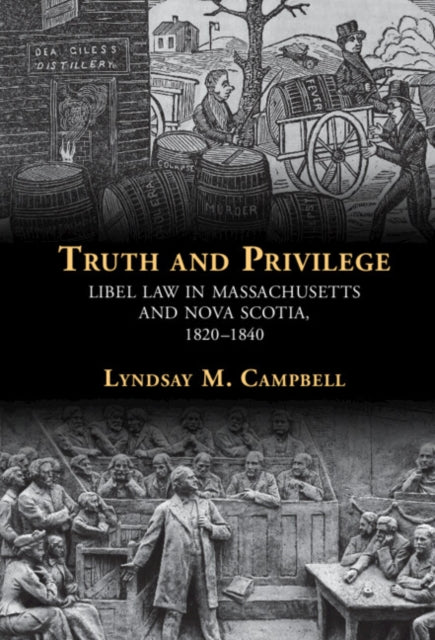
Truth and Privilege is a comparative study that explores the development of libel law, the defenses of truth and privilege, and the role of courts as forums for disputes in Nova Scotia and Massachusetts. It sheds light on the role of law in shaping societal change in the nineteenth century.
Format: Hardback
Length: 442 pages
Publication date: 16 December 2021
Publisher: Cambridge University Press
Truth and Privilege is a comprehensive comparative study that brings together legal, constitutional, and social history to explore the diverging paths of common law in two kindred places, committed to freedom of expression, but separated by the American Revolution. In her examination of Nova Scotia and Massachusetts, Lyndsay Campbell delves into the development of libel law, the defenses of truth and privilege, and the role of courts as forums for disputes. She contrasts the central role of courts in struggles over expression and the interpretation of individual rights in Massachusetts with the concerns about defining protective boundaries for the press and individuals through institutional design in Nova Scotia. Through her rich analysis, Campbell offers a lens through which to understand the role of law in shaping societal change in the nineteenth century, shedding light on the essential question we continue to grapple with today: what should law's role be in regulating expression we perceive as harmful?
Introduction:
Truth and Privilege is a captivating comparative study that delves into the intricate relationship between law, society, and freedom of expression. By examining the diverging paths of common law in two kindred places, Nova Scotia and Massachusetts, Lyndsay Campbell sheds light on the complex dynamics that shaped the development of libel law, the defenses of truth and privilege, and the role of courts as forums for disputes. This study offers a rich and insightful perspective on the nineteenth century, providing valuable insights into the ongoing debate about the appropriate role of law in regulating expression that we perceive as harmful.
Development of Libel Law:
In Nova Scotia and Massachusetts, the development of libel law was influenced by distinct historical, social, and legal factors. In Nova Scotia, the colonies were governed by the British Crown, and the law of libel was closely tied to the principles of English common law. The courts played a central role in shaping libel law, and the defense of truth and privilege was a fundamental principle. However, concerns about defining protective boundaries for the press and individuals through institutional design emerged.
In contrast, Massachusetts was a colony that sought to establish a distinct legal identity from England. The Massachusetts Bay Colony adopted a constitution that guaranteed freedom of expression and press freedom. The courts in Massachusetts were less central in shaping libel law, and the focus was more on protecting individual rights rather than defining boundaries for the press. This distinction can be attributed to the unique political and social context of Massachusetts, where there was a strong belief in the importance of individual liberty and the press as a watchdog for democracy.
Defenses of Truth and Privilege:
The defenses of truth and privilege were central to the legal frameworks in both Nova Scotia and Massachusetts. In Nova Scotia, the defense of truth was based on the principle that a statement was true if it could be proven to be true through evidence. The defense of privilege was based on the idea that certain statements were protected from libel by law, such as statements made in the course of official duties or statements made in good faith. These defenses were designed to balance the interests of the press and individuals, ensuring that false statements were not published without a reasonable basis.
In Massachusetts, the defenses of truth and privilege were also important, but they were shaped by the broader constitutional protections for freedom of expression. The right to free speech was enshrined in the Massachusetts Constitution, and the courts interpreted this right broadly to include the protection of libel. The defense of truth was based on the same principle as in Nova Scotia, while the defense of privilege was expanded to include statements made in the course of public interest or in good faith.
Role of Courts as Forums for Disputes:
Courts played a crucial role in shaping the legal frameworks in both Nova Scotia and Massachusetts. In Nova Scotia, the courts were the primary forum for resolving disputes related to libel. The judges were appointed by the British Crown and were known for their expertise in legal matters. The cases were often complex, and the judges had to balance the interests of the press and individuals to determine the truth and the appropriate legal consequences.
In Massachusetts, the courts were also important, but they had a different role. The courts were not as central in shaping libel law as in Nova Scotia, and the focus was more on protecting individual rights. The cases were often less complex, and the judges had to balance the interests of the press and individuals within the broader constitutional framework of freedom of expression.
Conclusion:
In conclusion, Truth and Privilege is a valuable contribution to the study of law, society, and freedom of expression. By examining the diverging paths of common law in Nova Scotia and Massachusetts, Campbell sheds light on the complex dynamics that shaped the development of libel law, the defenses of truth and privilege, and the role of courts as forums for disputes. This study offers a rich and insightful perspective on the nineteenth century, providing valuable insights into the ongoing debate about the appropriate role of law in regulating expression that we perceive as harmful. As we navigate the challenges of the modern world, it is essential to consider the lessons learned from the past and to strive for a legal framework that balances the interests of the press, individuals, and society as a whole.
Weight: 886g
Dimension: 159 x 235 x 37 (mm)
ISBN-13: 9781316510698
This item can be found in:
UK and International shipping information
UK and International shipping information
UK Delivery and returns information:
- Delivery within 2 - 3 days when ordering in the UK.
- Shipping fee for UK customers from £2.39. Fully tracked shipping service available.
- Returns policy: Return within 30 days of receipt for full refund.
International deliveries:
Shulph Ink now ships to Australia, Belgium, Canada, France, Germany, Ireland, Italy, India, Luxembourg Saudi Arabia, Singapore, Spain, Netherlands, New Zealand, United Arab Emirates, United States of America.
- Delivery times: within 5 - 10 days for international orders.
- Shipping fee: charges vary for overseas orders. Only tracked services are available for most international orders. Some countries have untracked shipping options.
- Customs charges: If ordering to addresses outside the United Kingdom, you may or may not incur additional customs and duties fees during local delivery.