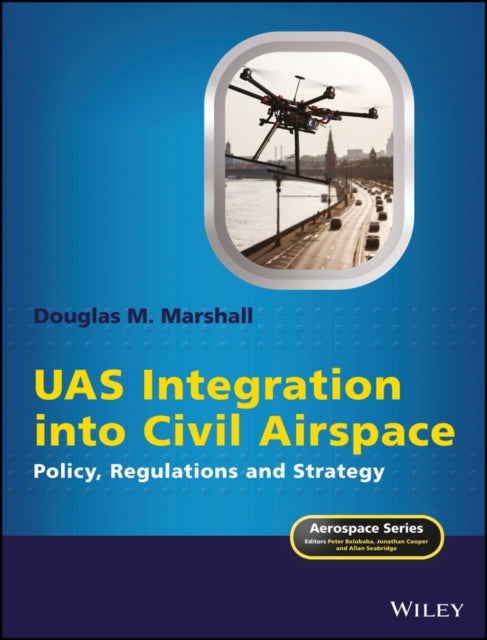
DM Marshall
UAS Integration into Civil Airspace: Policy, Regul ations and Strategy
UAS Integration into Civil Airspace: Policy, Regul ations and Strategy
💎 Earn 305 Points (£3.05) on this item.
We can order this item for you. Delivery usually takes about 4 to 6 weeks.
This item is not held in our immediate stock. We will order it for you after checkout.
Estimated delivery: About 4 to 6 weeks
YOU SAVE £7.93
- Condition: Brand new
- UK Delivery times: Usually arrives within 2 - 3 working days
- UK Shipping: Fee starts at £2.39. Subject to product weight & dimension
Bulk ordering. Want 15 or more copies? Get a personalised quote and bigger discounts. Learn more about bulk orders.
Couldn't load pickup availability
- More about UAS Integration into Civil Airspace: Policy, Regul ations and Strategy
The book explores the current policies and regulations surrounding the integration of Unmanned Air Systems (UAS) into civil airspace, with a focus on developing a common airspace access and integration strategy. It discusses the technological developments such as UTM and U-space and presents a comprehensive airspace integration strategy that balances safety, utility, and affordability.
Format: Hardback
Length: 208 pages
Publication date: 21 April 2022
Publisher: John Wiley & Sons Inc
The integration of unmanned air systems (UAS) into civil airspace is a complex and multifaceted issue that requires a comprehensive and coordinated approach. This paper explores the current policies and regulations surrounding UAS integration, as well as the strategies and technologies being developed to facilitate safe and efficient UAS operations.
Policy and Regulations:
The Federal Aviation Administration (FAA) in the United States is responsible for regulating UAS operations in civil airspace. The FAA has issued a series of rules and regulations to ensure the safe and responsible use of UAS, including restrictions on flight altitudes, flight paths, and the number of UAS operators in a given area.
In Europe, the European Union has also taken steps to regulate UAS integration. The EU's Aviation Safety Agency (EASA) has developed a regulatory framework for UAS operations, including requirements for registration, certification, and training of UAS operators.
Other countries, such as Canada, Australia, and Japan, have also developed their own policies and regulations for UAS integration. These policies may vary depending on the specific use cases and requirements of each country.
Strategies and Technologies:
Several strategies and technologies are being developed to facilitate UAS integration into civil airspace. One of the most promising is the use of unmanned traffic management (UTM), which is a system that uses sensors and communication technologies to manage the flow of UAS traffic in the air.
UTM systems can help to reduce the risk of collisions between UAS and manned aircraft, as well as to optimize the use of airspace resources. Another promising technology is the use of virtual and augmented reality (VR/AR) technologies to enhance the situational awareness of UAS operators and to improve the coordination of UAS operations with manned aircraft.
Other strategies and technologies being developed include the use of detect and avoid (DAA) systems, which use sensors and communication technologies to detect and avoid other aircraft in the air, and the use of geofencing, which uses GPS and other technologies to create virtual boundaries around sensitive areas.
Challenges and Opportunities:
Despite the progress that has been made in developing strategies and technologies for UAS integration, there are still several challenges and opportunities that need to be addressed. One of the biggest challenges is the need to balance the needs and demands of UAS users with the general public's right to safe skies and privacy.
Another challenge is the need to develop a comprehensive and coordinated regulatory framework that can accommodate the diverse range of UAS use cases and requirements across different countries. Finally, there is the need to address the technical and operational challenges associated with UAS integration, such as ensuring the reliability and safety of UAS systems and developing the necessary skills and training for UAS operators.
Conclusion:
The integration of UAS into civil airspace is a complex and multifaceted issue that requires a comprehensive and coordinated approach. While there are still several challenges and opportunities to be addressed, the development of strategies and technologies such as UTM, VR/AR, DAA, and geofencing is helping to pave the way for safe and efficient UAS operations.
As the use of UAS continues to grow, it is important for policymakers, regulators, and industry stakeholders to work together to develop a comprehensive and coordinated regulatory framework that can ensure the safe and responsible use of UAS in civil airspace.
Weight: 518g
Dimension: 251 x 176 x 18 (mm)
ISBN-13: 9781118339497
This item can be found in:
UK and International shipping information
UK and International shipping information
UK Delivery and returns information:
- Delivery within 2 - 3 days when ordering in the UK.
- Shipping fee for UK customers from £2.39. Fully tracked shipping service available.
- Returns policy: Return within 30 days of receipt for full refund.
International deliveries:
Shulph Ink now ships to Australia, Belgium, Canada, France, Germany, Ireland, Italy, India, Luxembourg Saudi Arabia, Singapore, Spain, Netherlands, New Zealand, United Arab Emirates, United States of America.
- Delivery times: within 5 - 10 days for international orders.
- Shipping fee: charges vary for overseas orders. Only tracked services are available for most international orders. Some countries have untracked shipping options.
- Customs charges: If ordering to addresses outside the United Kingdom, you may or may not incur additional customs and duties fees during local delivery.