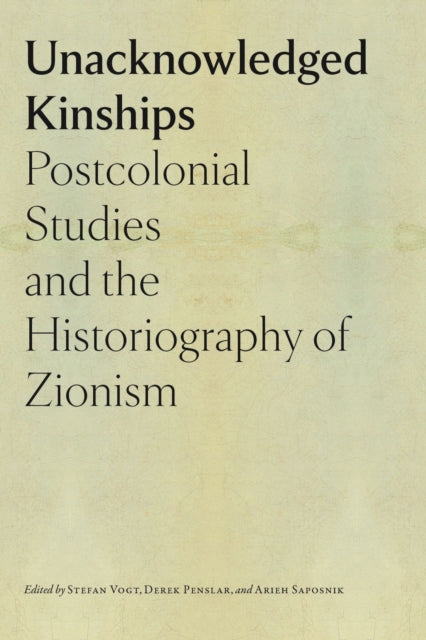
Stefan Vogt,Derek Penslar,Arieh Saposnik
Unacknowledged Kinships - Postcolonial Studies and the Historiography of Zionism
Unacknowledged Kinships - Postcolonial Studies and the Historiography of Zionism
💎 Earn 151 Points (£1.51) on this item.
YOU SAVE £1.79
- Condition: Brand new
- UK Delivery times: Usually arrives within 2 - 3 working days
- UK Shipping: Fee starts at £2.39. Subject to product weight & dimension
Bulk ordering. Want 15 or more copies? Get a personalised quote and bigger discounts. Learn more about bulk orders.
Couldn't load pickup availability
- More about Unacknowledged Kinships - Postcolonial Studies and the Historiography of Zionism
Unacknowledged Kinships explores the potential for a dialogue between postcolonial studies and Zionist historiography by identifying and exploring possible linkages and affiliations between their subjects, while also arguing that postcolonial studies could gain from looking at the history of Zionism as an example of colonial domination and national liberation.
Format: Paperback / softback
Length: 360 pages
Publication date: 24 July 2023
Publisher: Brandeis University Press
Unacknowledged Kinships: Exploring the Interconnections between Zionism and Postcolonial Studies
The relationship between Zionism and postcolonial studies is a subject that has long been overlooked, yet it holds immense potential for scholarly exploration. In Unacknowledged Kinships, a groundbreaking work that delves into this understudied area, the authors argue that there exists an "unacknowledged kinship" between these two fields of study. This kinship, they suggest, deserves to be both discovered and acknowledged.
The book aims to facilitate a conversation between the historiography of Zionism and postcolonial studies by identifying and exploring possible linkages and affiliations between their subjects. The contributors to this volume discuss central theoretical concepts developed within the field of postcolonial studies, and they use these concepts to analyze crucial aspects of the history of Zionism while contextualizing Zionist thought, politics, and culture within colonial and postcolonial histories.
One of the key insights of Unacknowledged Kinships is that postcolonial studies could gain valuable insights from examining the history of Zionism. The authors argue that Zionism is not just a case of colonial domination, but also a complex phenomenon that involves processes of national liberation and self-empowerment. By studying the history of Zionism, postcolonial scholars can gain a deeper understanding of the complexities of colonialism, the struggles for national identity, and the processes of decolonization.
Furthermore, the book suggests that postcolonial concepts can be applied to the history of European Zionism just as comprehensively as to the history of Zionism in Palestine and Israel or Arab countries. The authors argue that Zionism is a product of a global history of colonialism and imperialism, and it cannot be understood solely within the context of the Middle East. By examining the history of European Zionism, postcolonial scholars can gain a broader understanding of the transnational dimensions of colonialism and the ways in which different colonial powers interacted with each other.
Unacknowledged Kinships is a groundbreaking work that makes a significant contribution to the field of postcolonial studies. It is the first work to systematically investigate the potential for a dialogue between postcolonial studies and Zionist historiography. The book is an overture for a dialogue between these two fields of study, and it encourages scholars to explore the interconnections between Zionism and postcolonialism in new and innovative ways.
In conclusion, Unacknowledged Kinships is a must-read for anyone interested in the intersection of Zionism, postcolonialism, and historiography. The book offers a fresh perspective on these subjects and encourages scholars to think critically about the ways in which these two fields of study can contribute to our understanding of the world. By acknowledging and exploring the unacknowledged kinship between Zionism and postcolonial studies, we can gain a deeper appreciation of the complex and multifaceted history of our world and work towards a more just and equitable future.
Weight: 492g
Dimension: 153 x 230 x 24 (mm)
ISBN-13: 9781684581542
UK and International shipping information
UK and International shipping information
UK Delivery and returns information:
- Delivery within 2 - 3 days when ordering in the UK.
- Shipping fee for UK customers from £2.39. Fully tracked shipping service available.
- Returns policy: Return within 30 days of receipt for full refund.
International deliveries:
Shulph Ink now ships to Australia, Belgium, Canada, France, Germany, Ireland, Italy, India, Luxembourg Saudi Arabia, Singapore, Spain, Netherlands, New Zealand, United Arab Emirates, United States of America.
- Delivery times: within 5 - 10 days for international orders.
- Shipping fee: charges vary for overseas orders. Only tracked services are available for most international orders. Some countries have untracked shipping options.
- Customs charges: If ordering to addresses outside the United Kingdom, you may or may not incur additional customs and duties fees during local delivery.