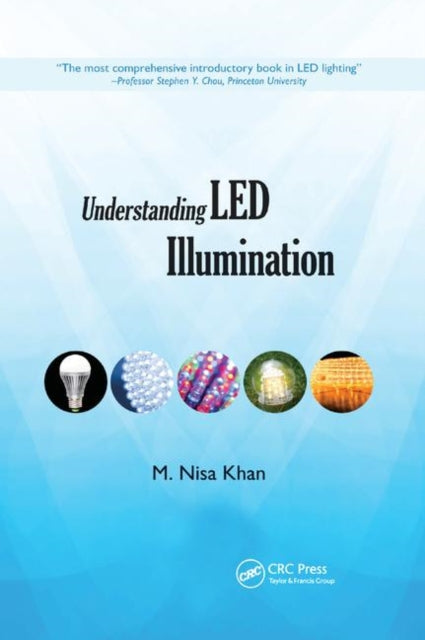
M. Nisa Khan
Understanding LED Illumination
Understanding LED Illumination
💎 Earn 264 Points (£2.64) on this item.
We can order this item for you. Delivery usually takes about 4 to 6 weeks.
This item is not held in our immediate stock. We will order it for you after checkout.
Estimated delivery: About 4 to 6 weeks
YOU SAVE £3.14
- Condition: Brand new
- UK Delivery times: Usually arrives within 2 - 3 working days
- UK Shipping: Fee starts at £2.39. Subject to product weight & dimension
Bulk ordering. Want 15 or more copies? Get a personalised quote and bigger discounts. Learn more about bulk orders.
Couldn't load pickup availability
- More about Understanding LED Illumination
LED Illumination explores the science of lighting for light emitting diodes, providing concepts, theory, simulations, and new design techniques to improve illumination, energy efficiency, and reduce electrical power consumption. It covers lamp output metrics and characterization methods, light propagation and distribution characteristics, and design and simulation requirements for LED lamps. It also addresses light generation, efficiency, theoretical limits, efficiency limiting factors, and LED lamp design elements. Case studies from Osram Optosemiconductors, Sylvania, and Phillips, GE, and others are included, as well as a novel design for improving tubular LED replacements.
Format: Paperback / softback
Length: 272 pages
Publication date: 30 September 2020
Publisher: Taylor & Francis Ltd
Understanding LED Illumination: Illuminating the Science of Lighting for Light Emitting Diodes
LED illumination is a rapidly evolving field that has revolutionized the lighting industry. This comprehensive text provides a comprehensive overview of the science of LED lighting, covering concepts, theory, simulations, and new design techniques that enhance illumination, energy efficiency, and reduce electrical power consumption.
The first part of the book delves into lamp output metrics and characterization methods, providing a solid foundation for understanding the performance of LED lamps. It explores various lamp types, including compact fluorescent lamps (CFLs), incandescent lamps, and LED lamps, and compares their characteristics and performance. The second part of the book focuses on retail and prototype lamp comparisons, using theory, simulations, and experiments to evaluate the effectiveness of different LED lamp designs.
The book covers the light propagation and distribution characteristics of LED light sources for general illumination applications. It discusses the principles of light distribution, color rendering, and color temperature, and provides design and simulation requirements for LED lamps suited for real-world applications. It also addresses light generation, efficiency, theoretical limits, efficiency limiting factors, and LED lamp design elements.
One of the key aspects of LED illumination is the emphasis on quality and improvement. The book highlights the importance of designing LED lamps that provide high-quality light output, with minimal glare and color distortion. It discusses the intricacies of compound semiconductor optoelectronic properties, including the thermal, electrical, optical, and mechanical aspects, and explains how these properties affect the performance of LED lamps.
Another challenge of LED lighting is the challenges of scientific and mathematical terms. The book takes the mysteries out of solid-state lighting for lighting designers, and helps LED scientists and engineers effectively design their products. It includes case studies from Osram Optosemiconductors, Sylvania, and Phillips, GE, and others, which demonstrate the successful application of LED lighting in various applications.
The book also characterizes several LED replacement lamps for household and commercial lighting. It discusses a novel design for improving tubular LED replacements, which can provide a more efficient and cost-effective solution for lighting applications.
In conclusion, Understanding LED Illumination is a valuable resource for lighting designers, engineers, and scientists who are interested in learning more about the science of LED lighting. It provides a comprehensive overview of the field, covering concepts, theory, simulations, and new design techniques that enhance illumination, energy efficiency, and reduce electrical power consumption. By understanding the intricacies of compound semiconductor optoelectronic properties, lighting designers can create LED lamps that provide high-quality light output, with minimal glare and color distortion.
Weight: 454g
Dimension: 154 x 235 x 12 (mm)
ISBN-13: 9780367867102
UK and International shipping information
UK and International shipping information
UK Delivery and returns information:
- Delivery within 2 - 3 days when ordering in the UK.
- Shipping fee for UK customers from £2.39. Fully tracked shipping service available.
- Returns policy: Return within 30 days of receipt for full refund.
International deliveries:
Shulph Ink now ships to Australia, Belgium, Canada, France, Germany, Ireland, Italy, India, Luxembourg Saudi Arabia, Singapore, Spain, Netherlands, New Zealand, United Arab Emirates, United States of America.
- Delivery times: within 5 - 10 days for international orders.
- Shipping fee: charges vary for overseas orders. Only tracked services are available for most international orders. Some countries have untracked shipping options.
- Customs charges: If ordering to addresses outside the United Kingdom, you may or may not incur additional customs and duties fees during local delivery.