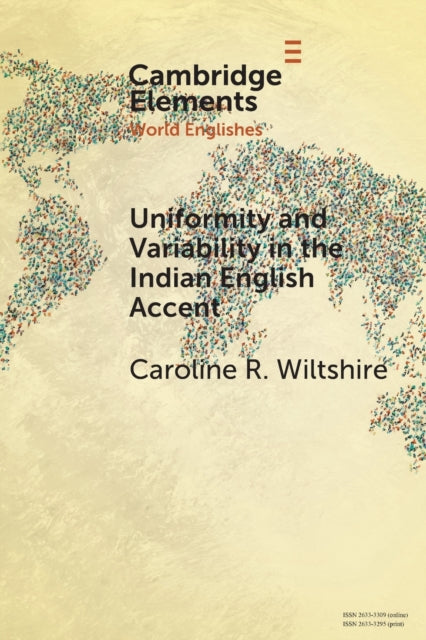
Caroline R.Wiltshire
Uniformity and Variability in the Indian English Accent
Uniformity and Variability in the Indian English Accent
💎 Earn 84 Points (£0.84) on this item.
We can order this item for you. Delivery usually takes about 4 to 6 weeks.
This item is not held in our immediate stock. We will order it for you after checkout.
Estimated delivery: About 4 to 6 weeks
YOU SAVE £1.01
- Condition: Brand new
- UK Delivery times: Usually arrives within 2 - 3 working days
- UK Shipping: Fee starts at £2.39. Subject to product weight & dimension
Bulk ordering. Want 15 or more copies? Get a personalised quote and bigger discounts. Learn more about bulk orders.
Couldn't load pickup availability
- More about Uniformity and Variability in the Indian English Accent
The sounds of Indian English are distinct and recognizable to outsiders, while insiders perceive variations in how English has developed in this large diverse population. This Element synthesizes research over the past fifty years and adds to it, focusing on selected features of consonants, vowels, and suprasegmentals to understand the characteristics of Indian English accents and sources of its uniformity and variability. These accent features, perceptible by humans and discoverable by computational approaches, may be used in expressing identity, both local and pan-Indian.
Format: Paperback / softback
Length: 75 pages
Publication date: 17 December 2020
Publisher: Cambridge University Press
Indian English is a unique and recognizable dialect to those outside of India, while insiders recognize variations in how English has evolved within this vast and diverse population. What characteristics unite this language, and what clues can we find to a speaker's origins or identity? This Element synthesizes research conducted over the past fifty years and expands upon it, focusing on selected features of consonants, vowels, and suprasegmentals (stress, intonation, rhythm) to understand the characteristics of Indian English accents and the sources of their uniformity and variability. These accent features, perceptible to humans and discernible through computational approaches, have the potential to be used to express identity, both local and pan-Indian.
Consonants:
Indian English has a distinct set of consonant sounds that set it apart from other English dialects. One notable feature is the use of the retroflex approximant /r/, which is pronounced as a trilled /r/ or a tapped /r/. This approximant is often found in words like "car" and "far," where the /r/ sound is replaced by a trill or tap.
Another characteristic of Indian English is the use of the palatal approximant /j/, which is pronounced as a y sound in some contexts. This approximant is often found in words like "yet" and "key," where the /j/ sound is replaced by a y sound.
Vowels:
Indian English has a variety of vowel sounds that are unique to the dialect. One notable feature is the use of the schwa sound /ə/, which is pronounced as a neutral vowel sound. This sound is often found in unstressed syllables and can be heard in words like "father" and "water."
Another characteristic of Indian English vowels is the use of the diphthong /ai/, which is pronounced as a long /i/ sound. This sound is often found in words like "pay" and "say," where the /ai/ sound is replaced by a long /i/ sound.
Suprasegmentals:
Suprasegmentals, which include features such as stress, intonation, and rhythm, play a significant role in Indian English accents. One notable feature is the use of stress, which is often placed on the first syllable of a word. This stress pattern can be heard in words like "computer" and "India," where the stress is placed on the first syllable.
Another characteristic of Indian English intonation is the use of rising intonation, which is characterized by a rising pitch at the end of a sentence. This intonation pattern can be heard in words like "yes" and "no," where the pitch rises at the end of the sentence.
Conclusion:
Indian English is a unique and recognizable dialect that has evolved within a vast and diverse population. The sounds of Indian English are distinct and recognizable to outsiders, while insiders perceive variations in how English has developed in this large diverse population. The characteristics that mark the unity of Indian English include the use of retroflex approximants /r/ and /j/, the use of schwa sound /ə/, the use of diphthong /ai/, and the use of stress and rising intonation. These accent features, perceptible to humans and discernible through computational approaches, have the potential to be used in expressing identity, both local and pan-Indian.
Weight: 160g
Dimension: 151 x 229 x 8 (mm)
ISBN-13: 9781108823272
UK and International shipping information
UK and International shipping information
UK Delivery and returns information:
- Delivery within 2 - 3 days when ordering in the UK.
- Shipping fee for UK customers from £2.39. Fully tracked shipping service available.
- Returns policy: Return within 30 days of receipt for full refund.
International deliveries:
Shulph Ink now ships to Australia, Belgium, Canada, France, Germany, Ireland, Italy, India, Luxembourg Saudi Arabia, Singapore, Spain, Netherlands, New Zealand, United Arab Emirates, United States of America.
- Delivery times: within 5 - 10 days for international orders.
- Shipping fee: charges vary for overseas orders. Only tracked services are available for most international orders. Some countries have untracked shipping options.
- Customs charges: If ordering to addresses outside the United Kingdom, you may or may not incur additional customs and duties fees during local delivery.