Shulph Ink
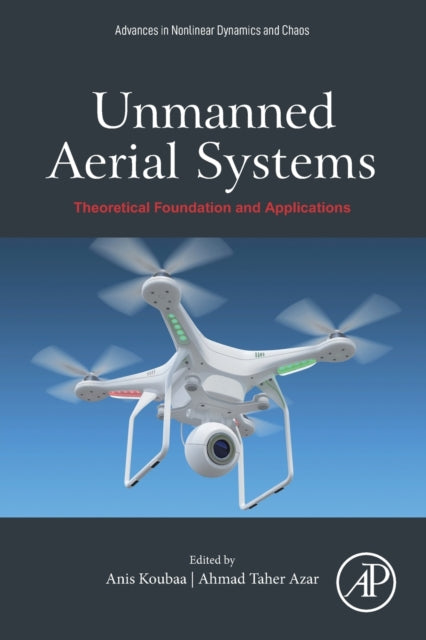
Unmanned Aerial Systems: Theoretical Foundation and Applications
Unmanned Aerial Systems: Theoretical Foundation and Applications
💎 Earn 567 Points (£5.67) on this item.
YOU SAVE £9.53
- Condition: Brand new
- UK Delivery times: Usually arrives within 2 - 3 working days
- UK Shipping: Fee starts at £2.39. Subject to product weight & dimension
Bulk ordering. Want 15 or more copies? Get a personalised quote and bigger discounts. Learn more about bulk orders.
Couldn't load pickup availability
- More about Unmanned Aerial Systems: Theoretical Foundation and Applications
Unmanned Aerial Systems: Theoretical Foundation and Applications provides a comprehensive overview of innovative approaches to drones, covering dynamic modeling, system analysis, optimization, control, communications, 3D-mapping, search and rescue, surveillance, farmland and construction monitoring, and more. It covers the safe operation of UAS and is a valuable resource for researchers, instructors, and practitioners.
Format: Paperback / softback
Length: 650 pages
Publication date: 26 January 2021
Publisher: Elsevier Science Publishing Co Inc
Unmanned Aerial Systems: Theoretical Foundation and Applications delves into the cutting-edge advancements in drone technology, offering a comprehensive perspective on dynamic modeling, system analysis, optimization, control, communications, 3D mapping, search and rescue, surveillance, farmland and construction monitoring, and various other applications. The rise of affordable unmanned aerial systems (UAS) has sparked a surge of research endeavors in academia and the industrial sectors. This book comprehensively covers the safe operation of UAS, encompassing fundamental design, mission and path planning, control theory, computer vision, artificial intelligence, application requirements, and more. It serves as a valuable reference for researchers, instructors, and practitioners, providing a comprehensive overview of the state-of-the-art research and development in unmanned aerial systems.
The theoretical foundation of unmanned aerial systems (UAS) is rooted in the principles of aerodynamics, control theory, and computer science. Aerodynamics plays a crucial role in determining the flight characteristics of UAS, including lift, drag, and stability. Control theory is employed to design the flight control systems that enable the UAS to navigate and perform various tasks. Computer science is utilized to develop the software and hardware components that power UAS, including sensors, cameras, and communication systems.
UAS can be classified into different types based on their design, payload capacity, and intended applications. Some common types of UAS include fixed-wing aircraft, rotary-wing aircraft, and hybrid aircraft. Fixed-wing aircraft are typically used for longer-range missions, such as surveillance and transportation, while rotary-wing aircraft are more maneuverable and commonly used for search and rescue operations. Hybrid aircraft combine the benefits of both fixed-wing and rotary-wing aircraft, allowing for greater flexibility and adaptability.
UAS have numerous applications in various industries, including agriculture, construction, transportation, and security. In agriculture, UAS can be used for crop monitoring, precision spraying, and soil analysis. In construction, UAS can be used for site inspections, surveying, and demolition tasks. In transportation, UAS can be used for package delivery, traffic monitoring, and aerial photography. In security, UAS can be used for surveillance, border patrol, and emergency response.
One of the key challenges in the development and deployment of UAS is ensuring the safe operation of these vehicles. Safety concerns include the potential for collisions with manned aircraft, the risk of losing control of the UAS, and the potential for privacy violations. To address these concerns, various safety measures have been implemented, including the use of sensors, redundant systems, and remote control capabilities.
In conclusion, unmanned aerial systems have emerged as a powerful tool for a wide range of applications, from agriculture to security. The theoretical foundation of UAS is rooted in aerodynamics, control theory, and computer science, and the technology is constantly evolving to meet the growing demand for innovative solutions. While safety concerns remain a key challenge, ongoing research and development efforts are aimed at ensuring the safe and responsible deployment of UAS.
Weight: 1006g
Dimension: 229 x 209 x 34 (mm)
ISBN-13: 9780128202760
This item can be found in:
UK and International shipping information
UK and International shipping information
UK Delivery and returns information:
- Delivery within 2 - 3 days when ordering in the UK.
- Shipping fee for UK customers from £2.39. Fully tracked shipping service available.
- Returns policy: Return within 30 days of receipt for full refund.
International deliveries:
Shulph Ink now ships to Australia, Belgium, Canada, France, Germany, Ireland, Italy, India, Luxembourg Saudi Arabia, Singapore, Spain, Netherlands, New Zealand, United Arab Emirates, United States of America.
- Delivery times: within 5 - 10 days for international orders.
- Shipping fee: charges vary for overseas orders. Only tracked services are available for most international orders. Some countries have untracked shipping options.
- Customs charges: If ordering to addresses outside the United Kingdom, you may or may not incur additional customs and duties fees during local delivery.