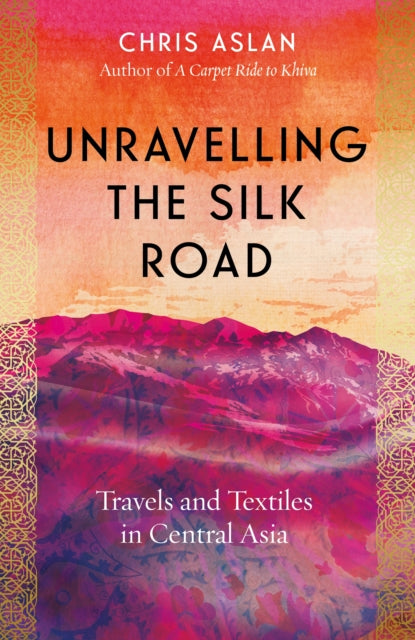
Chris Aslan
Unravelling the Silk Road: Travels and Textiles in Central Asia
Unravelling the Silk Road: Travels and Textiles in Central Asia
💎 Earn 88 Points (£0.88) on this item.
YOU SAVE £7.30
- Condition: Brand new
- UK Delivery times: Usually arrives within 2 - 3 working days
- UK Shipping: Fee starts at £2.39. Subject to product weight & dimension
Bulk ordering. Want 15 or more copies? Get a personalised quote and bigger discounts. Learn more about bulk orders.
Couldn't load pickup availability
- More about Unravelling the Silk Road: Travels and Textiles in Central Asia
Three textile roads, the Silk Road, the Wool Road, and the Cotton Road, crisscrossed Central Asia, facilitating trade, housing nomads, and causing environmental disasters. Chris Aslan, a fifteen-year resident of the region, unravels these threads and shares his experiences.
Format: Hardback
Length: 352 pages
Publication date: 15 June 2023
Publisher: Icon Books
Three textile roads weave their intricate paths through Central Asia, each carrying its own rich tapestry of history and significance. The renowned Silk Road, a testament to the age-old connections between east and west, served as a vital conduit for trade, fostering cultural exchange and economic prosperity. Yet, there existed an even older road, the venerable Wool Road, which held immense importance in enabling nomads to traverse the treacherous winter steppes, providing them with shelter and warmth amidst the harsh climate. Complementing these two historic routes was the enigmatic Cotton Road, marked by a complex interplay of greed, colonialism, and environmental devastation.
At this crossroads of human civilization, fortunes were amassed and lost amidst the shimmering expanse of silks, the life-sustaining felts, and the delicate threads of gossamer cotton. It is within this intricate tapestry that Chris Aslan, a seasoned explorer and resident of the region for fifteen years, skillfully unravels the threads of this complex history, weaving them together with his personal anecdotes and insights into life in the heart of Asia.
The Silk Road, a symbol of cultural exchange and economic interconnectedness, stretches its roots back thousands of years. It emerged as a vital trade route connecting the empires of China, India, Persia, and Europe, facilitating the exchange of goods, ideas, and religions. The Silk Road not only revolutionized commerce but also fostered a profound cultural exchange, with influences and ideas flowing freely between different civilizations.
The Wool Road, on the other hand, played a crucial role in the survival and mobility of nomadic communities in Central Asia. Houses made from wool provided insulation against the harsh winters, allowing nomads to traverse the vast expanses of the steppes with ease. The road not only facilitated trade but also facilitated cultural exchange, as nomads interacted with different communities and learned about their customs and traditions.
However, the Cotton Road, although initially promising, eventually became marred by greed, colonialism, and environmental degradation. The desire for cheap cotton led to the exploitation of indigenous peoples and the destruction of their ecosystems. The road also facilitated the spread of diseases, as people from different regions came into contact with each other, leading to the spread of illnesses such as cholera and smallpox.
Chris Aslan's book, "The Silk Roads: A New History of the World," delves deep into the history of these three textile roads, providing a comprehensive and nuanced understanding of their significance. Through his firsthand experiences and extensive research, Aslan sheds light on the complex web of relationships, alliances, and conflicts that shaped the course of history in Central Asia.
One of the key themes of the book is the impact of trade on cultural exchange. Aslan highlights how the Silk Road facilitated the spread of Buddhism, Hinduism, and Islam to different parts of the world, transforming the religious and cultural landscape of the region. The road also played a crucial role in the exchange of ideas, literature, and art, contributing to the development of a rich and diverse cultural heritage.
Another important aspect of the book is the role of nomads in shaping the history of Central Asia. Aslan explores the lives of nomads, their customs, and their relationships with the surrounding communities. He sheds light on the challenges faced by nomads, including the harsh climate, the lack of infrastructure, and the constant threat of conflict. Despite these challenges, nomads played a vital role in the development of Central Asia, contributing to the trade, agriculture, and cultural exchange of the region.
The Cotton Road, although often portrayed as a symbol of greed and exploitation, also holds a significant place in the history of Central Asia. Aslan argues that the road was not solely driven by economic interests but also by political and cultural factors. The desire for cheap cotton was intertwined with the ambitions of European powers, who sought to expand their influence and control in the region. The road also facilitated the spread of colonialism, as European powers colonized different parts of Central Asia and exploited their resources for their own benefit.
However, the environmental consequences of the Cotton Road were devastating. The intensive cultivation of cotton led to deforestation, soil erosion, and water pollution, which had a profound impact on the health and well-being of the local communities. The road also contributed to the spread of diseases, as people from different regions came into contact with each other, leading to the spread of illnesses such as cholera and smallpox.
In conclusion, the three textile roads of Central Asia, the Silk Road, the Wool Road, and the Cotton Road, each carry their own rich tapestry of history and significance. These roads not only facilitated trade and cultural exchange but also shaped the course of history in the region. Chris Aslan's book, "The Silk Roads: A New History of the World," provides a comprehensive and nuanced understanding of these roads, shedding light on the complex web of relationships, alliances, and conflicts that shaped the course of history in Central Asia. Through his firsthand experiences and extensive research, Aslan offers a valuable perspective on the lives of nomads, the impact of trade on cultural exchange, and the environmental consequences of colonialism.
Weight: 630g
Dimension: 165 x 242 x 36 (mm)
ISBN-13: 9781785789861
UK and International shipping information
UK and International shipping information
UK Delivery and returns information:
- Delivery within 2 - 3 days when ordering in the UK.
- Shipping fee for UK customers from £2.39. Fully tracked shipping service available.
- Returns policy: Return within 30 days of receipt for full refund.
International deliveries:
Shulph Ink now ships to Australia, Belgium, Canada, France, Germany, Ireland, Italy, India, Luxembourg Saudi Arabia, Singapore, Spain, Netherlands, New Zealand, United Arab Emirates, United States of America.
- Delivery times: within 5 - 10 days for international orders.
- Shipping fee: charges vary for overseas orders. Only tracked services are available for most international orders. Some countries have untracked shipping options.
- Customs charges: If ordering to addresses outside the United Kingdom, you may or may not incur additional customs and duties fees during local delivery.