James A. Banks,Michael Yellow Bird
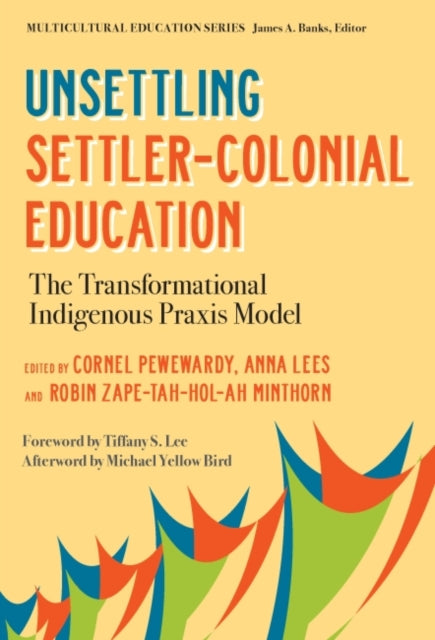
Unsettling Settler-Colonial Education: The Transformational Indigenous Praxis Model
Unsettling Settler-Colonial Education: The Transformational Indigenous Praxis Model
💎 Earn 185 Points (£1.85) on this item.
YOU SAVE £0.91
- Condition: Brand new
- UK Delivery times: Usually arrives within 2 - 3 working days
- UK Shipping: Fee starts at £2.39. Subject to product weight & dimension
Bulk ordering. Want 15 or more copies? Get a personalised quote and bigger discounts. Learn more about bulk orders.
Couldn't load pickup availability
- More about Unsettling Settler-Colonial Education: The Transformational Indigenous Praxis Model
The Transformational Indigenous Praxis Model (TIPM) is a framework for promoting critical consciousness toward decolonization efforts among educators. It challenges readers to examine how even the most well-intentioned educators are complicit in reproducing ethnic stereotypes, racist actions, deficit-based ideology, and recolonization. The book is organized in four sections: Birth–Grade 12 and Community Education, Teacher Education, Higher Education, and Educational Leadership and provides examples of how pathway-making across various settings takes shape on the TIPM continuum. It also highlights a diverse group of authors who are making significant contributions to the transformation agendas of Indigenous knowledge and ways of knowing.
Format: Paperback / softback
Length: 240 pages
Publication date: 30 June 2022
Publisher: Teachers' College Press
This book presents the Transformational Indigenous Praxis Model (TIPM), an innovative framework for promoting critical consciousness toward decolonization efforts among educators. The TIPM challenges readers to examine how even the most well-intentioned educators are complicit in reproducing ethnic stereotypes, racist actions, deficit-based ideology, and recolonization. Drawing from decades of collaboration with teachers and school leaders serving Indigenous children and communities, this volume will help educators better support the development of their students' critical thinking skills. Representing a holistic balance, the text is organized in four sections: Birth–Grade 12 and Community Education, Teacher Education, Higher Education, and Educational Leadership.
Unsettling Settler-Colonial Education centers the needs of teachers, children, families, and communities that are currently engaged in public education and who deserve an improved experience today, while also committing to more positive Indigenous futurities.
Book Features:
Introduces the TIPM as a structure that supports educators in decolonizing and indigenizing their practices.
Provides examples of how pathway-making across a variety of settings takes shape on the TIPM continuum.
Highlights a diverse group of authors who are making major contributions to the transformation agendas of Indigenous knowledge and ways of knowing.
Includes a brief summary of the TIPM dimensions with examples of the challenges that educators face as they expand their critical consciousness toward decolonization.
Follows Native oral traditions by sharing lessons, research, and personal lived experience.
Identifies the deficit ideological underpinnings that frame Indigenous students' school experiences.
Employs a metaphor of "walking on two legs" to describe the challenges of decolonizing education.
The TIPM is a powerful tool for educators who are committed to promoting critical consciousness and decolonizing their practices. By examining the ways in which settler-colonialism has shaped education, educators can develop a deeper understanding of the challenges that Indigenous students face and work to create more inclusive and equitable learning environments. The model emphasizes the importance of collaboration, cultural humility, and the recognition of Indigenous knowledge systems as a source of wisdom and guidance.
One of the key strengths of the TIPM is its ability to provide a comprehensive framework for decolonizing education. The model recognizes that decolonization is not a one-time event but a ongoing process that requires educators to continuously examine their practices and challenge their assumptions. The four sections of the book provide a roadmap for educators to navigate this process, from the early years of education to higher education and educational leadership.
Each section of the book includes examples of how educators can apply the TIPM in their practice. These examples are drawn from a wide range of settings, including Indigenous communities, public schools, and universities. The authors use a variety of methods, including storytelling, research, and personal reflection, to illustrate the challenges and opportunities that educators face as they work to decolonize their practice.
One of the most important themes of the book is the need to recognize the deficit-based ideology that underpins settler-colonial education. The authors argue that this ideology is rooted in the belief that Indigenous cultures and knowledge systems are inferior to Western cultures and knowledge systems. This ideology is perpetuated by a range of policies and practices, including the residential school system, the assimilation of Indigenous children into mainstream society, and the marginalization of Indigenous languages and cultures.
By challenging this ideology, educators can work to create more inclusive and equitable learning environments for Indigenous students. The TIPM provides a framework for educators to identify and challenge these ideologies, and to develop a more nuanced and respectful understanding of Indigenous knowledge systems.
Another important theme of the book is the importance of collaboration and partnership. The authors argue that decolonizing education requires a collective effort, and that educators must work in partnership with Indigenous communities and organizations to develop effective strategies for promoting critical consciousness and decolonizing education. The book includes examples of how educators have worked in partnership with Indigenous communities to develop curriculum, programs, and policies that promote Indigenous knowledge and ways of knowing.
In conclusion, this book presents the Transformational Indigenous Praxis Model (TIPM), an innovative framework for promoting critical consciousness toward decolonization efforts among educators. The TIPM challenges readers to examine how even the most well-intentioned educators are complicit in reproducing ethnic stereotypes, racist actions, deficit-based ideology, and recolonization. By drawing from decades of collaboration with teachers and school leaders serving Indigenous children and communities, the book provides a comprehensive framework for decolonizing education. The model emphasizes the importance of collaboration, cultural humility, and the recognition of Indigenous knowledge systems as a source of wisdom and guidance. The book includes examples of how educators can apply the TIPM in their practice, and provides a roadmap for educators to navigate this process. By working together, educators can create more inclusive and equitable learning environments for Indigenous students and work towards a more just and sustainable world.
Dimension: 229 x 152 (mm)
ISBN-13: 9780807766804
This item can be found in:
UK and International shipping information
UK and International shipping information
UK Delivery and returns information:
- Delivery within 2 - 3 days when ordering in the UK.
- Shipping fee for UK customers from £2.39. Fully tracked shipping service available.
- Returns policy: Return within 30 days of receipt for full refund.
International deliveries:
Shulph Ink now ships to Australia, Belgium, Canada, France, Germany, Ireland, Italy, India, Luxembourg Saudi Arabia, Singapore, Spain, Netherlands, New Zealand, United Arab Emirates, United States of America.
- Delivery times: within 5 - 10 days for international orders.
- Shipping fee: charges vary for overseas orders. Only tracked services are available for most international orders. Some countries have untracked shipping options.
- Customs charges: If ordering to addresses outside the United Kingdom, you may or may not incur additional customs and duties fees during local delivery.