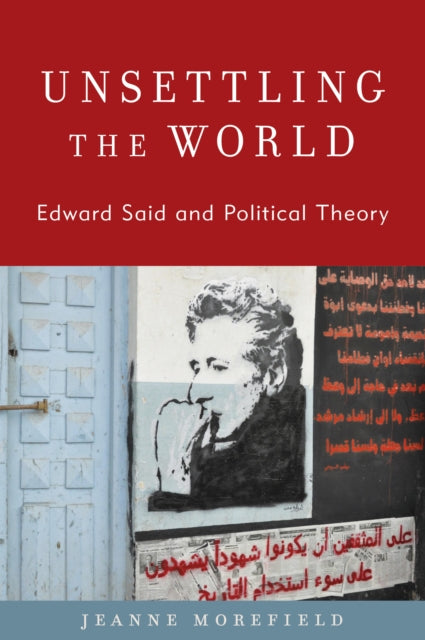
Jeanne Morefield
Unsettling the World: Edward Said and Political Theory
Unsettling the World: Edward Said and Political Theory
We can order this item for you. Delivery usually takes about 4 to 6 weeks.
This item is not held in our immediate stock. We will order it for you after checkout.
Estimated delivery: About 4 to 6 weeks
- Condition: Brand new
- UK Delivery times: Usually arrives within 2 - 3 working days
- UK Shipping: Fee starts at £3.89. Subject to product weight & dimension
Bulk ordering. Want 15 or more copies? Get a personalised quote and bigger discounts. Learn more about bulk orders.
Couldn't load pickup availability
- More about Unsettling the World: Edward Said and Political Theory
Unsettling the World explores Edward Saids cultural criticism from a political theorist's perspective, highlighting its relevance to debates in political theory and offering a model for addressing contemporary global crises and American foreign policy.
Format: Paperback / softback
Length: 346 pages
Publication date: 29 April 2022
Publisher: Rowman & Littlefield
Unsettling the World: A Political Theorist's Perspective on Edward Said's Cultural Criticism
Edward Said's influential cultural criticism has been explored in numerous works, but Unsettling the World is the first book-length treatment of his ideas from the perspective of a political theorist. Arguing that Said's thought extends beyond Orientalism, the book delves into his writings on exile, contrapuntal criticism, and worldly humanism. Morefield contends that Said's critical vision offers a fresh perspective on debates in political theory, particularly regarding subjectivity, global justice, identity, and the history of political thought. Most importantly, she maintains that Said's approach provides theorists with a model for applying the insights gained from historical analyses of imperialism and anti-colonialism to contemporary global crises and the politics of American foreign policy.
Said's cultural criticism has been widely recognized for its ability to challenge dominant narratives and expose the power dynamics that underlie them. His work on exile, for example, has highlighted the experiences of individuals and communities who have been forced to leave their homes and navigate new environments. Said's contrapuntal criticism, which involves analyzing multiple perspectives and voices, has been influential in the study of literature, music, and other cultural forms. His emphasis on worldly humanism, which emphasizes the importance of human agency and the ability of individuals to shape their own destinies, has resonated with many readers.
Unsettling the World builds on Said's ideas by exploring his writings on exile, contrapuntal criticism, and worldly humanism in greater detail. The book begins by examining Said's early life and education, which shaped his perspective on the world. It then explores his key works, including Orientalism, The Question of Palestine, and Culture and Imperialism. The book also examines Said's influence on other scholars and thinkers, including Michel Foucault, Jacques Derrida, and Gayatri Chakravorty Spivak.
One of the key themes of Unsettling the World is Said's critique of Western imperialism and colonialism. Said argues that these systems of power have been responsible for the exploitation, oppression, and marginalization of many people around the world. He highlights the ways in which these systems have been perpetuated through the use of language, culture, and economic power. Said's critique of Western imperialism and colonialism has been influential in the development of postcolonial theory and has helped to shape the way that we think about the world.
Another important theme of Unsettling the World is Said's emphasis on the importance of human agency and the ability of individuals to shape their own destinies. Said argues that individuals have the power to resist and transform the systems of power that have been imposed upon them. He emphasizes the importance of education, activism, and cultural production in this process. Said's work has inspired many individuals and communities to engage in social and political activism, and has helped to promote a more just and equitable world.
Unsettling the World also explores Said's writings on exile and the experience of displacement. Said argues that exile is a form of resistance and that it can be a powerful tool for social and political change. He highlights the ways in which exile can provide individuals with a new perspective on the world and can help them to develop new skills and knowledge. Said's writings on exile have been influential in the study of literature, film, and other cultural forms.
In addition to his writings on exile and the experience of displacement, Said's work has also been influential in the study of literature, film, and other cultural forms. Said's emphasis on the importance of language and the ways in which language can be used to shape and control people has been influential in the development of postcolonial theory. Said's work has also been influential in the study of literature, film, and other cultural forms.
Said's critical vision has been criticized by some scholars, who argue that it is too focused on the West and that it ignores the experiences of people in other parts of the world. However, Morefield argues that Said's critical vision is not limited to the West and that it is applicable to all societies. She contends that Said's approach provides theorists with a model for bringing the insights developed through historical analyses of imperialism and anti-colonialism to bear on critiques of contemporary global crises and the politics of American foreign policy.
In conclusion, Unsettling the World is a valuable contribution to the study of Edward Said's cultural criticism. The book explores Said's ideas from the perspective of a political theorist and provides a fresh perspective on debates in political theory. Said's critical vision offers a model for bringing the insights developed through historical analyses of imperialism and anti-colonialism to bear on critiques of contemporary global crises and the politics of American foreign policy. Unsettling the World is a must-read for anyone interested in the study of political theory, cultural criticism, and the history of political thought.
Weight: 513g
Dimension: 220 x 154 x 25 (mm)
ISBN-13: 9781538168622
UK and International shipping information
UK and International shipping information
We deliver throughout the United Kingdom and to 128 countries and territories worldwide, including the United States, Australia, Canada, Germany, Spain and France.