Myra Faye Turner
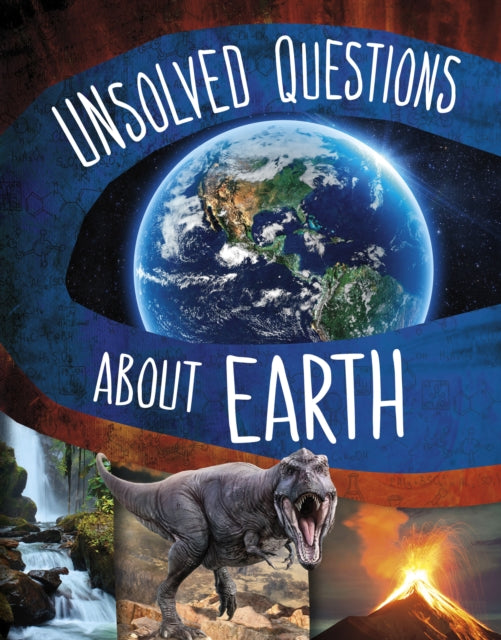
Unsolved Questions About Earth
Unsolved Questions About Earth
💎 Earn 55 Points (£0.55) on this item.
YOU SAVE £2.93
- Condition: Brand new
- UK Delivery times: Usually arrives within 2 - 3 working days
- UK Shipping: Fee starts at £2.39. Subject to product weight & dimension
Bulk ordering. Want 15 or more copies? Get a personalised quote and bigger discounts. Learn more about bulk orders.
Couldn't load pickup availability
- More about Unsolved Questions About Earth
Scientists are still trying to answer questions about how Earth formed, where the water came from, how the plates shifted, and other mysteries. This book uses engaging text and photos to explore the unknown and explain why some questions may never be answered.
Format: Hardback
Length: 32 pages
Publication date: 09 November 2023
Publisher: Capstone Global Library Ltd
The formation of Earth is a complex and fascinating subject that has captivated scientists for centuries. While we have made significant progress in understanding the processes that led to the formation of our planet, many questions remain unanswered. In this article, we will explore some of the key theories and hypotheses about Earth's formation, as well as the evidence that supports them.
One of the most widely accepted theories about Earth's formation is the Big Bang Theory. According to this theory, the universe began as a tiny, dense point of matter that expanded rapidly over time, eventually forming the planets, stars, and galaxies that we see today. The Big Bang Theory provides a framework for understanding the origin of the universe and the formation of matter, but it does not explain the specific details of Earth's formation.
Another theory about Earth's formation is the Nebular Hypothesis. This theory suggests that Earth was formed from a cloud of gas and dust that collapsed under the influence of gravity. The resulting debris formed a protoplanet, which gradually grew larger and larger until it became the Earth we know today. The Nebular Hypothesis provides a detailed explanation for the formation of the Earth's atmosphere, oceans, and continents, but it does not explain the origin of life or the mechanisms that led to the evolution of species.
A third theory about Earth's formation is the Plate Tectonics Theory. This theory suggests that the Earth's crust is divided into large plates that move slowly over time. These plates interact with each other, causing earthquakes, volcanoes, and other geological phenomena. The Plate Tectonics Theory provides a detailed explanation for the formation of mountain ranges, ocean basins, and the distribution of minerals and resources on Earth, but it does not explain the origin of the Earth's magnetic field or the mechanisms that led to the evolution of life.
Despite the many theories and hypotheses about Earth's formation, there is still much to be learned. Scientists are continuing to study the Earth's past and present using a variety of techniques, including satellite imagery, geologic mapping, and laboratory experiments. These studies are helping to refine our understanding of the processes that led to the formation of our planet and to identify new questions that need to be addressed.
One of the most important questions about Earth's formation is the source of water. Water is essential for life on Earth, and it is believed that most of the water on Earth was formed during the formation of the planet. However, the exact mechanisms that led to the formation of water are still not fully understood. Some scientists suggest that water was formed from the collision of asteroids or comets, while others suggest that water was formed from the outgassing of gases from the early Earth's mantle.
Another important question about Earth's formation is the origin of life. While we have a good understanding of the processes that led to the evolution of species, we still do not know the exact mechanisms that led to the origin of life. Some scientists suggest that life originated on Earth from simple organic molecules that were synthesized in the early Earth's atmosphere or oceans, while others suggest that life originated on other planets and was transported to Earth by meteorites or other means.
The formation of Earth's plates is another important topic that scientists are studying. The Earth's crust is divided into several large plates that move slowly over time. These plates interact with each other, causing earthquakes, volcanoes, and other geological phenomena. The formation of Earth's plates is believed to have played a significant role in the evolution of life on Earth, as it provided a stable platform for the development of ecosystems and the distribution of resources.
Despite the many questions that remain about Earth's formation, scientists are making significant progress in understanding the processes that led to the formation of our planet. These advances are helping to refine our understanding of the Earth's past and present and to identify new opportunities for scientific discovery.
In conclusion, the formation of Earth is a complex and fascinating subject that has captivated scientists for centuries. While we have made significant progress in understanding the processes that led to the formation of our planet, many questions remain unanswered. In this article, we have explored some of the key theories and hypotheses about Earth's formation, as well as the evidence that supports them. We have also discussed the importance of continuing to study the Earth's past and present and the potential for scientific discovery in this field. As we continue to explore the unknown, we can expect to make new discoveries that will help us to better understand the Earth and our place in the universe.
Weight: 228g
Dimension: 180 x 237 x 11 (mm)
ISBN-13: 9781398250802
UK and International shipping information
UK and International shipping information
UK Delivery and returns information:
- Delivery within 2 - 3 days when ordering in the UK.
- Shipping fee for UK customers from £2.39. Fully tracked shipping service available.
- Returns policy: Return within 30 days of receipt for full refund.
International deliveries:
Shulph Ink now ships to Australia, Belgium, Canada, France, Germany, Ireland, Italy, India, Luxembourg Saudi Arabia, Singapore, Spain, Netherlands, New Zealand, United Arab Emirates, United States of America.
- Delivery times: within 5 - 10 days for international orders.
- Shipping fee: charges vary for overseas orders. Only tracked services are available for most international orders. Some countries have untracked shipping options.
- Customs charges: If ordering to addresses outside the United Kingdom, you may or may not incur additional customs and duties fees during local delivery.