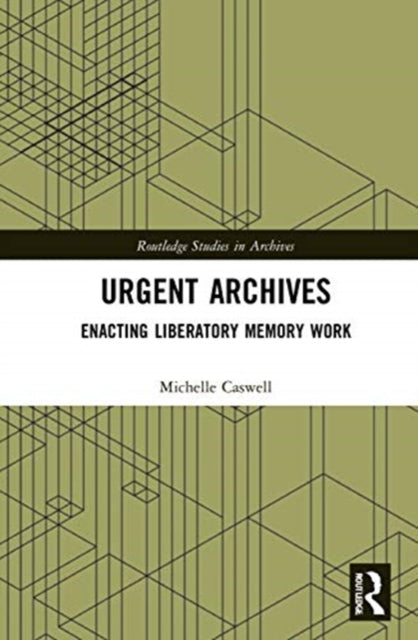
MichelleCaswell
Urgent Archives: Enacting Liberatory Memory Work
Urgent Archives: Enacting Liberatory Memory Work
We can order this item for you. Delivery usually takes about 4 to 6 weeks.
This item is not held in our immediate stock. We will order it for you after checkout.
Estimated delivery: About 4 to 6 weeks
YOU SAVE £15.13
- Condition: Brand new
- UK Delivery times: Usually arrives within 2 - 3 working days
- UK Shipping: Fee starts at £3.89. Subject to product weight & dimension
Bulk ordering. Want 15 or more copies? Get a personalised quote and bigger discounts. Learn more about bulk orders.
Couldn't load pickup availability
- More about Urgent Archives: Enacting Liberatory Memory Work
This book explores how dominant western archival theories and practices are oppressive and proposes community archives as a liberatory alternative. It emphasizes the role of minoritized communities in activating records to build solidarities, challenge linear progress narratives, and disrupt cycles of oppression. It also explores the temporal, representational, and material aspects of liberatory memory work.
\n Format: Hardback
\n Length: 130 pages
\n Publication date: 31 May 2021
\n Publisher: Taylor & Francis Ltd
\n
This book delves into the oppressive nature of dominant Western archival theories and practices, while also exploring the radical politics of community archives to envision new liberatory theories and practices. It examines how members of marginalized communities utilize records to foster solidarity both within and across communities, challenge linear progress narratives, and disrupt cycles of oppression. Caswell delves into the temporal, representational, and material aspects of liberatory memory work, arguing that archival disruptions in time and space should focus on the liberatory affects and effects of memory work in the present rather than solely on the past or the future.
Introduction:
The Western archival tradition has long been shaped by dominant ideologies and practices that perpetuate power imbalances and marginalize certain groups. Archival theories and practices have often been used to reinforce existing hierarchies, suppress dissent, and maintain the status quo. This book aims to challenge these dominant narratives and explore the potential for new liberatory theories and practices within the realm of community archives.
The Oppressive Nature of Western Archival Theories and Practices:
Western archival theories and practices have been criticized for their Eurocentric and colonialist assumptions, which have led to the erasure and marginalization of non-Western voices and experiences. Archivists have often been trained to prioritize the preservation of records that reflect the interests of dominant groups, while neglecting or erasing records that challenge these interests. This has resulted in a skewed representation of history that perpetuates harmful stereotypes and reinforces systems of oppression.
The Radical Politics of Community Archives:
In response to the oppressive nature of Western archival theories and practices, community archives have emerged as a powerful tool for marginalized communities to reclaim their histories and voices. Community archives are defined as archives that are created, managed, and accessed by members of a specific community or group. They are often led by members of the marginalized community and are designed to reflect the community's unique experiences and perspectives.
Activating Records for Solidarity:
One of the key ways in which community archives activate records for solidarity is by challenging linear progress narratives. Linear progress narratives suggest that history moves in a straight line, with each generation improving upon the previous one. Community archives, however, highlight the complexities and contradictions of history, showing how marginalized communities have been erased, oppressed, and marginalized throughout history. By challenging these narratives, community archives help to build solidarity among marginalized communities and promote a more inclusive and equitable understanding of history.
Troubling Linear Progress Narratives:
Community archives also trouble linear progress narratives by highlighting the contributions of marginalized communities to society. These contributions may have been overlooked or erased by dominant narratives, but community archives provide a space for these voices to be heard and recognized. By documenting the experiences and struggles of marginalized communities, community archives help to disrupt the notion that progress is only possible through the efforts of privileged groups.
Disrupting Cycles of Oppression:
Community archives also play a crucial role in disrupting cycles of oppression. By providing access to records that document historical patterns of discrimination and violence, community archives can help to empower marginalized communities to challenge these patterns and work towards a more just and equitable society. For example, community archives have been used to document the experiences of LGBTQ+ individuals and to advocate for their rights and protections.
The Temporal, Representational, and Material Aspects of Liberatory Memory Work:
Caswell argues that liberatory memory work should not be limited to the past or the future, but should also focus on the liberatory affects and effects of memory work in the present. He explores the temporal, representational, and material aspects of liberatory memory work, showing how these aspects intersect to shape the experiences and perspectives of marginalized communities.
Conclusion:
In conclusion, this book provides a critical analysis of dominant Western archival theories and practices, while also exploring the potential for new liberatory theories and practices within the realm of community archives. Community archives are a powerful tool for marginalized communities to reclaim their histories and voices, challenge linear progress narratives, disrupt cycles of oppression, and promote a more inclusive and equitable understanding of history. By activating records for solidarity, troubling linear progress narratives, and disrupting cycles of oppression, community archives can help to build a more just and equitable society.
\n Weight: 360g\n
Dimension: 240 x 162 x 15 (mm)\n
ISBN-13: 9780367427276\n \n
UK and International shipping information
UK and International shipping information
We deliver throughout the United Kingdom and to 128 countries and territories worldwide, including the United States, Australia, Canada, Germany, Spain and France.