Charles C Roberts, Jr
US Airborne Tanks, 1939-1945
US Airborne Tanks, 1939-1945
💎 Earn 70 Points (£0.70) on this item.
YOU SAVE £5.84
- Condition: Brand new
- UK Delivery times: Usually arrives within 2 - 3 working days
- UK Shipping: Fee starts at £2.39. Subject to product weight & dimension
Bulk ordering. Want 15 or more copies? Get a personalised quote and bigger discounts. Learn more about bulk orders.
Couldn't load pickup availability
- More about US Airborne Tanks, 1939-1945
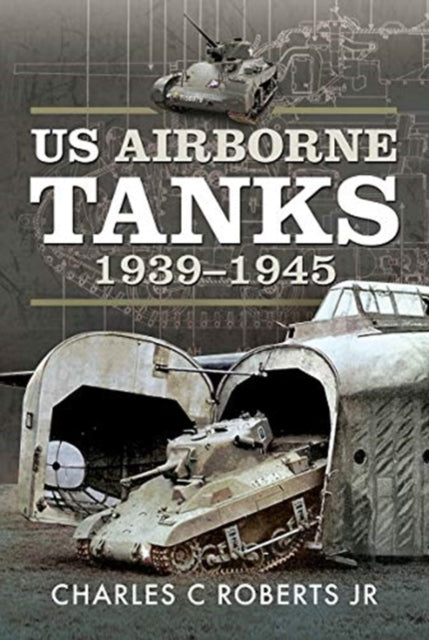
The development of tanks and airborne forces during the First and Second World Wars is explored in Charles Roberts' book, with a focus on the efforts to produce lightweight tanks for airborne operations. The 28th Airborne Tank Battalion was formed as a result of the combination of light tank and glider, making it a realistic proposition for airborne forces to be supported by armor.
\n Format: Hardback
\n Length: 208 pages
\n Publication date: 02 March 2021
\n Publisher: Pen & Sword Books Ltd
\n
From their initial introduction at the Battle of the Somme in the First World War, tanks emerged as one of the most significant military advancements in the annals of warfare. Their profound impact on the battlefield, whether serving as infantry support or as an armored spearhead, rendered their presence a determinant of battle outcomes. During the 1930s, another noteworthy development occurred with the emergence of airborne forces. Several countries engaged in experiments involving air-dropped troops, offering the potential to deploy soldiers behind enemy lines to sow fear and confusion. However, these troops, parachuting from aircraft, were limited in armament, thereby restricting their effectiveness. It is thus understandable that considerable deliberation was given to the practicality of air-lifting tanks that could be dropped or deposited alongside paratroopers. Tanks, being heavy and cumbersome vehicles, posed a significant challenge before the idea of carrying them by air could be contemplated. Consequently, the development of lighter models was imperative to facilitate their airborne transport. Charles Roberts' captivating book commences with an in-depth exploration into the endeavors undertaken by Britain, the Soviet Union, and the United States during the 1930s to develop or adapt light tanks for airborne operations. This marked the commencement of the Second World War, which further propelled efforts to produce an airborne tank and the means of delivery. The utilization of conventional powered aircraft to transport the tanks constrained their utility to existing airfields, rendering them inapplicable to airborne troops deploying in open countryside. Consequently, a different delivery method was sought, and it took the form of the glider, which could be landed in a field behind enemy lines. The combination of light tank and glider achieved the objective of airborne forces being supported by armor, thereby enhancing their effectiveness and mobility on the battlefield.
\n Weight: 556g\n
Dimension: 164 x 242 x 22 (mm)\n
ISBN-13: 9781526785022\n \n
UK and International shipping information
UK and International shipping information
UK Delivery and returns information:
- Delivery within 2 - 3 days when ordering in the UK.
- Shipping fee for UK customers from £2.39. Fully tracked shipping service available.
- Returns policy: Return within 30 days of receipt for full refund.
International deliveries:
Shulph Ink now ships to Australia, Belgium, Canada, France, Germany, Ireland, Italy, India, Luxembourg Saudi Arabia, Singapore, Spain, Netherlands, New Zealand, United Arab Emirates, United States of America.
- Delivery times: within 5 - 10 days for international orders.
- Shipping fee: charges vary for overseas orders. Only tracked services are available for most international orders. Some countries have untracked shipping options.
- Customs charges: If ordering to addresses outside the United Kingdom, you may or may not incur additional customs and duties fees during local delivery.