Mark F. Cancian
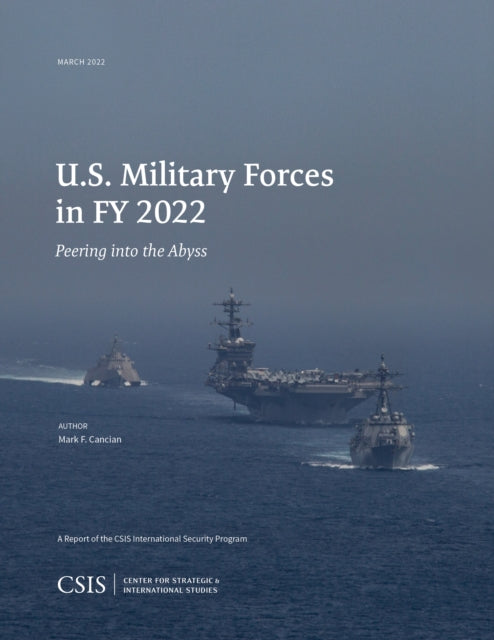
U.S. Military Forces in FY 2022: Peering into the Abyss
U.S. Military Forces in FY 2022: Peering into the Abyss
💎 Earn 173 Points (£1.73) on this item.
YOU SAVE £3.23
- Condition: Brand new
- UK Delivery times: Usually arrives within 2 - 3 working days
- UK Shipping: Fee starts at £2.39. Subject to product weight & dimension
Bulk ordering. Want 15 or more copies? Get a personalised quote and bigger discounts. Learn more about bulk orders.
Couldn't load pickup availability
- More about U.S. Military Forces in FY 2022: Peering into the Abyss
CSIS's Mark Cancian's annual white papers on U.S. military forces are compiled in this report, covering FY 2022 budget, legacy equipment, budget-force size interaction, and force size decline due to retiring older systems without replacements.
Format: Paperback / softback
Length: 154 pages
Publication date: 27 May 2022
Publisher: Bloomsbury Publishing Plc
CSIS's Mark Cancian annually produces a series of white papers on U.S. military forces, including their composition, new initiatives, long-term trends, and challenges. This report is a compilation of these papers, taking a deep look at each military service, as well as special operations forces, DOD civilians, and contractors in the FY 2022 budget. The report also discusses the debate about legacy equipment, the interaction of the budget and force size, and the decline in force size that the services face with retiring older systems without adequate replacements.
The report begins by examining the composition of the U.S. military forces. The Army is the largest service, with over 500,000 active-duty personnel, followed by the Navy, Air Force, and Marine Corps. The Army is primarily responsible for ground operations, while the Navy is responsible for maritime operations, the Air Force for air operations, and the Marine Corps for amphibious operations.
The report also discusses the new initiatives that the military services are undertaking. These initiatives include the development of new weapons systems, the modernization of existing weapons systems, and the expansion of special operations forces. The Army is investing in the development of the Next-Generation Combat Vehicle (NGCV), which is a new armored vehicle that is designed to replace the aging M1 Abrams tank. The Navy is investing in the development of the F-35 Lightning II fighter jet, which is a fifth-generation fighter jet that is designed to replace the aging F-16 Fighting Falcon. The Air Force is investing in the development of the B-21 Raider bomber, which is a new long-range bomber that is designed to replace the aging B-52 Stratofortress.
The report also discusses the long-term trends that are affecting the U.S. military forces. These trends include the increasing demand for military personnel, the increasing cost of military operations, and the changing nature of warfare. The Army is facing a significant shortage of personnel, particularly in the infantry and special operations forces. The Navy is facing a significant shortage of personnel in the aviation and maritime operations. The Air Force is facing a significant shortage of personnel in the air operations.
The report also discusses the challenges that the U.S. military forces face. These challenges include the threat of terrorism, the threat of cyber warfare, and the threat of natural disasters. The Army is investing in the development of new technologies to combat these threats, such as the development of the Joint Light Tactical Vehicle (JLTV) and the development of the Army Combat Fitness Test (ACFT). The Navy is investing in the development of new technologies to combat these threats, such as the development of the Littoral Combat Ship (LCS) and the development of the Navy's Cyber Warfare Command. The Air Force is investing in the development of new technologies to combat these threats, such as the development of the F-35 Lightning II fighter jet and the development of the B-21 Raider bomber.
The report also discusses the debate about legacy equipment. Legacy equipment is equipment that has been in service for a long time and is becoming increasingly obsolete. The military services are facing a significant challenge in replacing legacy equipment with new equipment. The budget and force size are also playing a significant role in this debate. The budget is limited, and the force size is declining. This means that the military services are unable to replace legacy equipment with new equipment as quickly as they would like.
The report also discusses the interaction of the budget and force size. The budget is a critical component of the military services' ability to operate. The budget determines the number of personnel that the military services can hire, the number of weapons systems that the military services can purchase, and the number of operations that the military services can conduct. The force size is also a critical component of the military services' ability to operate. The force size determines the number of personnel that the military services can deploy, the number of weapons systems that the military services can deploy, and the number of operations that the military services can conduct.
The report also discusses the decline in force size that the services face with retiring older systems without adequate replacements. The Army is facing a significant decline in force size with the retirement of the M1 Abrams tank. The Navy is facing a significant decline in force size with the retirement of the F-16 Fighting Falcon. The Air Force is facing a significant decline in force size with the retirement of the B-52 Stratofortress.
In conclusion, CSIS's Mark Cancian's annual report on U.S. military forces provides a comprehensive look at the composition, new initiatives, long-term trends, and challenges of the military services. The report takes a deep look at each military service, as well as special operations forces, DOD civilians, and contractors in the FY 2022 budget. The report also discusses the debate about legacy equipment, the interaction of the budget and force size, and the decline in force size that the services face with retiring older systems without adequate replacements. The report provides valuable insights into the current state of the U.S. military forces and the challenges that they face in the future.
Weight: 476g
Dimension: 281 x 217 x 10 (mm)
ISBN-13: 9781538170434
This item can be found in:
UK and International shipping information
UK and International shipping information
UK Delivery and returns information:
- Delivery within 2 - 3 days when ordering in the UK.
- Shipping fee for UK customers from £2.39. Fully tracked shipping service available.
- Returns policy: Return within 30 days of receipt for full refund.
International deliveries:
Shulph Ink now ships to Australia, Belgium, Canada, France, Germany, Ireland, Italy, India, Luxembourg Saudi Arabia, Singapore, Spain, Netherlands, New Zealand, United Arab Emirates, United States of America.
- Delivery times: within 5 - 10 days for international orders.
- Shipping fee: charges vary for overseas orders. Only tracked services are available for most international orders. Some countries have untracked shipping options.
- Customs charges: If ordering to addresses outside the United Kingdom, you may or may not incur additional customs and duties fees during local delivery.