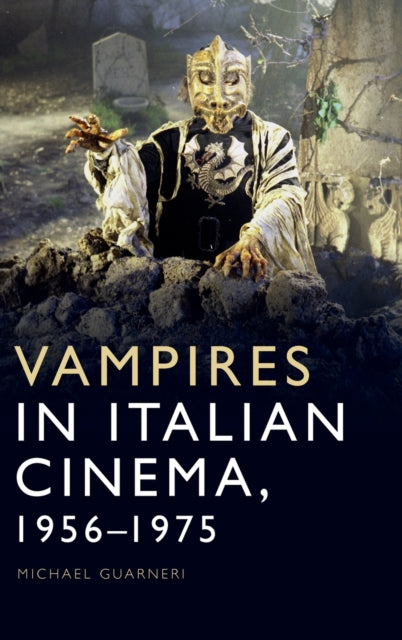
Michael Guarneri
Vampires in Italian Cinema, 1956-1975
Vampires in Italian Cinema, 1956-1975
💎 Earn 383 Points (£3.83) on this item.
YOU SAVE £23.30
- Condition: Brand new
- UK Delivery times: Usually arrives within 2 - 3 working days
- UK Shipping: Fee starts at £2.39. Subject to product weight & dimension
Bulk ordering. Want 15 or more copies? Get a personalised quote and bigger discounts. Learn more about bulk orders.
Couldn't load pickup availability
- More about Vampires in Italian Cinema, 1956-1975
Italian genre filmmakers appropriated the transnational figure of the vampire between 1956 and 1975, using it to comment on social and political issues of the time. The vampire became a symbol of fear and oppression, representing the dangers of communism and the Cold War.
Format: Hardback
Length: 224 pages
Publication date: 31 July 2020
Publisher: Edinburgh University Press
Between 1956 and 1975, Italian genre filmmakers embraced the transnational figure of the vampire, adapting it to their own unique visions and cultural contexts. This essay explores the ways in which these filmmakers used the vampire as a metaphor for social and political issues, as well as a tool for exploring the complexities of human sexuality and identity.
Between 1956 and 1975, Italian genre filmmakers embraced the transnational figure of the vampire, adapting it to their own unique visions and cultural contexts. This essay explores the ways in which these filmmakers used the vampire as a metaphor for social and political issues, as well as a tool for exploring the complexities of human sexuality and identity.
The vampire has long been a staple of horror literature and film, captivating audiences with its supernatural abilities and mysterious allure. However, it was in the mid-20th century that the vampire began to transcend its traditional European roots and take on a new life in Italian genre films. These films were characterized by their boldness, creativity, and willingness to explore taboo subjects, making them perfect vehicles for the vampire's reinvention.
One of the most notable examples of the vampire's appropriation by Italian genre filmmakers is the film "The Vampire Lovers" (1970), directed by Lucio Fulci. This film is a surreal and erotic masterpiece that explores the relationship between two women, one of whom is a vampire. Fulci uses the vampire as a metaphor for the power of sexuality and the dangers of obsession, creating a visually stunning and emotionally charged film that has become a cult classic.
Another notable example is the film "The Beyond" (1981), directed by Lucio Fulci. This film is a horror masterpiece that explores the boundaries of human consciousness and the supernatural. Fulci uses the vampire as a symbol of the unknowable and the unknowable, creating a film that is both terrifying and thought-provoking.
In addition to their use of the vampire as a metaphor for social and political issues, Italian genre filmmakers also used the vampire as a tool for exploring the complexities of human sexuality and identity. This was particularly evident in the films of Pier Paolo Pasolini, who was known for his bold and controversial approach to filmmaking. Pasolini's films often explored the themes of homosexuality, bisexuality, and transgenderism, using the vampire as a symbol of the Other and the outsider.
One of Pasolini's most famous films, "The Night of the Shooting Stars" (1960), is a surreal and erotic masterpiece that explores the relationship between a young man and a woman who is a vampire. Pasolini uses the vampire as a metaphor for the power of sexuality and the dangers of obsession, creating a film that is both beautiful and disturbing.
Another notable example of Pasolini's use of the vampire is the film "Teorema" (1968), which is a surreal and philosophical masterpiece that explores the nature of love and desire. Pasolini uses the vampire as a symbol of the Other and the outsider, creating a film that is both erotic and philosophical.
In conclusion, Italian genre filmmakers embraced the transnational figure of the vampire between 1956 and 1975, adapting it to their own unique visions and cultural contexts. These filmmakers used the vampire as a metaphor for social and political issues, as well as a tool for exploring the complexities of human sexuality and identity. The vampire's reinvention in Italian genre films was a testament to the power of cinema to transcend boundaries and challenge societal norms.
Weight: 504g
Dimension: 162 x 239 x 21 (mm)
ISBN-13: 9781474458115
UK and International shipping information
UK and International shipping information
UK Delivery and returns information:
- Delivery within 2 - 3 days when ordering in the UK.
- Shipping fee for UK customers from £2.39. Fully tracked shipping service available.
- Returns policy: Return within 30 days of receipt for full refund.
International deliveries:
Shulph Ink now ships to Australia, Belgium, Canada, France, Germany, Ireland, Italy, India, Luxembourg Saudi Arabia, Singapore, Spain, Netherlands, New Zealand, United Arab Emirates, United States of America.
- Delivery times: within 5 - 10 days for international orders.
- Shipping fee: charges vary for overseas orders. Only tracked services are available for most international orders. Some countries have untracked shipping options.
- Customs charges: If ordering to addresses outside the United Kingdom, you may or may not incur additional customs and duties fees during local delivery.