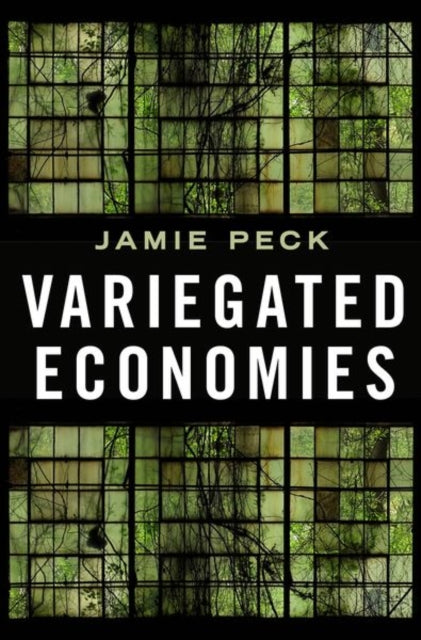
Jamie, PhDPeck
Variegated Economies
Variegated Economies
💎 Earn 103 Points (£1.03) on this item.
YOU SAVE £1.23
- Condition: Brand new
- UK Delivery times: Usually arrives within 2 - 3 working days
- UK Shipping: Fee starts at £2.39. Subject to product weight & dimension
Bulk ordering. Want 15 or more copies? Get a personalised quote and bigger discounts. Learn more about bulk orders.
Couldn't load pickup availability
- More about Variegated Economies
Variegated Economies is a book that looks at how to approach, conceptualize, and analyze economies as geographically differentiated phenomena, drawing from economic geography and critical political economy. It argues that economic forms, worlds, and lives are inherently spatial and discusses issues such as capitalism's diversity, late-stage neoliberalization, and uneven geographical development.
Format: Unspecified
Length: 392 pages
Publication date: 30 November 2023
Publisher: Oxford University Press Inc
Variegated Economies, a groundbreaking work that spans more than two decades of research on the spatiality of economic forms, worlds, and lives, delves into the critical question of how to approach, conceptualize, and analyze economies as geographically differentiated phenomena. Positioned within the field of economic geography, this book aims to forge connections with complementary developments in critical political economy and heterodox economic studies through a robust theoretical and methodological program. In his comprehensive exploration, Jamie Peck presents a series of compelling arguments highlighting the inherent spatiality of economic forms, worlds, and lives, addressing a wide range of issues such as the diversity of capitalism(s), the dynamics of late-stage neoliberalization, the problematic uneven geographical development, and the challenges and opportunities presented by conjunctural methodologies.
The book begins by situating Variegated Economies within the broader context of economic geography, emphasizing its commitment to studying the spatial dimensions of economic processes and their implications for society. Peck draws upon a rich array of theoretical frameworks, including critical political economy, heterodox economics, and spatial analysis, to develop a comprehensive framework for understanding the spatiality of economic forms, worlds, and lives.
One of the central themes of Variegated Economies is the recognition of the diverse and complex spatialities of economic forms. Peck argues that economic activities are not merely localized or aggregated but are deeply embedded in specific geographical contexts, shaped by factors such as land, infrastructure, and natural resources. He explores how these spatialities interact with social, political, and cultural processes to shape economic outcomes and inequalities. For example, Peck examines how the location of industries and firms affects labor markets, transportation networks, and access to resources, leading to different patterns of economic development and inequality across regions.
Another important aspect of Variegated Economies is the analysis of the dynamics of late-stage neoliberalization. Peck argues that neoliberal policies and practices have led to the spatial reorganization of economic activities, with the emergence of new economic centers and the concentration of wealth and power in specific regions. He explores how these processes have impacted local communities, labor markets, and the environment, leading to social and economic disparities. Peck also examines the role of globalization in shaping the spatiality of economic forms, highlighting how transnational corporations and international trade networks have contributed to the expansion of economic activities and the erosion of national borders.
In addition to the analysis of economic forms and dynamics, Variegated Economies also explores the problematic uneven geographical development. Peck argues that economic growth and development have often been concentrated in specific regions, leading to the marginalization and exclusion of marginalized communities and regions. He explores how these processes have shaped the spatial distribution of resources, wealth, and power, leading to social and economic inequalities. Peck also examines the role of government policies and interventions in promoting equitable geographical development, such as urban planning, infrastructure investment, and social welfare programs.
Conjunctural methodologies are another key theme of Variegated Economies. Peck argues that economic analysis should be approached from a multi-scalar and multi-temporal perspective, taking into account the complex and interconnected nature of economic processes. He explores how different temporal scales, such as the individual, the firm, the industry, and the region, interact with each other to shape economic outcomes and inequalities. Peck also examines the role of historical processes, cultural norms, and social movements in shaping economic spatialities, highlighting the importance of understanding the long-term historical roots of economic phenomena.
Throughout Variegated Economies, Peck employs a rich and interdisciplinary approach to his analysis, drawing upon a wide range of empirical evidence and case studies to support his arguments. He includes examples from various regions and industries, including the United States, Europe, Asia, and Latin America, to illustrate the diverse spatialities of economic forms, worlds, and lives. Peck's writing is accessible and engaging, making his insights accessible to a broad audience, including scholars, policymakers, and activists.
In conclusion, Variegated Economies is a groundbreaking work that contributes significantly to our understanding of the spatiality of economic forms, worlds, and lives. By highlighting the diverse and complex spatialities of economic activities, the book provides a valuable framework for analyzing the dynamics of late-stage neoliberalization, uneven geographical development, and the challenges and opportunities presented by conjunctural methodologies. Through its interdisciplinary approach and rich empirical evidence, Variegated Economies offers valuable insights for scholars, policymakers, and activists seeking to promote equitable and sustainable economic development.
Weight: 574g
Dimension: 156 x 237 x 41 (mm)
ISBN-13: 9780190076948
This item can be found in:
UK and International shipping information
UK and International shipping information
UK Delivery and returns information:
- Delivery within 2 - 3 days when ordering in the UK.
- Shipping fee for UK customers from £2.39. Fully tracked shipping service available.
- Returns policy: Return within 30 days of receipt for full refund.
International deliveries:
Shulph Ink now ships to Australia, Belgium, Canada, France, Germany, Ireland, Italy, India, Luxembourg Saudi Arabia, Singapore, Spain, Netherlands, New Zealand, United Arab Emirates, United States of America.
- Delivery times: within 5 - 10 days for international orders.
- Shipping fee: charges vary for overseas orders. Only tracked services are available for most international orders. Some countries have untracked shipping options.
- Customs charges: If ordering to addresses outside the United Kingdom, you may or may not incur additional customs and duties fees during local delivery.