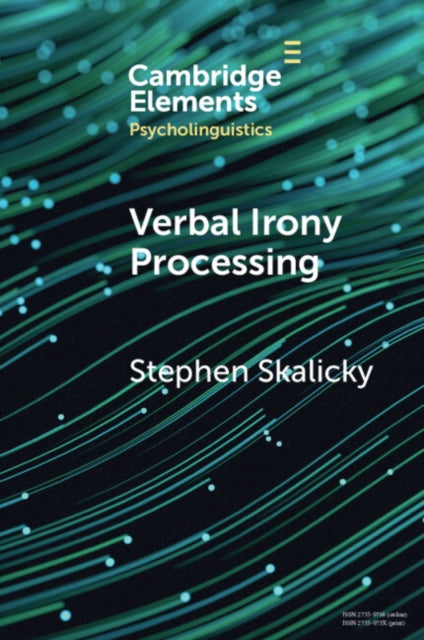
StephenSkalicky
Verbal Irony Processing
Verbal Irony Processing
💎 Earn 84 Points (£0.84) on this item.
We can order this item for you. Delivery usually takes about 4 to 6 weeks.
This item is not held in our immediate stock. We will order it for you after checkout.
Estimated delivery: About 4 to 6 weeks
YOU SAVE £1.01
- Condition: Brand new
- UK Delivery times: Usually arrives within 2 - 3 working days
- UK Shipping: Fee starts at £2.39. Subject to product weight & dimension
Bulk ordering. Want 15 or more copies? Get a personalised quote and bigger discounts. Learn more about bulk orders.
Couldn't load pickup availability
- More about Verbal Irony Processing
Ironic language is a reminder that speakers of all languages do not always mean what they say. Psycholinguistic methods have been employed to investigate how readers and hearers detect, process, and comprehend ironic language since the 1980s. This Element reviews foundational definitions, theories, and psycholinguistic models of ironic language, covering key questions such as the distinction between literal and ironic meaning, the role of contextual information, and the cognitive mechanisms involved.
Format: Paperback / softback
Length: 75 pages
Publication date: 02 February 2023
Publisher: Cambridge University Press
Ironic language serves as a poignant reminder that the intentions behind what speakers say may not always be transparent. While the study of ironic language has garnered the interest of theorists and scholars for centuries, it has only been in recent decades that psycholinguistic methods have been employed to investigate how readers and hearers perceive, process, and comprehend ironic language. This Element provides a comprehensive review of the foundational definitions, theories, and psycholinguistic models of ironic language, addressing key questions such as the distinction between literal and ironic meaning, the role of contextual information in irony processing, and the cognitive mechanisms involved. These fundamental inquiries continue to drive new research and methodological advancements, offering ample opportunities for future scholars to delve deeper into the complexities of how ironic language is processed and interpreted.
Ironic language is a linguistic phenomenon that involves the use of words or phrases that convey a meaning that is opposite to their literal interpretation. It is often characterized by understatement, sarcasm, or double entendre, and it can be found in various forms of communication, including literature, comedy, and everyday conversation.
One of the key features of ironic language is its ability to create a sense of surprise or unexpectedness in the listener or reader. This is achieved by using language that is contrary to what is expected or conventional, and it often involves the use of paradoxical or contradictory statements. For example, a statement such as "I'm not sure what you mean" may be said in an ironic tone, as the speaker is actually aware of the meaning but is using the statement to convey a different message.
Ironic language can also be used to convey a sense of humor or playfulness. It is often used in comedic situations to create a laugh or to add a lighthearted tone to a conversation. In this sense, ironic language can be seen as a form of social commentary or as a way of subverting social norms or expectations.
The study of ironic language has been the subject of much research and debate among linguists and psychologists. One of the key questions that has been investigated is the distinction between literal and ironic meaning. Linguists have argued that ironic language is not simply a matter of using words or phrases that are contrary to their literal meaning, but rather that it involves a complex interplay between language and context. Contextual information, such as the speaker's tone of voice, facial expressions, and body language, can play a crucial role in determining whether a statement is ironic or not.
Psychologists have also investigated the cognitive mechanisms involved in irony processing. Research has shown that irony processing involves a number of different cognitive processes, including attention, memory, and cognitive flexibility. For example, when we hear or read an ironic statement, we may need to pay close attention to the context in order to determine whether the statement is ironic or not. We may also need to store the information in our memory in order to recall it later. Additionally, we may need to use cognitive flexibility to adjust our understanding of the statement based on new information or context.
Another important aspect of ironic language is its role in communication. Ironic language can be used to convey a range of emotions, including amusement, surprise, and frustration. It can also be used to create a sense of intimacy or closeness between speakers or to establish a particular tone or mood in a conversation. For example, a sarcastic comment made in a joking or playful tone can be used to convey a sense of camaraderie or intimacy between friends.
In conclusion, ironic language is a fascinating and complex phenomenon that involves the use of words or phrases that convey a meaning that is opposite to their literal interpretation. It is often characterized by understatement, sarcasm, or double entendre, and it can be found in various forms of communication, including literature, comedy, and everyday conversation. The study of ironic language has been the subject of much research and debate among linguists and psychologists, and it has revealed a number of important insights into the nature of language and communication. As our understanding of ironic language continues to evolve, we may be able to gain a deeper appreciation of the ways in which language can be used to convey complex and nuanced meanings and to create meaningful connections between people.
ISBN-13: 9781009234542
This item can be found in:
UK and International shipping information
UK and International shipping information
UK Delivery and returns information:
- Delivery within 2 - 3 days when ordering in the UK.
- Shipping fee for UK customers from £2.39. Fully tracked shipping service available.
- Returns policy: Return within 30 days of receipt for full refund.
International deliveries:
Shulph Ink now ships to Australia, Belgium, Canada, France, Germany, Ireland, Italy, India, Luxembourg Saudi Arabia, Singapore, Spain, Netherlands, New Zealand, United Arab Emirates, United States of America.
- Delivery times: within 5 - 10 days for international orders.
- Shipping fee: charges vary for overseas orders. Only tracked services are available for most international orders. Some countries have untracked shipping options.
- Customs charges: If ordering to addresses outside the United Kingdom, you may or may not incur additional customs and duties fees during local delivery.