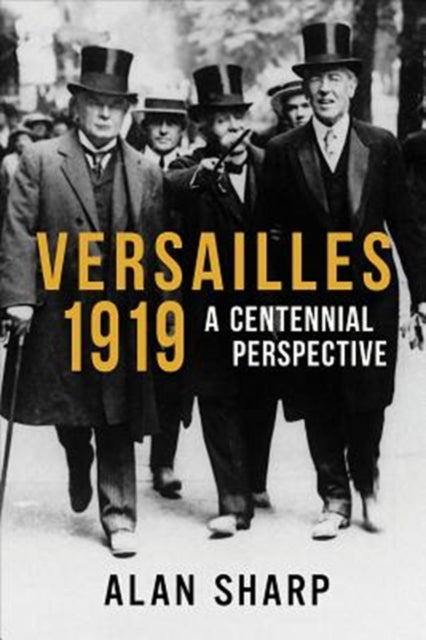
Alan Sharp
Versailles 1919: A Centennial Perspective
Versailles 1919: A Centennial Perspective
💎 Earn 70 Points (£0.70) on this item.
YOU SAVE £5.84
- Condition: Brand new
- UK Delivery times: Usually arrives within 2 - 3 working days
- UK Shipping: Fee starts at £2.39. Subject to product weight & dimension
Bulk ordering. Want 15 or more copies? Get a personalised quote and bigger discounts. Learn more about bulk orders.
Couldn't load pickup availability
- More about Versailles 1919: A Centennial Perspective
The Versailles Settlement is widely seen as having set the world on the path to a second major conflict within a generation, due to Woodrow Wilson's principle of self-determination and the war's settlement. Other objectives, such as global disarmament and minority protection, have yet to be realized, and the settlement still casts a long shadow a century later. This book argues that the responsibility for Europe's continuing interwar instability cannot be wholly attributed to the peacemakers of 1919-23.
Format: Hardback
Length: 320 pages
Publication date: 18 October 2018
Publisher: Haus Publishing
The Versailles Settlement, hailed as a grand initiative to bring about global harmony, has garnered a less-than-stellar reputation. Despite its ambitious goal of resolving world affairs in a single stroke, it is widely regarded as having paved the way for a second major conflict within a generation. The controversial principle of self-determination championed by President Woodrow Wilson further complicated political dynamics in the Balkans, leading to the outbreak of war and its subsequent settlement. The war and its aftermath have left lasting impacts on boundaries and related conflicts in the Middle East. Furthermore, other objectives of the peacemakers, such as global disarmament and minority protection, remain unfulfilled. A century after the settlement, its shadow looms large.
In this comprehensive book, meticulously revised and updated to commemorate the centenary of the Paris Peace Conferences at Versailles in 1919, the consequences of the Peace Treaties are placed in their broader historical context. The author argues that the responsibility for Europe's lingering interwar instability cannot be solely attributed to the peacemakers of 1919-23.
The Versailles Settlement, despite its lofty aspirations, has faced widespread criticism. Many view it as a flawed agreement that failed to address the root causes of the war and left a lasting legacy of resentment and instability. The settlement's territorial concessions and the creation of new nations, particularly in the Balkans, have been seen as contributing to the region's ongoing conflicts and political divisions.
Furthermore, the settlement's emphasis on punishment and retribution rather than reconciliation and healing further exacerbated tensions between nations. The harsh terms imposed on Germany, particularly in the Treaty of Versailles, were seen as a symbol of Western imperialism and contributed to the country's economic and political decline.
The principle of self-determination, championed by President Wilson, also played a role in the settlement's complexities. While it aimed to give nations the right to self-govern, it led to the division of existing territories and the creation of new nations, often based on ethnic and religious lines. This has been a source of contention and conflict in many parts of the world, particularly in the Middle East, where the borders drawn after World War I have been a source of ongoing tensions and violence.
The war and its settlement also had significant consequences for global disarmament and security. The Treaty of Versailles imposed harsh restrictions on Germany's military capabilities and required the country to disarm and surrender its colonies. However, these provisions were largely ignored by Germany, which resumed its military buildup and eventually led to World War II.
Furthermore, the settlement failed to address the underlying causes of the war, such as economic inequality, political instability, and nationalism. The peace treaties did not address the power imbalances between nations or address the political and economic grievances of many countries, which continued to simmer and eventually erupted in new conflicts.
In conclusion, the Versailles Settlement has a complicated and controversial legacy. While it aimed to bring about global harmony and address the consequences of the war, it has been widely criticized for its flaws, territorial concessions, and emphasis on punishment. The settlement's legacy continues to shape the world today, with its territorial divisions, economic and political instability, and ongoing conflicts in the Middle East. It is essential to examine the settlement's consequences and learn from its mistakes to build a more peaceful and equitable world for the future.
Weight: 480g
Dimension: 239 x 169 x 21 (mm)
ISBN-13: 9781912208098
UK and International shipping information
UK and International shipping information
UK Delivery and returns information:
- Delivery within 2 - 3 days when ordering in the UK.
- Shipping fee for UK customers from £2.39. Fully tracked shipping service available.
- Returns policy: Return within 30 days of receipt for full refund.
International deliveries:
Shulph Ink now ships to Australia, Belgium, Canada, France, Germany, Ireland, Italy, India, Luxembourg Saudi Arabia, Singapore, Spain, Netherlands, New Zealand, United Arab Emirates, United States of America.
- Delivery times: within 5 - 10 days for international orders.
- Shipping fee: charges vary for overseas orders. Only tracked services are available for most international orders. Some countries have untracked shipping options.
- Customs charges: If ordering to addresses outside the United Kingdom, you may or may not incur additional customs and duties fees during local delivery.