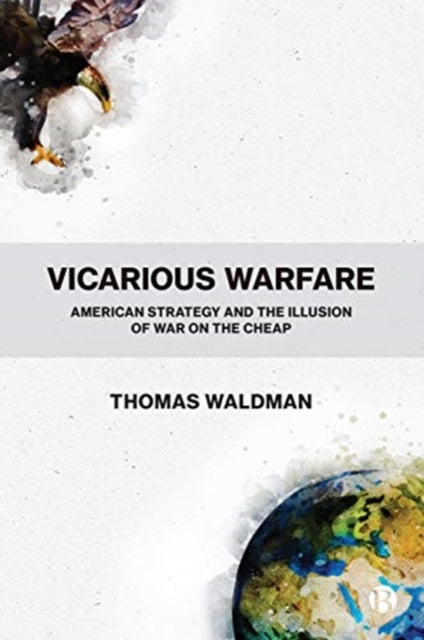
ThomasWaldman
Vicarious Warfare: American Strategy and the Illusion of War on the Cheap
Vicarious Warfare: American Strategy and the Illusion of War on the Cheap
💎 Earn 132 Points (£1.32) on this item.
YOU SAVE £1.57
- Condition: Brand new
- UK Delivery times: Usually arrives within 2 - 3 working days
- UK Shipping: Fee starts at £2.39. Subject to product weight & dimension
Bulk ordering. Want 15 or more copies? Get a personalised quote and bigger discounts. Learn more about bulk orders.
Couldn't load pickup availability
- More about Vicarious Warfare: American Strategy and the Illusion of War on the Cheap
America has shifted to delegating key tasks to proxies, limiting military exposure and increasing special forces and covert instruments in warfare. This approach offers tactical advantages but comes with hidden costs and the potential for strategic harm.
\n Format: Hardback
\n Length: 320 pages
\n Publication date: 06 January 2021
\n Publisher: Bristol University Press
\n
America has been embroiled in conflict for the majority of the 20th and 21st centuries, gradually shifting towards a form of warfare characterized by the delegation of key tasks to proxies, the limitation of military exposure to danger, and the proliferation of special forces and covert instruments. Crucial strategic decisions are made with minimal scrutiny or public engagement. This captivating account traces the historical origins of this distinct tradition of war and delves into the factors that have contributed to its contemporary prominence. It juxtaposes the tactical advantages of vicarious warfare with its concealed costs and the potential for causing substantial strategic harm.
The United States has been involved in numerous conflicts throughout the 20th and 21st centuries, ranging from small-scale interventions to large-scale wars. During this period, the country has gradually shifted towards a form of warfare known as "vicarious warfare," in which key tasks are delegated to proxies, the military's exposure to danger is limited, and special forces and covert instruments are increasingly utilized.
One of the primary drivers of this shift has been the desire to minimize American casualties and reduce the political and economic costs of military engagement. By relying on proxies, the United States can limit its own military personnel's exposure to harm, while still achieving its strategic objectives. This approach has been particularly effective in conflicts such as the War on Terror, where the United States has partnered with local forces and intelligence agencies to target terrorist organizations and prevent attacks.
However, vicarious warfare also comes with significant risks and costs. One of the most significant is the potential for unintended consequences and miscalculations. When the United States delegates key tasks to proxies, it loses control over the actions of those forces and may be held responsible for any atrocities they commit. This was evident in the case of the Iraq War, where the United States relied on Iraqi forces to combat the terrorist group ISIS, but those forces were ultimately unable to hold the country together and descended into chaos.
Another risk of vicarious warfare is the erosion of American credibility and influence. By relying on proxies, the United States may appear to be less committed to its own values and interests, and may be perceived as a bully or imperialist by other countries. This can lead to increased hostility and resistance, making it more difficult for the United States to achieve its goals.
Despite these risks, vicarious warfare has become increasingly prevalent in recent years. The rise of non-state actors and the increasing complexity of global conflicts have made it difficult for traditional military forces to achieve their objectives on their own. As a result, the United States has increasingly turned to proxies and special forces to carry out its military operations.
One of the most notable examples of vicarious warfare is the use of drone strikes by the United States. These strikes have been used to target terrorist organizations and other militant groups in countries such as Pakistan, Yemen, and Somalia, without the need for American military personnel to be deployed on the ground. Drone strikes have been controversial, with some critics arguing that they are a violation of international law and that they have killed innocent civilians. However, others argue that they are a necessary tool in the fight against terrorism and that they have saved countless American lives.
Another example of vicarious warfare is the use of special forces by the United States. Special forces are highly trained and specialized military units that are deployed to carry out covert operations and engage in high-risk missions. These forces have been used to target terrorist organizations, overthrow authoritarian regimes, and support rebel groups in countries such as Syria, Afghanistan, and Libya.
Despite the benefits of vicarious warfare, there are also concerns about its long-term implications. One of the most significant is the potential for the United States to become overly reliant on proxies and special forces, and to lose its ability to conduct traditional military operations on its own. This could lead to a situation where the United States is vulnerable to threats from other countries and unable to respond effectively to crises.
Another concern is the potential for vicarious warfare to exacerbate existing conflicts and create new ones. By relying on proxies, the United States may be able to achieve its short-term objectives, but it may also contribute to the long-term destabilization of the region and the emergence of new terrorist organizations. This was evident in the case of the Syrian Civil War, where the United States supported opposition groups that were ultimately unable to defeat the Syrian government and led to the emergence of ISIS.
In conclusion, America has been at war for most of the 20th and 21st centuries, and during that time has progressively moved towards a vicarious form of warfare. This approach has been driven by the desire to minimize American casualties and reduce the political and economic costs of military engagement. However, vicarious warfare also comes with significant risks and costs, including the potential for unintended consequences and miscalculations, the erosion of American credibility and influence, and the potential for the United States to become overly reliant on proxies and special forces. While vicarious warfare has been effective in some cases, it is important for the United States to carefully consider the long-term implications of this approach and to explore alternative strategies for achieving its goals.
\n Weight: 640g\n
Dimension: 164 x 240 x 25 (mm)\n
ISBN-13: 9781529206999\n \n
UK and International shipping information
UK and International shipping information
UK Delivery and returns information:
- Delivery within 2 - 3 days when ordering in the UK.
- Shipping fee for UK customers from £2.39. Fully tracked shipping service available.
- Returns policy: Return within 30 days of receipt for full refund.
International deliveries:
Shulph Ink now ships to Australia, Belgium, Canada, France, Germany, Ireland, Italy, India, Luxembourg Saudi Arabia, Singapore, Spain, Netherlands, New Zealand, United Arab Emirates, United States of America.
- Delivery times: within 5 - 10 days for international orders.
- Shipping fee: charges vary for overseas orders. Only tracked services are available for most international orders. Some countries have untracked shipping options.
- Customs charges: If ordering to addresses outside the United Kingdom, you may or may not incur additional customs and duties fees during local delivery.