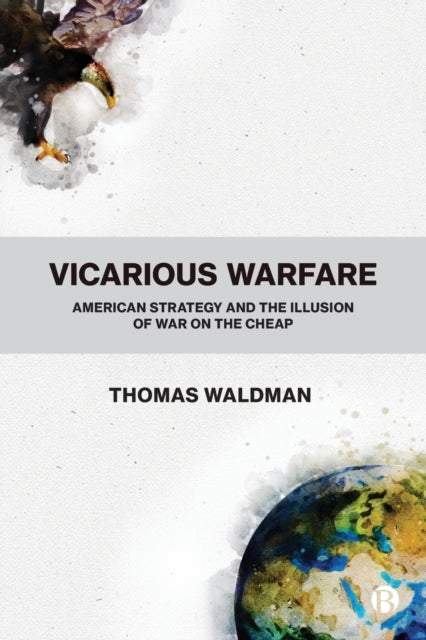
Thomas Waldman
Vicarious Warfare: American Strategy and the Illusion of War on the Cheap
Vicarious Warfare: American Strategy and the Illusion of War on the Cheap
💎 Earn 76 Points (£0.76) on this item.
YOU SAVE £4.66
- Condition: Brand new
- UK Delivery times: Usually arrives within 2 - 3 working days
- UK Shipping: Fee starts at £3.89. Subject to product weight & dimension
Bulk ordering. Want 15 or more copies? Get a personalised quote and bigger discounts. Learn more about bulk orders.
Couldn't load pickup availability
- More about Vicarious Warfare: American Strategy and the Illusion of War on the Cheap
America has shifted to delegating key tasks to proxies, limiting military exposure and increasing the use of special forces and covert instruments in warfare. This approach has advantages in terms of tactics but comes with hidden costs and the potential for strategic harm.
Format: Paperback / softback
Length: 320 pages
Publication date: 10 January 2023
Publisher: Bristol University Press
America has been embroiled in conflict for the majority of the 20th and 21st centuries, gradually shifting towards a form of warfare characterized by the delegation of key tasks to proxies, limited exposure of the military to danger, and an increase in the use of special forces and covert instruments. These strategic decisions are often made with minimal scrutiny or public engagement. This captivating account delves into the historical roots of this distinct tradition of war, exploring the factors that have contributed to its contemporary prominence. It juxtaposes the tactical advantages of vicarious warfare with its concealed costs and the potential for causing substantial strategic harm.
The United States has been involved in numerous conflicts throughout the 20th and 21st centuries, ranging from small-scale interventions to large-scale wars. During this period, the country has gradually shifted towards a form of warfare known as "vicarious warfare." In vicarious warfare, key tasks are delegated to proxies, such as private military contractors or local militias, rather than the U.S. military itself. This approach limits the military's exposure to danger and reduces the risk of casualties.
One of the primary advantages of vicarious warfare is that it allows the United States to project power and influence without putting its own troops in harm's way. By relying on proxies, the country can engage in conflicts without risking the lives of its soldiers. This is particularly useful in situations where the risks are high or the objectives are difficult to achieve.
However, vicarious warfare also comes with several hidden costs. One of the most significant is the potential for civilian casualties. When proxies are used, there is a greater risk of collateral damage and unintended harm to non-combatants. This can lead to resentment and opposition among local populations, which can complicate the overall mission and increase the risk of counter-insurgency operations.
Another hidden cost of vicarious warfare is the erosion of military readiness and training. When the military is not directly involved in combat, it can lose its edge and expertise. This can make it more difficult for the country to respond to future threats or emergencies.
Furthermore, vicarious warfare can also contribute to the erosion of democratic values and the rule of law. When the military is not accountable to the civilian population, there is a greater risk of human rights abuses and violations. This can undermine the country's reputation and legitimacy in the international community.
Despite these hidden costs, vicarious warfare has become increasingly prevalent in recent years. This is due to a variety of factors, including the increasing complexity of modern conflicts, the need for cost-effectiveness, and the desire to avoid putting American troops in harm's way.
One of the primary drivers of vicarious warfare is the increasing reliance on technology and precision-guided munitions. These technologies allow the military to strike targets with greater accuracy and precision, reducing the risk of civilian casualties and collateral damage. They also enable the military to engage in remote operations, which can be particularly useful in situations where the risks are high or the objectives are difficult to achieve.
Another driver of vicarious warfare is the growing demand for specialized skills and expertise. In many modern conflicts, the military requires specialized skills and expertise that are not readily available in the U.S. military itself. By delegating these tasks to proxies, the country can access these skills and expertise without risking the lives of its soldiers.
However, the increasing use of vicarious warfare has also raised concerns about the accountability and transparency of the military. When the military is not directly involved in combat, it can be difficult to hold it accountable for its actions. This can lead to a lack of transparency and a lack of public engagement, which can undermine the legitimacy of the military and the broader political system.
To address these concerns, there are several steps that the United States can take. One of the most important is to increase transparency and accountability in the use of proxies. This can be achieved by requiring greater disclosure of the terms of contracts with private military contractors and by establishing mechanisms for monitoring and reporting civilian casualties.
Another step is to invest in the training and readiness of the U.S. military. By ensuring that the military is well-trained and equipped to handle a wide range of threats, the country can reduce the need for vicarious warfare and increase its ability to respond to future emergencies.
Finally, the United States can work to promote democratic values and the rule of law in the countries where it engages in vicarious warfare. This can be achieved through diplomatic efforts, humanitarian aid, and support for local institutions and organizations. By promoting these values, the country can build trust and legitimacy in the local population, which can help to reduce the risk of counter-insurgency operations and civilian casualties.
In conclusion, America has been at war for most of the 20th and 21st centuries, gradually shifting towards a form of warfare characterized by the delegation of key tasks to proxies, limited exposure of the military to danger, and an increase in the use of special forces and covert instruments. While vicarious warfare has its tactical advantages, it also comes with hidden costs and potential to cause significant strategic harm. To address these concerns, the United States can increase transparency and accountability in the use of proxies, invest in the training and readiness of the military, and promote democratic values and the rule of law in the countries where it engages in vicarious warfare. By taking these steps, the country can reduce the risks associated with vicarious warfare and ensure that its military is well-prepared to face the challenges of the 21st century.
Weight: 482g
Dimension: 154 x 234 x 44 (mm)
ISBN-13: 9781529207002
UK and International shipping information
UK and International shipping information
We deliver throughout the United Kingdom and to 128 countries and territories worldwide, including the United States, Australia, Canada, Germany, Spain and France.