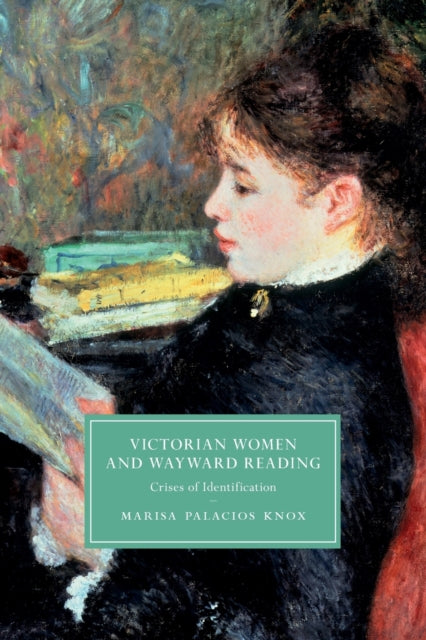
Marisa Palacios Knox
Victorian Women and Wayward Reading: Crises of Identification
Victorian Women and Wayward Reading: Crises of Identification
💎 Earn 118 Points (£1.18) on this item.
We can order this item for you. Delivery usually takes about 4 to 6 weeks.
This item is not held in our immediate stock. We will order it for you after checkout.
Estimated delivery: About 4 to 6 weeks
YOU SAVE £1.40
- Condition: Brand new
- UK Delivery times: Usually arrives within 2 - 3 working days
- UK Shipping: Fee starts at £2.39. Subject to product weight & dimension
Bulk ordering. Want 15 or more copies? Get a personalised quote and bigger discounts. Learn more about bulk orders.
Couldn't load pickup availability
- More about Victorian Women and Wayward Reading: Crises of Identification
During the 19th century, there was a belief that women were more impressionable than men and that they could identify with fictional characters easily. This belief led to anxious rhetoric about "female quixotes" who would imitate inappropriate characters or apply incongruous frames of reference from literature to their own lives. However, Palacios Knox reveals that Victorian women were increasingly using literary identification as a deliberate strategy to challenge dominant assumptions about "feminine reading" and femininity itself. Victorian Women and Wayward Reading contextualizes these crises as reactions to significant changes in the legal, political, educational, and professional status of women over the course of the 19th century, which wayward reading helped women to imagine and then to enact.
Format: Paperback / softback
Length: 253 pages
Publication date: 03 November 2022
Publisher: Cambridge University Press
In the nineteenth century, the notion that women had a unique ability to connect with fictional characters sparked a range of conflicting attitudes. The belief that women were more susceptible to influence than men led to a persistent stream of anxious rhetoric about "female quixotes," referring to women who imitated inappropriate characters or applied literary frameworks to their own lives in an inappropriate manner. While the prevailing cultural discourse portrayed female literary identification as passive and delusional, Palacios Knox highlights a growing body of evidence that reveals Victorian women actively employing literary identification as a deliberate strategy. These wayward women readers challenged dominant notions about "feminine reading" and, by extension, femininity itself.
Victorian Women and Wayward Reading provides a valuable context for understanding crises related to female identification as responses to significant changes in the legal, political, educational, and professional status of women throughout the nineteenth century. These changes, facilitated by wayward reading, allowed women to first envision and then actively pursue new possibilities for self-expression and empowerment.
Through a comprehensive analysis of literature, letters, and other primary sources, Palacios Knox demonstrates how wayward women readers subverted traditional gender roles and challenged the boundaries of femininity. They explored a wide range of literary genres, including novels, poetry, and periodicals, and used these texts to construct alternative identities and narratives that defied societal expectations. By engaging with literature in unconventional ways, these women expanded their intellectual horizons, developed critical thinking skills, and gained a deeper understanding of the world around them.
Furthermore, wayward women readers played a crucial role in shaping public discourse about women's rights and gender roles. They used their literary experiences to advocate for women's education, employment opportunities, and political participation, challenging the notion that women were solely confined to domestic roles and subordinate positions. Through their writings and public speeches, they contributed to the broader feminist movement and helped pave the way for subsequent generations of women to assert their rights and achieve greater equality.
In conclusion, Victorian Women and Wayward Reading offers a rich and nuanced exploration of the complex relationship between women, literature, and identity in the nineteenth century. By highlighting the ways in which wayward women readers challenged dominant assumptions and expanded their horizons, the book provides valuable insights into the historical and cultural contexts that shaped women's lives during this period. It serves as a reminder of the power of literature to inspire, challenge, and transform, and of the important role that women played in shaping the course of nineteenth-century history.
Weight: 386g
Dimension: 152 x 227 x 18 (mm)
ISBN-13: 9781108791601
UK and International shipping information
UK and International shipping information
UK Delivery and returns information:
- Delivery within 2 - 3 days when ordering in the UK.
- Shipping fee for UK customers from £2.39. Fully tracked shipping service available.
- Returns policy: Return within 30 days of receipt for full refund.
International deliveries:
Shulph Ink now ships to Australia, Belgium, Canada, France, Germany, Ireland, Italy, India, Luxembourg Saudi Arabia, Singapore, Spain, Netherlands, New Zealand, United Arab Emirates, United States of America.
- Delivery times: within 5 - 10 days for international orders.
- Shipping fee: charges vary for overseas orders. Only tracked services are available for most international orders. Some countries have untracked shipping options.
- Customs charges: If ordering to addresses outside the United Kingdom, you may or may not incur additional customs and duties fees during local delivery.