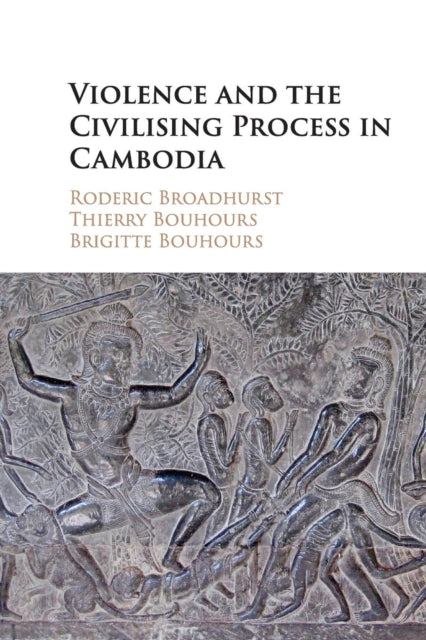
RodericBroadhurst,ThierryBouhours,BrigitteBouhours
Violence and the Civilising Process in Cambodia
Violence and the Civilising Process in Cambodia
💎 Earn 184 Points (£1.84) on this item.
We can order this item for you. Delivery usually takes about 4 to 6 weeks.
This item is not held in our immediate stock. We will order it for you after checkout.
Estimated delivery: About 4 to 6 weeks
YOU SAVE £2.18
- Condition: Brand new
- UK Delivery times: Usually arrives within 2 - 3 working days
- UK Shipping: Fee starts at £2.39. Subject to product weight & dimension
Bulk ordering. Want 15 or more copies? Get a personalised quote and bigger discounts. Learn more about bulk orders.
Couldn't load pickup availability
- More about Violence and the Civilising Process in Cambodia
The Civilizing Process by Norbert Elias was published in 1939 and is considered a groundbreaking work of sociology. This new study by Broadhurst, Bouhours, and Bouhours evaluates Elias's theories in a non-Western context, tracing trends and forms of violence in Cambodia from the mid-nineteenth century to the present day. The authors assess whether violence has decreased and whether Elias's civilizing process can be attributed to this decline, identifying universal factors that have historically reduced violence.
Format: Paperback / softback
Length: 380 pages
Publication date: 08 February 2018
Publisher: Cambridge University Press
In 1939, the renowned German sociologist Norbert Elias released his groundbreaking work, "The Civilizing Process," which has since gained widespread recognition as one of the most influential sociological texts of our time. In this insightful and pioneering study, the authors delve into the history of violence in Cambodia, seeking to assess the applicability of Elias's theories in a non-Western context. Drawing upon a wealth of historical and contemporary archival sources, police statistics, victim surveys, and newspaper reports, Broadhurst, Bouhours, and Bouhours meticulously chart the trends and forms of violence that have unfolded throughout Cambodia from the mid-nineteenth century to the present day.
The authors analyze various periods, including colonization, anti-colonial wars, interdependence, civil war, the revolutionary terror of the 1970s, and post-conflict development, to evaluate whether violence has declined and, if so, whether this decline can be attributed to Elias's civilizing process. Through their comprehensive analysis, the authors identify a series of universal factors that have historically contributed to the reduction of violence.
The study highlights the complex interplay between cultural, social, economic, and political factors that have shaped the patterns of violence in Cambodia. It explores the historical roots of conflict, such as land disputes, ethnic tensions, and political rivalries, as well as the impact of external influences, such as colonialism and globalization. The authors also examine the role of institutions, such as the government, the military, and social organizations, in perpetuating and mitigating violence.
One of the key findings of the study is that violence has declined significantly in Cambodia over the past century. This decline can be attributed to a combination of factors, including the establishment of democratic institutions, the promotion of human rights, and the development of social and economic infrastructure. The authors argue that Elias's theories of civilizing processes, which emphasize the importance of socialization, education, and cultural change, can indeed be applied to non-Western contexts, such as Cambodia.
However, the study also raises important questions about the limitations and complexities of applying such theories in a diverse and complex society like Cambodia. The authors note that Elias's theories were developed primarily in Western societies and may not fully account for the unique cultural, historical, and social factors that shape violence in non-Western contexts. They suggest that further research and analysis are needed to develop more nuanced and context-specific understandings of the civilizing process and its potential to reduce violence in different societies.
In conclusion, "Violence in Cambodia: Tracing the History of Violence and Assessing the Applicability of Elias's Civilizing Process" is a groundbreaking work that contributes significantly to our understanding of the history and dynamics of violence in a non-Western context. Through its comprehensive analysis and thoughtful insights, the study provides valuable lessons for policymakers, researchers, and activists working to promote peace and stability in societies around the world.
Weight: 229g
Dimension: 230 x 150 x 19 (mm)
ISBN-13: 9781107521193
UK and International shipping information
UK and International shipping information
UK Delivery and returns information:
- Delivery within 2 - 3 days when ordering in the UK.
- Shipping fee for UK customers from £2.39. Fully tracked shipping service available.
- Returns policy: Return within 30 days of receipt for full refund.
International deliveries:
Shulph Ink now ships to Australia, Belgium, Canada, France, Germany, Ireland, Italy, India, Luxembourg Saudi Arabia, Singapore, Spain, Netherlands, New Zealand, United Arab Emirates, United States of America.
- Delivery times: within 5 - 10 days for international orders.
- Shipping fee: charges vary for overseas orders. Only tracked services are available for most international orders. Some countries have untracked shipping options.
- Customs charges: If ordering to addresses outside the United Kingdom, you may or may not incur additional customs and duties fees during local delivery.