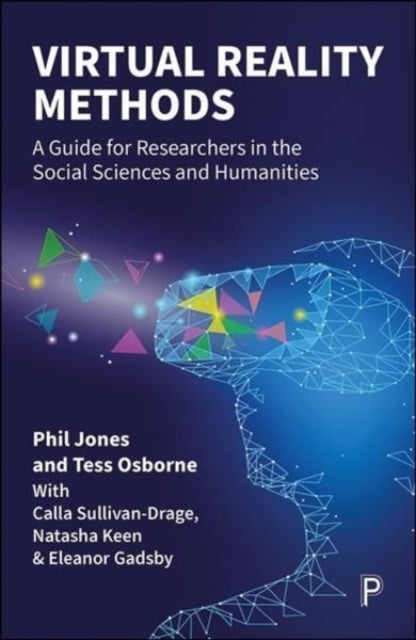
PhilJones,TessOsborne
Virtual Reality Methods: A Guide for Researchers in the Social Sciences and Humanities
Virtual Reality Methods: A Guide for Researchers in the Social Sciences and Humanities
💎 Earn 226 Points (£2.26) on this item.
We can order this item for you. Delivery usually takes about 4 to 6 weeks.
This item is not held in our immediate stock. We will order it for you after checkout.
Estimated delivery: About 4 to 6 weeks
YOU SAVE £2.69
- Condition: Brand new
- UK Delivery times: Usually arrives within 2 - 3 working days
- UK Shipping: Fee starts at £2.39. Subject to product weight & dimension
Bulk ordering. Want 15 or more copies? Get a personalised quote and bigger discounts. Learn more about bulk orders.
Couldn't load pickup availability
- More about Virtual Reality Methods: A Guide for Researchers in the Social Sciences and Humanities
This book explores the potential of virtual reality (VR) technology for humanities and social sciences research, providing a user-friendly guide to using ready-made VR content and 360° video and creating custom materials. It examines the advantages and disadvantages of different approaches and offers real-world examples of how researchers have used VR.
Format: Hardback
Length: 158 pages
Publication date: 15 June 2022
Publisher: Bristol University Press
Since the mid-2010s, the realm of virtual reality (VR) technology has experienced a remarkable surge in advancement, offering a multitude of exciting opportunities for scholars in the humanities and social sciences. In response to this demand, this comprehensive book has been crafted to delve into the vast potential that VR presents for researchers.
The book begins by providing a user-friendly, non-technical guide to utilizing pre-made VR content, as well as 360° video, and creating custom materials. It systematically examines the advantages and disadvantages of various approaches to VR usage, offering valuable real-world examples of how researchers have successfully integrated this technology into their research endeavors. Through this insightful analysis, scholars will be inspired to embark on their own explorations of the possibilities that VR offers in their respective fields.
The potential benefits of VR in the humanities and social sciences are manifold. For instance, it enables researchers to immerse themselves in historical events, cultural contexts, and human experiences in a more immersive and authentic way. By leveraging VR, scholars can explore complex phenomena, such as social movements, cultural practices, and historical narratives, from new perspectives, fostering a deeper understanding and interpretation of the past.
Moreover, VR offers unique opportunities for data collection and analysis. By creating virtual environments, researchers can gather data in real-time and in a controlled manner, eliminating the biases and limitations associated with traditional research methods. This allows for more accurate and comprehensive insights into human behavior, social interactions, and cultural phenomena.
Furthermore, VR can facilitate interdisciplinary collaboration and knowledge exchange. By bringing together researchers from different fields, VR can create new research paradigms and foster innovative thinking. It enables scholars to bridge the gap between disciplines, combining insights from psychology, sociology, history, and more to address complex research questions.
However, it is important to note that the use of VR also presents certain challenges. One of the primary concerns is the potential for sensory overload and disorientation, particularly for individuals who may be less familiar with the technology. Additionally, the creation and dissemination of high-quality VR content can be resource-intensive and requires specialized expertise.
To address these challenges, the book offers practical tips and strategies for using VR effectively in research. It provides guidance on selecting appropriate VR platforms, designing immersive experiences, and ensuring ethical considerations are taken into account. It also highlights the importance of collaboration and interdisciplinary approaches, encouraging researchers to work together to maximize the potential of VR in their respective fields.
In conclusion, the advent of VR technology has opened up a world of possibilities for humanities and social sciences researchers. This book serves as a valuable resource, providing a comprehensive guide to utilizing VR in research. By embracing this technology, scholars can explore new avenues for understanding and interpreting the world, fostering interdisciplinary collaboration, and contributing to the advancement of knowledge. As the field of VR continues to evolve, it is clear that the potential for innovative research and discovery is limitless.
Weight: 278g
Dimension: 133 x 211 x 18 (mm)
ISBN-13: 9781447360759
UK and International shipping information
UK and International shipping information
UK Delivery and returns information:
- Delivery within 2 - 3 days when ordering in the UK.
- Shipping fee for UK customers from £2.39. Fully tracked shipping service available.
- Returns policy: Return within 30 days of receipt for full refund.
International deliveries:
Shulph Ink now ships to Australia, Belgium, Canada, France, Germany, Ireland, Italy, India, Luxembourg Saudi Arabia, Singapore, Spain, Netherlands, New Zealand, United Arab Emirates, United States of America.
- Delivery times: within 5 - 10 days for international orders.
- Shipping fee: charges vary for overseas orders. Only tracked services are available for most international orders. Some countries have untracked shipping options.
- Customs charges: If ordering to addresses outside the United Kingdom, you may or may not incur additional customs and duties fees during local delivery.