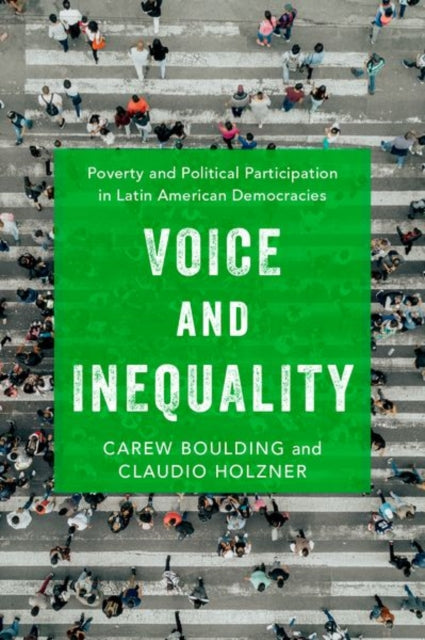
CarewBoulding,Claudio A.Holzner
Voice and Inequality: Poverty and Political Participation in Latin American Democracies
Voice and Inequality: Poverty and Political Participation in Latin American Democracies
💎 Earn 414 Points (£4.14) on this item.
We can order this item for you. Delivery usually takes about 4 to 6 weeks.
This item is not held in our immediate stock. We will order it for you after checkout.
Estimated delivery: About 4 to 6 weeks
- Condition: Brand new
- UK Delivery times: Usually arrives within 2 - 3 working days
- UK Shipping: Fee starts at £2.39. Subject to product weight & dimension
Bulk ordering. Want 15 or more copies? Get a personalised quote and bigger discounts. Learn more about bulk orders.
Couldn't load pickup availability
- More about Voice and Inequality: Poverty and Political Participation in Latin American Democracies
The first large-scale study of political participation in eighteen Latin American democracies, focusing on the political participation of the region's poorest citizens. The study finds that in recent years, most countries in the region have achieved near equality of participation across wealth groups, and in some cases, poor people participate more than wealthier individuals. Key institutions of democracy, such as civil society, political parties, and competitive elections, have an enormous impact on whether or not poor people turn out to vote, protest, and contact government officials. Poor people's activism also benefits from strong parties, robust electoral competition, and well-functioning democratic institutions.
\n Format: Hardback
\n Length: 264 pages
\n Publication date: 07 September 2021
\n Publisher: Oxford University Press Inc
\n
The first comprehensive study of political participation in eighteen Latin American democracies, with a particular emphasis on the political engagement of the region's most disadvantaged citizens. Political regimes in Latin America have a long history of marginalizing the poor. Today, the region's democracies exist in contexts that are still characterized by profound poverty and some of the world's most severe socioeconomic disparities. Preventing socioeconomic inequality from translating into political inequality is one of the central challenges confronting these young democracies. In Voice and Inequality, Carew Boulding and Claudio Holzner present the first large-scale empirical analysis of political participation in Latin America. They find that, in recent years, most (but not all) countries in the region have achieved near equality of participation across wealth groups, and in some cases, poor people participate more than wealthier individuals. How is this possible, given the long history of excluding poor people from the political arena in Latin America? Boulding and Holzner argue that key institutions of democracy, namely civil society, political parties, and competitive elections, have a profound impact on whether or not poor people turn out to vote, protest, and contact government officials. Far from being politically inert, under certain conditions, the poorest citizens can act and speak for themselves with an intensity that far exceeds their modest socioeconomic resources. When voluntary organizations thrive in poor communities and when political parties prioritize their mobilization efforts on poor individuals, they respond with high levels of political activism. Poor people's activism also benefits from strong parties, robust electoral competition, and well-functioning democratic institutions. Where electoral competition is fierce and political parties are strong, poor people are more likely to participate in the political process. In countries with weak political parties and limited electoral competition, poor people are less likely to engage in political activity. Overall, Voice and Inequality provides valuable insights into the factors that influence political participation among the poor in Latin America. It highlights the importance of promoting inclusive democracy and ensuring that all citizens have the opportunity to participate in the political process. It also emphasizes the need for political parties and civil society organizations to prioritize the needs of the poor and work towards creating a more equitable society.
The first comprehensive study of political participation in eighteen Latin American democracies, with a particular emphasis on the political engagement of the region's most disadvantaged citizens. Political regimes in Latin America have a long history of marginalizing the poor. Today, the region's democracies exist in contexts that are still characterized by profound poverty and some of the world's most severe socioeconomic disparities. Preventing socioeconomic inequality from translating into political inequality is one of the central challenges confronting these young democracies. In Voice and Inequality, Carew Boulding and Claudio Holzner present the first large-scale empirical analysis of political participation in Latin America. They find that, in recent years, most (but not all) countries in the region have achieved near equality of participation across wealth groups, and in some cases, poor people participate more than wealthier individuals. How is this possible, given the long history of excluding poor people from the political arena in Latin America? Boulding and Holzner argue that key institutions of democracy, namely civil society, political parties, and competitive elections, have a profound impact on whether or not poor people turn out to vote, protest, and contact government officials. Far from being politically inert, under certain conditions, the poorest citizens can act and speak for themselves with an intensity that far exceeds their modest socioeconomic resources. When voluntary organizations thrive in poor communities and when political parties prioritize their mobilization efforts on poor individuals, they respond with high levels of political activism. Poor people's activism also benefits from strong parties, robust electoral competition, and well-functioning democratic institutions. Where electoral competition is fierce and political parties are strong, poor people are more likely to participate in the political process. In countries with weak political parties and limited electoral competition, poor people are less likely to engage in political activity. Overall, Voice and Inequality provides valuable insights into the factors that influence political participation among the poor in Latin America. It highlights the importance of promoting inclusive democracy and ensuring that all citizens have the opportunity to participate in the political process. It also emphasizes the need for political parties and civil society organizations to prioritize the needs of the poor and work towards creating a more equitable society.
\n Weight: 540g\n
Dimension: 163 x 244 x 24 (mm)\n
ISBN-13: 9780197542149\n \n
This item can be found in:
UK and International shipping information
UK and International shipping information
UK Delivery and returns information:
- Delivery within 2 - 3 days when ordering in the UK.
- Shipping fee for UK customers from £2.39. Fully tracked shipping service available.
- Returns policy: Return within 30 days of receipt for full refund.
International deliveries:
Shulph Ink now ships to Australia, Belgium, Canada, France, Germany, Ireland, Italy, India, Luxembourg Saudi Arabia, Singapore, Spain, Netherlands, New Zealand, United Arab Emirates, United States of America.
- Delivery times: within 5 - 10 days for international orders.
- Shipping fee: charges vary for overseas orders. Only tracked services are available for most international orders. Some countries have untracked shipping options.
- Customs charges: If ordering to addresses outside the United Kingdom, you may or may not incur additional customs and duties fees during local delivery.