Liya Yu
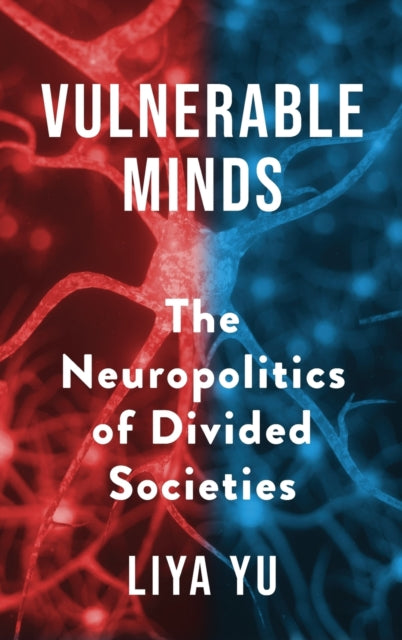
Vulnerable Minds: The Neuropolitics of Divided Societies
Vulnerable Minds: The Neuropolitics of Divided Societies
💎 Earn 473 Points (£4.73) on this item.
YOU SAVE £22.32
- Condition: Brand new
- UK Delivery times: Usually arrives within 2 - 3 working days
- UK Shipping: Fee starts at £2.39. Subject to product weight & dimension
Bulk ordering. Want 15 or more copies? Get a personalised quote and bigger discounts. Learn more about bulk orders.
Couldn't load pickup availability
- More about Vulnerable Minds: The Neuropolitics of Divided Societies
Neuroscience research suggests that the brain is prone to in-group and out-group classifications, with consequences from ordinary blind spots to dehumanization. Liya Yu develops a novel political framework that builds on neuroscientific discoveries to rethink the social contract and argues that cognitive dehumanization is the most crucial disruptor of cooperation and solidarity. She advances a new neuropolitical language of persuasion that appeals to shared neurobiological vulnerabilities and provides practical strategies to address those we disagree with most strongly.
Format: Hardback
Length: 304 pages
Publication date: 12 July 2022
Publisher: Columbia University Press
Neuroscience research has sparked a concerning possibility: Could the inclination to stigmatize others be innate? Some evidence suggests that the brain is predisposed to categorizing individuals into in-groups and out-groups, with implications ranging from ordinary blind spots to full-scale dehumanization. Many tend to dismiss the argument that racism and discrimination could have a cognitive basis. However, if we all possess the capacity for thinking in exclusionary ways, whether it's found among ardent social justice advocates, bigots, or xenophobes, could this shared flaw present new opportunities for political reconciliation?
Liya Yu, in her groundbreaking work, develops a novel political framework that harnesses neuroscientific discoveries to reimagine the social contract. She argues that our political identities should be understood in terms of our shared social capacities, particularly our everyday tendencies toward exclusion. Yu contends that cognitive dehumanization poses the greatest threat to cooperation and solidarity, and traditional liberal values-based discourse is insufficient in combating it. She proposes a new neuropolitical language of persuasion that avoids moralizing or shaming and instead appeals to shared neurobiological vulnerabilities. Vulnerable Minds offers practical strategies for engaging with those we disagree with most strongly, providing timely guidance on inclusivity and humanizing others.
The brain's tendency to classify individuals into in-groups and out-groups has profound implications for our social interactions and relationships. Research has shown that this cognitive bias can lead to various biases and prejudices, including racism, discrimination, and xenophobia. For example, studies have shown that people are more likely to favor their in-group and discriminate against out-groups when they are presented with ambiguous information or when their identity is at stake.
One of the most significant consequences of cognitive dehumanization is the erosion of cooperation and solidarity. When individuals perceive others as different or inferior, they are less likely to work together towards common goals or to support each other in times of need. This can have far-reaching consequences for society as a whole, including economic inequality, political instability, and social unrest.
To address the challenge of cognitive dehumanization, it is important to develop new approaches to persuasion and communication. One approach is to focus on shared values and common goals rather than differences and divisions. This can help to create a sense of unity and common purpose, which can override the brain's tendency to categorize and dehumanize others.
Another approach is to promote empathy and understanding of different perspectives. By learning to see the world through the eyes of others, we can develop a greater sense of compassion and empathy for their experiences and challenges. This can help to break down barriers and promote social cohesion and harmony.
In addition to these practical strategies, it is also important to address the underlying causes of cognitive dehumanization. This can include addressing social inequality, promoting education and awareness, and addressing the impact of media and popular culture on our perceptions of others.
In conclusion, neuroscience research has raised a troubling possibility: Could the tendency to stigmatize others be innate? While many may reject the idea that racism and discrimination could have a cognitive basis, it is important to recognize that we all possess the capacity for thinking in exclusionary ways. By developing new approaches to persuasion and communication, promoting empathy and understanding, and addressing the underlying causes of cognitive dehumanization, we can work towards creating a more inclusive and compassionate society.
Dimension: 229 x 152 (mm)
ISBN-13: 9780231200301
This item can be found in:
UK and International shipping information
UK and International shipping information
UK Delivery and returns information:
- Delivery within 2 - 3 days when ordering in the UK.
- Shipping fee for UK customers from £2.39. Fully tracked shipping service available.
- Returns policy: Return within 30 days of receipt for full refund.
International deliveries:
Shulph Ink now ships to Australia, Belgium, Canada, France, Germany, Ireland, Italy, India, Luxembourg Saudi Arabia, Singapore, Spain, Netherlands, New Zealand, United Arab Emirates, United States of America.
- Delivery times: within 5 - 10 days for international orders.
- Shipping fee: charges vary for overseas orders. Only tracked services are available for most international orders. Some countries have untracked shipping options.
- Customs charges: If ordering to addresses outside the United Kingdom, you may or may not incur additional customs and duties fees during local delivery.