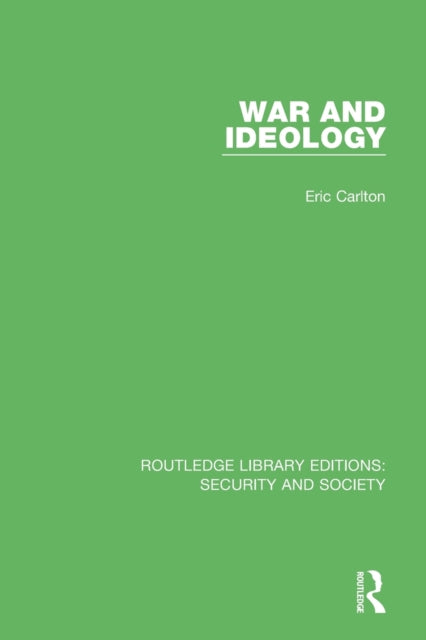
Eric Carlton
War and Ideology
War and Ideology
💎 Earn 160 Points (£1.60) on this item.
We can order this item for you. Delivery usually takes about 4 to 6 weeks.
This item is not held in our immediate stock. We will order it for you after checkout.
Estimated delivery: About 4 to 6 weeks
YOU SAVE £1.91
- Condition: Brand new
- UK Delivery times: Usually arrives within 2 - 3 working days
- UK Shipping: Fee starts at £2.39. Subject to product weight & dimension
Bulk ordering. Want 15 or more copies? Get a personalised quote and bigger discounts. Learn more about bulk orders.
Couldn't load pickup availability
- More about War and Ideology
Eric Carlton's book "Why Men and Women Go to War" investigates why men and women go to war, and how they are able to commit atrocities against their enemy. He believes that the perception of the enemy is central to these issues and that military training and ideology are based on the definition of the enemy as "the other". The book explores the underlying problem of how and why societies resort to war by analysing the motivations, usually religious and ideological, which legitimize warlike policies and activities. It uses an historical method to comment on situations which are still relevant to the modern world and is of great value and interest to students of history, sociology, and politics, as well as to those engaged in war studies.
Format: Paperback / softback
Length: 216 pages
Publication date: 04 November 2022
Publisher: Taylor & Francis Ltd
Why do nations go to war? Is war an institutionalized outlet for our aggressive instincts? Or is it a cultural invention rather than a biological necessity?
Originally published in 1990, Eric Carlton, in his book "Why Men and Women Go to War," delves into the complex and multifaceted reasons why nations engage in armed conflicts. Drawing from a wide range of societies, Carlton examines the motivations behind war, exploring whether it is a product of our innate aggression or a cultural creation.
Central to Carlton's analysis is the perception of the enemy. He argues that the way we perceive and conceptualize our adversaries plays a crucial role in shaping the nature and intensity of warfare. Military training and ideology are often built upon the notion of the enemy as "the other," a stereotyped image that can be consciously or unconsciously converted into an ideology of aggression.
Throughout the text, Carlton conducts extensive studies to uncover the significance of this stereotyped image when soldiers commit atrocities during war. He explores the underlying problem of how and why societies resort to war, analyzing the religious and ideological motivations that legitimize warlike policies and activities. Fascinating case studies are presented, examining how the enemy has been perceived in various historical and comparative contexts, such as ancient Egyptians, Romans, and Maoists. These studies highlight the profound impact that perceptions of the adversary have on the nature of warfare, surpassing any other single factor.
One of the unique aspects of Carlton's book is its discussion of the idea of the enemy in warfare and military ideology. He challenges the conventional notion that war is solely driven by territorial expansion or economic interests. Instead, he argues that the enemy is often portrayed as a moral adversary, representing a threat to our values, beliefs, and way of life. This portrayal, Carlton suggests, can lead to the dehumanization of the enemy, making it easier for soldiers to commit atrocities against them.
Carlton's historical and comparative perspective is another distinguishing feature of his work. He examines war from a global and long-term perspective, drawing connections between different historical events and their implications for the modern world. By comparing the strategies and tactics employed by various nations and societies, Carlton offers valuable insights into the evolution of warfare and the factors that contribute to its recurrence.
The book's extensive case studies make it of great value and interest to students of history, sociology, politics, and war studies. It provides a comprehensive and nuanced understanding of the complex dynamics that drive nations to go to war, shedding light on the factors that contribute to the perpetuation of armed conflicts.
In conclusion, Eric Carlton's "Why Men and Women Go to War" is a seminal work that offers a comprehensive and insightful exploration of the reasons behind nations' engagement in armed conflicts. Through his analysis of the perception of the enemy, the role of military training and ideology, and the historical and comparative perspectives, Carlton provides a valuable contribution to our understanding of war and its consequences. This book is a must-read for anyone interested in the study of history, sociology, politics, and war, as well as for those who seek to promote peace and prevent future conflicts.
Weight: 410g
Dimension: 234 x 156 (mm)
ISBN-13: 9780367609313
This item can be found in:
UK and International shipping information
UK and International shipping information
UK Delivery and returns information:
- Delivery within 2 - 3 days when ordering in the UK.
- Shipping fee for UK customers from £2.39. Fully tracked shipping service available.
- Returns policy: Return within 30 days of receipt for full refund.
International deliveries:
Shulph Ink now ships to Australia, Belgium, Canada, France, Germany, Ireland, Italy, India, Luxembourg Saudi Arabia, Singapore, Spain, Netherlands, New Zealand, United Arab Emirates, United States of America.
- Delivery times: within 5 - 10 days for international orders.
- Shipping fee: charges vary for overseas orders. Only tracked services are available for most international orders. Some countries have untracked shipping options.
- Customs charges: If ordering to addresses outside the United Kingdom, you may or may not incur additional customs and duties fees during local delivery.