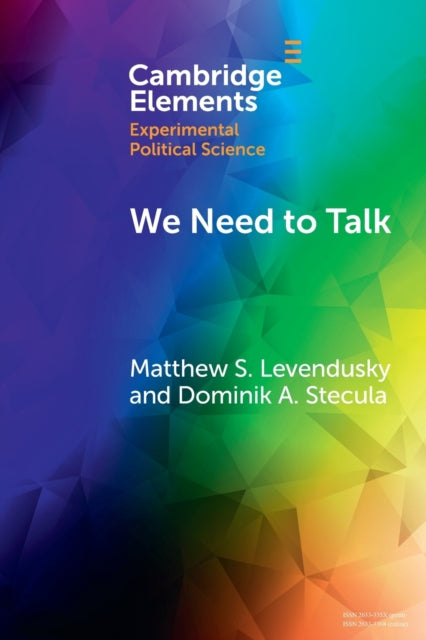
Matthew S. Levendusky,Dominik A. Stecula
We Need to Talk: How Cross-Party Dialogue Reduces Affective Polarization
We Need to Talk: How Cross-Party Dialogue Reduces Affective Polarization
💎 Earn 84 Points (£0.84) on this item.
We can order this item for you. Delivery usually takes about 4 to 6 weeks.
This item is not held in our immediate stock. We will order it for you after checkout.
Estimated delivery: About 4 to 6 weeks
YOU SAVE £1.01
- Condition: Brand new
- UK Delivery times: Usually arrives within 2 - 3 working days
- UK Shipping: Fee starts at £3.89. Subject to product weight & dimension
Bulk ordering. Want 15 or more copies? Get a personalised quote and bigger discounts. Learn more about bulk orders.
Couldn't load pickup availability
- More about We Need to Talk: How Cross-Party Dialogue Reduces Affective Polarization
Americans today are increasingly polarized, which has damaging consequences for their democracy. This Element tests a strategy for ameliorating this animus by having ordinary Democrats and Republicans come together for cross-party political discussions. An original experiment finds strong support for this hypothesis, with affective polarization falling substantially among subjects who participate in heterogeneous discussion relative to those who participate in either homogeneous political discussion or an apolitical control. The findings have considerable importance for efforts to ameliorate animus in the mass public and for understanding American politics more broadly.
\n Format: Paperback / softback
\n Length: 75 pages
\n Publication date: 02 December 2021
\n Publisher: Cambridge University Press
\n
Americans today are deeply divided, with a growing sense of dislike and distrust towards individuals from opposing political parties, a trend that has significant implications for their democracy. This polarization has led to a breakdown in civil discourse and a lack of understanding between different groups, ultimately hindering the progress of society.
One strategy proposed to address this issue is the facilitation of cross-party political discussions among ordinary Democrats and Republicans. Building on intergroup contact theory, the authors argue that these discussions have the potential to mitigate partisan animosity and promote greater understanding and cooperation between the two parties.
To test this hypothesis, an original experiment was conducted. The participants were randomly assigned to one of three groups: a heterogeneous discussion group, a homogeneous political discussion group, or an apolitical control group. The heterogeneous discussion group consisted of individuals from different political backgrounds who were encouraged to engage in open and respectful dialogue with one another.
The results of the experiment were striking. Participants in the heterogeneous discussion group reported significantly lower levels of partisan animosity compared to those in the homogeneous political discussion group or the apolitical control group. This reduction in animosity was maintained for at least one week after the initial experiment, indicating that the effects were long-lasting.
Several mechanisms were identified to explain these effects. First, the heterogeneous discussion group provided a unique opportunity for individuals to engage with others who held different political beliefs, challenging their preconceptions and stereotypes. This exposure to diverse perspectives helped to reduce cognitive biases and promote a more nuanced understanding of political issues.
Second, the structured and facilitated nature of the discussion promoted active listening and empathy, which are key components of effective communication. Participants were encouraged to listen to each other's perspectives and to try to understand their motivations and concerns. This increased understanding and respect between individuals from different political backgrounds helped to build trust and reduce animosity.
Third, the heterogeneous discussion group created a sense of shared identity and common purpose. Participants were united by their interest in promoting constructive dialogue and improving political discourse, which created a sense of community and belonging. This shared identity helped to override partisan affiliations and promote a more inclusive and unified perspective on politics.
These findings have significant implications for efforts to ameliorate animus in the mass public and to understand American politics more broadly. By promoting cross-party political discussions and encouraging individuals to engage with those who hold different beliefs, we can create a more inclusive and cohesive society that is better equipped to address the complex challenges facing our nation.
In conclusion, the growing polarization in American politics is a significant threat to our democracy. However, by facilitating cross-party political discussions and promoting greater understanding and empathy between individuals from different political backgrounds, we can mitigate partisan animosity and work towards a more inclusive and unified society. This approach has the potential to improve our political discourse, promote greater cooperation, and ultimately strengthen our democracy.
\n Weight: 118g\n \n
ISBN-13: 9781009045445\n
Edition number: New ed\n
UK and International shipping information
UK and International shipping information
We deliver throughout the United Kingdom and to 128 countries and territories worldwide, including the United States, Australia, Canada, Germany, Spain and France.