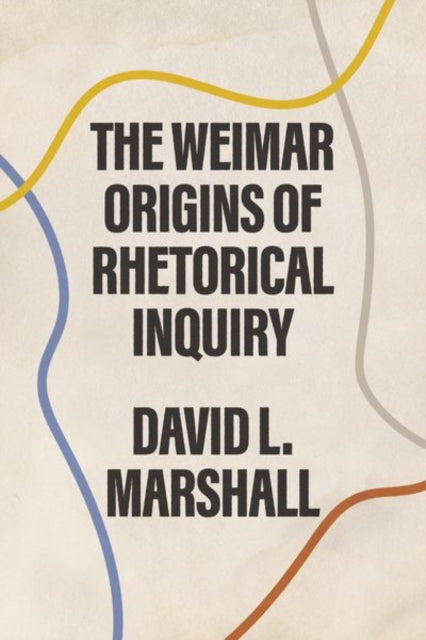
David L. Marshall
Weimar Origins of Rhetorical Inquiry
Weimar Origins of Rhetorical Inquiry
💎 Earn 174 Points (£1.74) on this item.
YOU SAVE £4.19
- Condition: Brand new
- UK Delivery times: Usually arrives within 2 - 3 working days
- UK Shipping: Fee starts at £2.39. Subject to product weight & dimension
Bulk ordering. Want 15 or more copies? Get a personalised quote and bigger discounts. Learn more about bulk orders.
Couldn't load pickup availability
- More about Weimar Origins of Rhetorical Inquiry
The Weimar origins of political theory are often overlooked, but David L. Marshall's work reveals the Weimar origins of rhetorical inquiry. He focuses on Martin Heidegger, Hannah Arendt, Walter Benjamin, and Aby Warburg, showing how they transformed problems set out by Max Weber, Carl Schmitt, Theodor Adorno, Hans Baron, and Leo Strauss. Marshall argues that we miss major opportunities if we do not attend to the rhetorical aspects of their thought, and his aim is to lay out an intellectual history that can become a zone of theoretical experimentation in para-democratic times.
\n Format: Hardback
\n Length: 392 pages
\n Publication date: 09 November 2020
\n Publisher: The University of Chicago Press
\n
The Weimar origins of political theory are a widely accepted narrative, but this singular focus overlooks another intellectual history that historian David L. Marshall seeks to uncover: the Weimar origins of rhetorical inquiry. Marshall directs his attention to Martin Heidegger, Hannah Arendt, Walter Benjamin, and Aby Warburg, revealing how these influential thinkers influenced and transformed problems initially set out by Max Weber, Carl Schmitt, Theodor Adorno, Hans Baron, and Leo Strauss. He argues that we miss significant opportunities if we do not attend to the rhetorical aspects of their thought, and his ultimate goal is to lay out an intellectual history that can serve as a zone of theoretical experimentation in para-democratic times.
Redescribing the Weimar origins of political theory in terms of rhetorical inquiry, Marshall offers fresh readings of pivotal thinkers and argues that the vision of rhetorical inquiry that they open up allows for new ways of imagining political communities today.
The Weimar origins of political theory are a widely accepted narrative, but this singular focus overlooks another intellectual history that historian David L. Marshall seeks to uncover: the Weimar origins of rhetorical inquiry. Marshall directs his attention to Martin Heidegger, Hannah Arendt, Walter Benjamin, and Aby Warburg, revealing how these influential thinkers influenced and transformed problems initially set out by Max Weber, Carl Schmitt, Theodor Adorno, Hans Baron, and Leo Strauss. He argues that we miss significant opportunities if we do not attend to the rhetorical aspects of their thought, and his ultimate goal is to lay out an intellectual history that can serve as a zone of theoretical experimentation in para-democratic times.
Redescribing the Weimar origins of political theory in terms of rhetorical inquiry, Marshall offers fresh readings of pivotal thinkers and argues that the vision of rhetorical inquiry that they open up allows for new ways of imagining political communities today.
The Weimar origins of political theory are a widely accepted narrative, but this singular focus overlooks another intellectual history that historian David L. Marshall seeks to uncover: the Weimar origins of rhetorical inquiry. Marshall directs his attention to Martin Heidegger, Hannah Arendt, Walter Benjamin, and Aby Warburg, revealing how these influential thinkers influenced and transformed problems initially set out by Max Weber, Carl Schmitt, Theodor Adorno, Hans Baron, and Leo Strauss. He argues that we miss significant opportunities if we do not attend to the rhetorical aspects of their thought, and his ultimate goal is to lay out an intellectual history that can serve as a zone of theoretical experimentation in para-democratic times.
Redescribing the Weimar origins of political theory in terms of rhetorical inquiry, Marshall offers fresh readings of pivotal thinkers and argues that the vision of rhetorical inquiry that they open up allows for new ways of imagining political communities today.
\n Weight: 628g\n
Dimension: 160 x 237 x 30 (mm)\n
ISBN-13: 9780226722214\n \n
This item can be found in:
UK and International shipping information
UK and International shipping information
UK Delivery and returns information:
- Delivery within 2 - 3 days when ordering in the UK.
- Shipping fee for UK customers from £2.39. Fully tracked shipping service available.
- Returns policy: Return within 30 days of receipt for full refund.
International deliveries:
Shulph Ink now ships to Australia, Belgium, Canada, France, Germany, Ireland, Italy, India, Luxembourg Saudi Arabia, Singapore, Spain, Netherlands, New Zealand, United Arab Emirates, United States of America.
- Delivery times: within 5 - 10 days for international orders.
- Shipping fee: charges vary for overseas orders. Only tracked services are available for most international orders. Some countries have untracked shipping options.
- Customs charges: If ordering to addresses outside the United Kingdom, you may or may not incur additional customs and duties fees during local delivery.