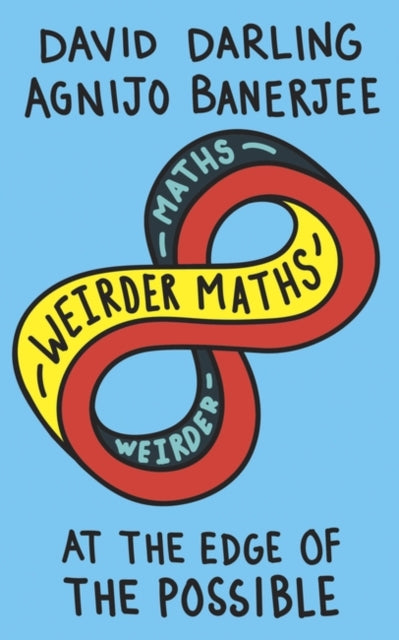
David Darling,Agnijo Banerjee
Weirder Maths: At the Edge of the Possible
Weirder Maths: At the Edge of the Possible
💎 Earn 34 Points (£0.34) on this item.
YOU SAVE £3.16
- Condition: Brand new
- UK Delivery times: Usually arrives within 2 - 3 working days
- UK Shipping: Fee starts at £3.89. Subject to product weight & dimension
Bulk ordering. Want 15 or more copies? Get a personalised quote and bigger discounts. Learn more about bulk orders.
Couldn't load pickup availability
- More about Weirder Maths: At the Edge of the Possible
Maths is used in many ways that we may not realize, such as in finding the perfect labyrinth, traveling back in time to discover "bubble math," and transforming complex concepts into beautiful ones.
Format: Paperback / softback
Length: 256 pages
Publication date: 04 July 2019
Publisher: Oneworld Publications
Maths is a subject that has been around for centuries and has been used in many different fields, from science and engineering to finance and economics. Despite its importance, many students may wonder when it will be useful in their daily lives. However, maths is everywhere in our world, and we are constantly using it without even realizing it.
In the book "The Perfect Labyrinth: How Maths Explains the World," authors David Darling and Agnijo Banerjee explore the vast applications of maths in our daily lives. They journey back to the second century to discover the origins of "bubble maths," a fascinating form of mathematics that was used to predict the weather. They also reveal the weirdest mathematicians in history, such as the eccentric English mathematician Charles Babbage, who is credited with inventing the first computer.
Darling and Banerjee use maths to transform the bewildering into the beautiful. They explain complex mathematical concepts in simple terms, making them accessible to everyone. For example, they use the concept of fractals to explain the patterns found in nature, such as the branching of trees and the shapes of coastlines. They also show how maths can be used to create beautiful art, such as the intricate designs of M.C. Escher.
One of the most interesting aspects of the book is its exploration of the role of maths in the modern world. Darling and Banerjee argue that maths is not just a subject that we learn in school but a skill that we need to develop throughout our lives. They suggest that we should embrace maths and use it to solve problems and make informed decisions.
The book also provides a wealth of practical tips and resources for students who want to improve their maths skills. They offer advice on how to study more effectively, how to approach difficult problems, and how to apply maths in real-world situations.
In conclusion, "The Perfect Labyrinth: How Maths Explains the World" is a fascinating and informative book that shows the vast applications of maths in our daily lives. Whether you are a maths student or just someone who enjoys learning about the world, this book will delight and inspire you. It is a must-read for anyone who wants to understand the power of maths and how it can be used to improve our lives.
Maths is a subject that has been around for centuries and has been used in many different fields, from science and engineering to finance and economics. Despite its importance, many students may wonder when it will be useful in their daily lives. However, maths is everywhere in our world, and we are constantly using it without even realizing it.
In the book "The Perfect Labyrinth: How Maths Explains the World," authors David Darling and Agnijo Banerjee explore the vast applications of maths in our daily lives. They journey back to the second century to discover the origins of "bubble maths," a fascinating form of mathematics that was used to predict the weather. They also reveal the weirdest mathematicians in history, such as the eccentric English mathematician Charles Babbage, who is credited with inventing the first computer.
Darling and Banerjee use maths to transform the bewildering into the beautiful. They explain complex mathematical concepts in simple terms, making them accessible to everyone. For example, they use the concept of fractals to explain the patterns found in nature, such as the branching of trees and the shapes of coastlines. They also show how maths can be used to create beautiful art, such as the intricate designs of M.C. Escher.
One of the most interesting aspects of the book is its exploration of the role of maths in the modern world. Darling and Banerjee argue that maths is not just a subject that we learn in school but a skill that we need to develop throughout our lives. They suggest that we should embrace maths and use it to solve problems and make informed decisions.
The book also provides a wealth of practical tips and resources for students who want to improve their maths skills. They offer advice on how to study more effectively, how to approach difficult problems, and how to apply maths in real-world situations.
In conclusion, "The Perfect Labyrinth: How Maths Explains the World" is a fascinating and informative book that shows the vast applications of maths in our daily lives. Whether you are a maths student or just someone who enjoys learning about the world, this book will delight and inspire you. It is a must-read for anyone who wants to understand the power of maths and how it can be used to improve our lives.
Weight: 242g
Dimension: 193 x 146 x 19 (mm)
ISBN-13: 9781786075086
UK and International shipping information
UK and International shipping information
We deliver throughout the United Kingdom and to 128 countries and territories worldwide, including the United States, Australia, Canada, Germany, Spain and France.