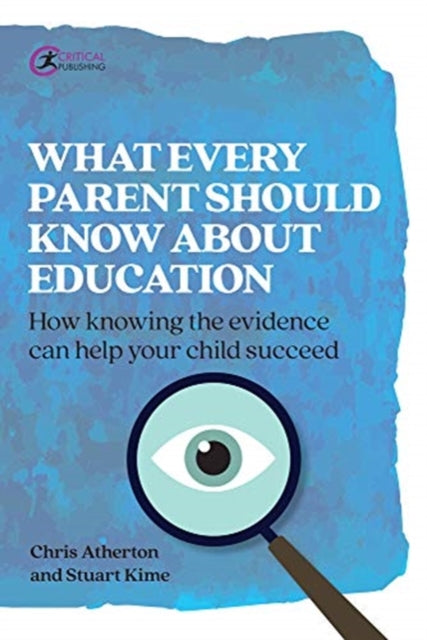
Chris Atherton,Stuart Kime
What Every Parent Should Know About Education: How knowing the facts can help your child succeed
What Every Parent Should Know About Education: How knowing the facts can help your child succeed
💎 Earn 76 Points (£0.76) on this item.
YOU SAVE £5.64
- Condition: Brand new
- UK Delivery times: Usually arrives within 2 - 3 working days
- UK Shipping: Fee starts at £2.39. Subject to product weight & dimension
Bulk ordering. Want 15 or more copies? Get a personalised quote and bigger discounts. Learn more about bulk orders.
Couldn't load pickup availability
- More about What Every Parent Should Know About Education: How knowing the facts can help your child succeed
This book provides parents with practical advice, research, and informative summaries to help their children succeed in school. It covers topics such as school choice, testing and assessment, homework and revision, primary- and secondary-specific topics, stress and mental health, and special needs. It also ensures parents can ask schools the right questions, interact positively with teachers, and effectively support their children.
Format: Paperback / softback
Length: 144 pages
Publication date: 05 May 2021
Publisher: Critical Publishing Ltd
The process of learning in children is a complex and multifaceted one that involves a range of cognitive, emotional, and social factors. As parents and caregivers, it is essential to understand the various ways in which children learn and to provide them with the appropriate support and environment to facilitate their growth and development.
One of the most important aspects of children's learning is their cognitive development. Cognitive development refers to the growth and development of children's thinking, reasoning, and problem-solving skills. During the early years of childhood, children's cognitive abilities are rapidly developing, and they are able to learn and understand new things at a remarkable pace.
To support children's cognitive development, parents and caregivers can provide a range of activities and experiences that encourage thinking and problem-solving. This can include reading books, playing games, solving puzzles, and engaging in creative activities such as drawing and painting. Parents can also encourage their children to ask questions and to explore their surroundings, as this can help to develop their curiosity and sense of inquiry.
In addition to cognitive development, children's emotional development is also an important aspect of their learning. Emotional development refers to the growth and development of children's emotional intelligence, which includes their ability to understand and manage their emotions, as well as their ability to form and maintain relationships with others. During the early years of childhood, children's emotional development is closely linked to their cognitive development, as they are learning to understand and regulate their emotions in response to different situations.
To support children's emotional development, parents and caregivers can provide a range of activities and experiences that promote emotional regulation and socialization. This can include providing a safe and supportive environment, modeling positive emotional behavior, and encouraging children to express their emotions in a healthy and constructive way. Parents can also provide opportunities for children to engage in social interactions with other children and adults, as this can help to develop their social skills and build their confidence.
Another important aspect of children's learning is their social development. Social development refers to the growth and development of children's social skills, including their ability to communicate effectively, collaborate with others, and resolve conflicts. During the early years of childhood, children's social development is closely linked to their cognitive and emotional development, as they are learning to interact with others in different social situations.
To support children's social development, parents and caregivers can provide a range of activities and experiences that promote socialization and collaboration. This can include providing opportunities for children to engage in group activities, such as playgroups and sports teams, as well as providing opportunities for children to interact with other children and adults in different social settings, such as family gatherings and community events. Parents can also provide opportunities for children to develop their communication skills, such as by encouraging them to talk and listen to others and by modeling effective communication behavior.
In addition to cognitive, emotional, and social development, children's learning also involves their physical development. Physical development refers to the growth and development of children's physical abilities, including their strength, coordination, and motor skills. During the early years of childhood, children's physical development is closely linked to their cognitive and emotional development, as they are learning to use their bodies in different ways to explore and interact with their environment.
To support children's physical development, parents and caregivers can provide a range of activities and experiences that promote physical activity and movement. This can include providing opportunities for children to play outside, such as running, jumping, and climbing, as well as providing opportunities for children to engage in physical activities such as sports and dance. Parents can also provide opportunities for children to develop their fine motor skills, such as by providing toys and materials that encourage hand-eye coordination and fine motor manipulation.
In conclusion, the process of learning in children is a complex and multifaceted one that involves a range of cognitive, emotional, and social factors. As parents and caregivers, it is essential to understand the various ways in which children learn and to provide them with the appropriate support and environment to facilitate their growth and development. By providing a range of activities and experiences that promote cognitive development, emotional development, social development, and physical development, parents and caregivers can help to ensure that their children are well-prepared for the challenges of the future.
Weight: 228g
Dimension: 155 x 233 x 23 (mm)
ISBN-13: 9781913063139
UK and International shipping information
UK and International shipping information
UK Delivery and returns information:
- Delivery within 2 - 3 days when ordering in the UK.
- Shipping fee for UK customers from £2.39. Fully tracked shipping service available.
- Returns policy: Return within 30 days of receipt for full refund.
International deliveries:
Shulph Ink now ships to Australia, Belgium, Canada, France, Germany, Ireland, Italy, India, Luxembourg Saudi Arabia, Singapore, Spain, Netherlands, New Zealand, United Arab Emirates, United States of America.
- Delivery times: within 5 - 10 days for international orders.
- Shipping fee: charges vary for overseas orders. Only tracked services are available for most international orders. Some countries have untracked shipping options.
- Customs charges: If ordering to addresses outside the United Kingdom, you may or may not incur additional customs and duties fees during local delivery.