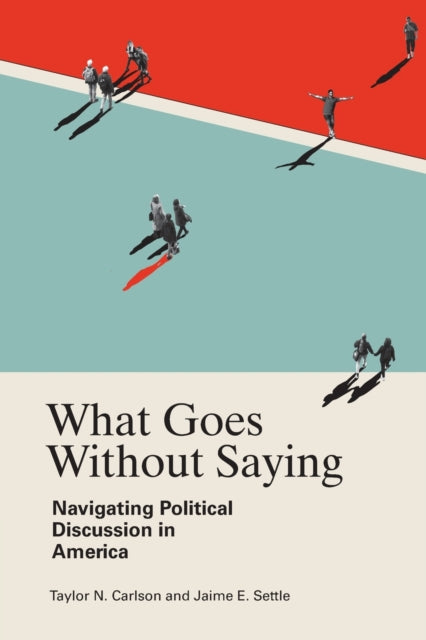
Taylor N.Carlson,Jaime E.Settle
What Goes Without Saying: Navigating Political Discussion in America
What Goes Without Saying: Navigating Political Discussion in America
💎 Earn 118 Points (£1.18) on this item.
We can order this item for you. Delivery usually takes about 4 to 6 weeks.
This item is not held in our immediate stock. We will order it for you after checkout.
Estimated delivery: About 4 to 6 weeks
YOU SAVE £1.40
- Condition: Brand new
- UK Delivery times: Usually arrives within 2 - 3 working days
- UK Shipping: Fee starts at £2.39. Subject to product weight & dimension
Bulk ordering. Want 15 or more copies? Get a personalised quote and bigger discounts. Learn more about bulk orders.
Couldn't load pickup availability
- More about What Goes Without Saying: Navigating Political Discussion in America
Political conversations are often uncomfortable for many people due to the 4D Framework of political conversation: identifying others' views, deciding whether to talk, discussing opinions honestly, and determining whether to repeat the experience.
Format: Paperback / softback
Length: 300 pages
Publication date: 09 June 2022
Publisher: Cambridge University Press
The study of political conversation has been a focal point in recent literature, with a particular emphasis on the structure of people's discussion networks and the frequency with which they engage in political discourse. However, there has been a lack of attention to the dynamics of these conversations themselves. In their book, "What Goes Without Saying," Taylor N. Carlson and Jaime E. Settle delve into the intricacies of how Americans navigate these discussions in their daily lives, particularly focusing on the decision-making process around when and how to broach politics.
The authors employ a multi-methods approach to unravel the 4D Framework of political conversation, which encompasses four key dimensions: identifying the ways in which people detect others' views, determining whether to engage in political talk, expressing their opinions honestly, and assessing whether they are likely to repeat the experience in the future. By developing a comprehensive framework for studying and explaining political discussion as a social process, "What Goes Without Saying" has the potential to shape the research agenda for political science, psychology, communication, and sociology for decades to come.
One of the key insights from the book is that political conversation is not a one-size-fits-all phenomenon. Different individuals and contexts have their own unique dynamics and factors that influence their engagement with politics. For example, some people may be more comfortable discussing politics with close friends and family, while others may prefer to avoid the topic altogether. Additionally, factors such as social norms, cultural backgrounds, and personal beliefs can shape the way in which people communicate about politics.
The authors argue that understanding these dynamics is crucial for promoting healthy and productive political discourse. By recognizing the different perspectives and experiences that people bring to political conversations, we can create spaces where individuals feel comfortable expressing their opinions and engaging in respectful dialogue. This, in turn, can lead to a more informed and engaged citizenry and a more robust democratic process.
Another important aspect of the book is its exploration of the decision-making process around when and how to broach politics. The authors argue that individuals often make decisions based on a combination of personal factors, such as their level of political interest and knowledge, as well as social factors, such as the context in which they are discussing politics. For example, some people may be more likely to engage in political talk during election season, while others may prefer to avoid the topic altogether during times of personal stress or conflict.
The authors suggest that by understanding these decision-making processes, we can develop strategies for promoting more open and inclusive political discourse. For example, policymakers and educators can create opportunities for individuals to engage in political talk, such as through community events or online forums, and can provide resources to help individuals develop their political knowledge and skills. Additionally, individuals can take steps
ownership of their political engagement by seeking out diverse perspectives and engaging in respectful dialogue with those who may hold different beliefs than their own.
In conclusion, "What Goes Without Saying" is a thought-provoking and insightful book that provides a comprehensive framework for studying and explaining political conversation as a social process. By delving into the dynamics of these conversations and the decision-making processes that shape them, the authors offer valuable insights into the challenges and opportunities of promoting healthy and productive political discourse. This book will be of interest to scholars, policymakers, and educators alike.
Weight: 600g
ISBN-13: 9781108927444
UK and International shipping information
UK and International shipping information
UK Delivery and returns information:
- Delivery within 2 - 3 days when ordering in the UK.
- Shipping fee for UK customers from £2.39. Fully tracked shipping service available.
- Returns policy: Return within 30 days of receipt for full refund.
International deliveries:
Shulph Ink now ships to Australia, Belgium, Canada, France, Germany, Ireland, Italy, India, Luxembourg Saudi Arabia, Singapore, Spain, Netherlands, New Zealand, United Arab Emirates, United States of America.
- Delivery times: within 5 - 10 days for international orders.
- Shipping fee: charges vary for overseas orders. Only tracked services are available for most international orders. Some countries have untracked shipping options.
- Customs charges: If ordering to addresses outside the United Kingdom, you may or may not incur additional customs and duties fees during local delivery.