NicholasJacobs,SidneyMilkis
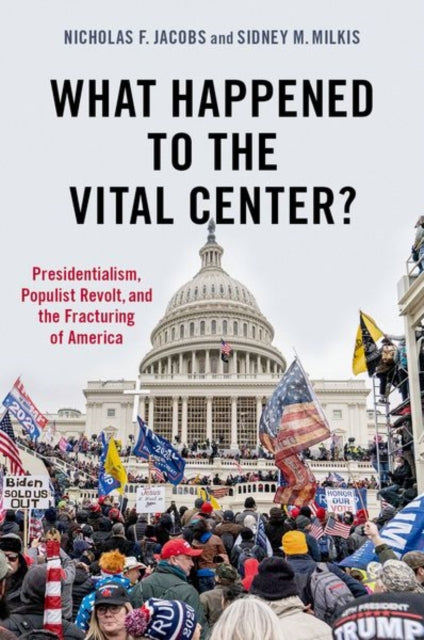
What Happened to the Vital Center?: Presidentialism, Populist Revolt, and the Fracturing of America
What Happened to the Vital Center?: Presidentialism, Populist Revolt, and the Fracturing of America
💎 Earn 127 Points (£1.27) on this item.
We can order this item for you. Delivery usually takes about 4 to 6 weeks.
This item is not held in our immediate stock. We will order it for you after checkout.
Estimated delivery: About 4 to 6 weeks
YOU SAVE £1.51
- Condition: Brand new
- UK Delivery times: Usually arrives within 2 - 3 working days
- UK Shipping: Fee starts at £2.39. Subject to product weight & dimension
Bulk ordering. Want 15 or more copies? Get a personalised quote and bigger discounts. Learn more about bulk orders.
Couldn't load pickup availability
- More about What Happened to the Vital Center?: Presidentialism, Populist Revolt, and the Fracturing of America
The book "What Happened to the Vital Center?" explores the history of American political polarization and the decline of moderating parties, arguing that current partisan division is a novel development. The authors suggest that the erosion of party moderating influence and the rise of executive-centered parties have contributed to extreme polarization and the dominance of the presidency. They propose ways for parties to be revitalized as institutions of collective responsibility that can transform personal ambition and partisanship into principled conflict over important issues.
Format: Paperback / softback
Length: 360 pages
Publication date: 29 April 2022
Publisher: Oxford University Press Inc
In his book "What Happened to the Vital Center?", Nicholas Jacobs and Sidney Milkis delve into a crucial aspect of American political history: the rise of partisan polarization and its implications for the country. The authors argue that current partisan polarization, exacerbated by populist disdain for constitutional principles and institutions, is a novel development in American politics. Populism, they contend, is not a new threat to the country's democratic experiment, but rather an insurgent force that intrudes directly into elections and government.
During previous periods of populist unrest, the United States was governed by resilient parties that moderated extremist currents within the political system. However, this began to crumble during the 1960s, as anti-institutionalist incursions into the Democratic and Republican organizations gave rise to reforms that empowered activists at the expense of the median voter and shifted the controlling power over parties to the executive branch.
Gradually, the moderating influence that parties played in structuring campaigns and the policy process eroded, leading to extreme polarization and the concentration of decision-making power in the presidency. Weakened parties were increasingly dominated by presidents and their partnerships with social activists, resulting in a gridlocked system characterized by the politics of demonization and demagoguery. Executive-centered parties, with their focus on the presidency, were more likely to ignore the sorts of moderating voices that had prevailed in an earlier era.
While the Republican Party may be more susceptible to the dangers of populism than the Democrats, the authors argue that both parties are facing a crisis of legitimacy. The decline of party identification and the rise of independent voters have made it difficult for politicians to appeal to a broad base of voters, leading to a polarized and fragmented political landscape.
The book offers several solutions to address the challenges posed by partisan polarization. One of the most important is the need for political parties to rediscover their role as moderating forces in the political system. Parties should prioritize the interests of the median voter and work to bridge the gap between different ideological perspectives. Additionally, the authors suggest that the media should play a more active role in promoting civil discourse and encouraging voters to consider different points of view.
In conclusion, "What Happened to the Vital Center?" is a thought-provoking and important contribution to the ongoing scholarly and popular discussion of how America fell apart and what might be done to end the Cold Civil War that fractures the country and weakens the national resolve. By tackling the foundational question of partisan polarization, the book offers a novel and important perspective on the challenges facing American politics. The solutions proposed by Jacobs and Milkis are timely and relevant, and they provide a roadmap for rebuilding a more inclusive and democratic political system.
Dimension: 235 x 156 (mm)
ISBN-13: 9780197603529
UK and International shipping information
UK and International shipping information
UK Delivery and returns information:
- Delivery within 2 - 3 days when ordering in the UK.
- Shipping fee for UK customers from £2.39. Fully tracked shipping service available.
- Returns policy: Return within 30 days of receipt for full refund.
International deliveries:
Shulph Ink now ships to Australia, Belgium, Canada, France, Germany, Ireland, Italy, India, Luxembourg Saudi Arabia, Singapore, Spain, Netherlands, New Zealand, United Arab Emirates, United States of America.
- Delivery times: within 5 - 10 days for international orders.
- Shipping fee: charges vary for overseas orders. Only tracked services are available for most international orders. Some countries have untracked shipping options.
- Customs charges: If ordering to addresses outside the United Kingdom, you may or may not incur additional customs and duties fees during local delivery.