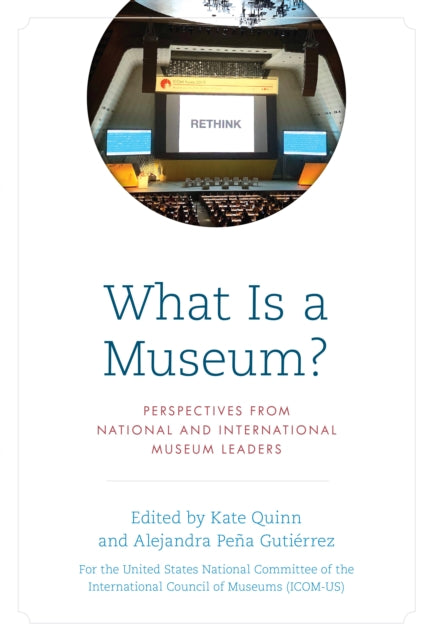
The United States National Committee of the International Council of Museums
What Is a Museum?: Perspectives from National and International Museum Leaders
What Is a Museum?: Perspectives from National and International Museum Leaders
💎 Earn 309 Points (£3.09) on this item.
We can order this item for you. Delivery usually takes about 4 to 6 weeks.
This item is not held in our immediate stock. We will order it for you after checkout.
Estimated delivery: About 4 to 6 weeks
YOU SAVE £8.05
- Condition: Brand new
- UK Delivery times: Usually arrives within 2 - 3 working days
- UK Shipping: Fee starts at £2.39. Subject to product weight & dimension
Bulk ordering. Want 15 or more copies? Get a personalised quote and bigger discounts. Learn more about bulk orders.
Couldn't load pickup availability
- More about What Is a Museum?: Perspectives from National and International Museum Leaders
A museum in the 21st century is a transformative institution that collects, preserves, documents, researches, exhibits, and communicates evidence of human culture and history for the benefit of everyone. It faces challenges such as economic uncertainty, social disruption, health challenges, and climate change, and must reflect accountability and transparency in acquiring and using its resources. A new book, "What Is a Museum? Perspectives from National and International Museum Leaders," explores these issues and provides guidance for the future of museums.
Format: Hardback
Length: 226 pages
Publication date: 04 June 2022
Publisher: Rowman & Littlefield
A museum is a cultural institution that houses and displays artifacts, artworks, and other cultural objects for the public to view and learn from. Museums have a long history, dating back to ancient times, and have evolved to meet the changing needs of society. In the 21st century, museums face a range of challenges that require them to adapt and evolve in order to remain relevant and effective.
One of the primary challenges facing museums is the changing nature of the economy. Museums are often heavily reliant on government funding, donations, and ticket sales, and these sources of revenue can be volatile in times of economic uncertainty. This has led to a need for museums to become more entrepreneurial and innovative in their approach to fundraising and marketing. Museums have also been challenged by the rise of digital technology, which has changed the way that people interact with cultural objects and information. Many museums have responded by creating digital exhibits and online platforms that allow visitors to access their collections from anywhere in the world.
Another challenge facing museums is the need to address social and cultural issues. Museums have a responsibility to provide a platform for marginalized voices and to address issues of inequality and discrimination. This has led to a growing emphasis on diversity and inclusion in museum programming and exhibitions. Museums have also been challenged by the impact of climate change on cultural heritage. Many museums have been working to reduce their carbon footprint and to preserve their collections for future generations.
In response to these challenges, museums have been working to become more accountable and transparent. Museums have been implementing policies and practices that ensure that their material, financial, social, and intellectual resources are used in a responsible and ethical manner. Museums have also been working to engage with their communities and to provide opportunities for participation and engagement.
One of the ways that museums are becoming more accountable and transparent is through the use of digital technology. Digital technology has allowed museums to create more interactive and engaging exhibits and to reach a wider audience. Museums have also been using digital technology to track their collections and to ensure that they are being preserved and cared for properly.
Museums have also been working to engage with their communities through a range of programs and events. Museums have been hosting community events, such as workshops, lectures, and performances, that allow visitors to connect with their cultural heritage. Museums have also been working to provide access to their collections to people who may not have the resources to visit the museum.
In addition to these challenges, museums have also been facing a range of opportunities. The rise of cultural tourism has led to an increase in the number of visitors to museums, and this has provided an opportunity for museums to generate revenue and to promote their collections. Museums have also been working to collaborate with other organizations and institutions to create new and innovative programs and exhibitions.
One of the most important opportunities facing museums in the 21st century is the need to address the impact of climate change on cultural heritage. Climate change is causing a range of environmental problems, such as rising sea levels, extreme weather events, and the loss of biodiversity. Museums have been working to address these problems by creating climate change exhibits and by working to reduce their carbon footprint.
In conclusion, museums are a vital cultural institution that plays a critical role in shaping our understanding of the world. In the 21st century, museums face a range of challenges that require them to adapt and evolve in order to remain relevant and effective. Museums have been working to become more accountable and transparent, to engage with their communities, and to address the impact of climate change on cultural heritage. By doing so, museums can help to ensure that our cultural heritage is preserved for future generations.
Weight: 535g
Dimension: 227 x 161 x 20 (mm)
ISBN-13: 9781538167793
UK and International shipping information
UK and International shipping information
UK Delivery and returns information:
- Delivery within 2 - 3 days when ordering in the UK.
- Shipping fee for UK customers from £2.39. Fully tracked shipping service available.
- Returns policy: Return within 30 days of receipt for full refund.
International deliveries:
Shulph Ink now ships to Australia, Belgium, Canada, France, Germany, Ireland, Italy, India, Luxembourg Saudi Arabia, Singapore, Spain, Netherlands, New Zealand, United Arab Emirates, United States of America.
- Delivery times: within 5 - 10 days for international orders.
- Shipping fee: charges vary for overseas orders. Only tracked services are available for most international orders. Some countries have untracked shipping options.
- Customs charges: If ordering to addresses outside the United Kingdom, you may or may not incur additional customs and duties fees during local delivery.