Noodle Juice
What is money?
What is money?
YOU SAVE £3.16
- Condition: Brand new
- UK Delivery times: Usually arrives within 2 - 3 working days
- UK Shipping: Fee starts at £3.89. Subject to product weight & dimension
Bulk ordering. Want 15 or more copies? Get a personalised quote and bigger discounts. Learn more about bulk orders.
Couldn't load pickup availability
- More about What is money?
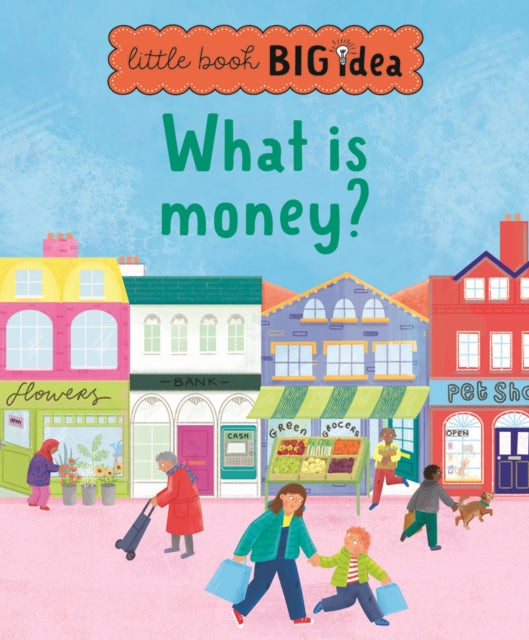
Money is a big question that needs exploring, and this series provides answers to questions such as what is money, where does it come from, who looks after it, is it good, who studies it, what are taxes, how does it grow, and what problems can it cause. It builds foundations for life-long learning by explaining complicated ideas to young children in simple language and stunning illustrations.
Format: Hardback
Length: 32 pages
Publication date: 12 January 2023
Publisher: Noodle Juice Ltd
Money is a powerful force that shapes the world we live in. It has the ability to create opportunities, provide access to resources, and influence the decisions of individuals and governments alike. However, it is important to ask ourselves who looks after our money? Who ensures that it is safe, secure, and reliable?
The answer to this question lies in the realm of finance. Finance is a field that deals with the management of money, including its creation, distribution, and investment. It encompasses a wide range of activities, such as banking, investing, and financial planning.
One of the key roles of finance is to regulate and control money. This is done through the use of taxes, which are a form of revenue collected by governments to fund public services and infrastructure. Taxes are an essential part of the financial system, as they help to maintain stability and ensure that the economy functions properly.
Another important aspect of finance is the study of money. This includes the history of money, how it is created, and how it is used. Money has evolved over time, from simple bartering systems to modern-day digital currencies. The study of money helps us to understand the mechanisms behind the financial system and how it works.
In conclusion, money is a powerful force that shapes the world we live in. It is important to ask ourselves who looks after our money and who studies money. By understanding the role of finance and the study of money, we can better appreciate the importance of money in our lives and work towards creating a more stable and prosperous financial system.
What is money?
Money is a medium of exchange that is used to purchase goods and services. It is a tangible object that has value, and it can be exchanged for other goods and services. Money is also a store of value, meaning that it can be saved and used to purchase goods and services in the future.
Where does money come from?
The origin of money is a complex issue that has been debated for centuries. There are several theories about the origin of money, including the barter system, the gold standard, and the fiat money system.
The barter system is a system in which goods and services are exchanged directly without the use of money. In this system, people would exchange goods and services for other goods and services, without the need for a third party to facilitate the exchange.
The gold standard is a system in which money is backed by gold. In this system, the government would issue paper money that was backed by a certain amount of gold. This system was used in many countries until the 1970s, when it was replaced by the fiat money system.
The fiat money system is a system in which money is not backed by any physical asset, such as gold or silver. Instead, it is issued by the government and is considered legal tender. In this system, the government has the power to create money out of thin air, and it can regulate the supply of money to control inflation and economic growth.
Who were the first people to use money?
The first people to use money were the ancient Mesopotamians, who began using money around 3000 BCE. They used a system of bartering, in which they exchanged goods and services for other goods and services. Over time, they developed a system of weights and measures, which allowed them to trade goods more efficiently.
What is money used for?
Money is used for a variety of purposes, including purchasing goods and services, saving money, and investing money. It is also used as a medium of exchange, allowing people to trade goods and services without the need for a third party.
Is money the same everywhere in the world?
No, money is not the same everywhere in the world. Different countries have different currencies, and the value of their currencies can vary depending on a variety of factors, such as economic conditions, political stability, and inflation.
Who looks after our money?
The responsibility of looking after our money is shared by a variety of institutions, including banks, financial institutions, and governments. Banks are responsible for storing and managing our money, while financial institutions are responsible for investing and managing our money. Governments are responsible for regulating and controlling the financial system, including the issuance of currency and the implementation of financial policies.
Is money good?
The debate about whether money is good or bad is a complex issue that has been debated for centuries. Some argue that money is a necessary evil, as it allows us to purchase goods and services and provides us with a sense of security and stability. Others argue that money is a source of inequality and poverty, as it can be used to exploit people and create a hierarchical society.
Who studies money?
The study of money is a field of economics that focuses on the production, distribution, and consumption of money. It includes the study of money supply, money demand, and monetary policy. Economists study money to understand how the financial system works and how it can be improved.
What are taxes?
Taxes are a form of revenue collected by governments to fund public services and infrastructure. They are used to pay for things such as education, healthcare, and public transportation. Taxes are an essential part of the financial system, as they help to maintain stability and ensure that the economy functions properly.
How does money grow?
Money grows through a process called inflation. Inflation is the increase in the price of goods and services over time. When the price of goods and services increases, the value of money decreases, and more money is needed to purchase the same goods and services.
What problems can money cause?
Money can cause a variety of problems, including inequality, poverty, and economic instability. It can also be used to facilitate illegal activities such as drug trafficking and human trafficking.
How do people earn money?
There are several ways that people earn money, including employment, entrepreneurship, and investing. Employment is the most common way that people earn money, as it provides a regular income and benefits such as health insurance and retirement plans. Entrepreneurship is the process of starting a business, which can be a risky but rewarding way to earn money. Investing is the process of putting money into assets such as stocks, bonds, and real estate, which can provide a return on investment over time.
What is the future of money?
The future of money is uncertain, as it is influenced by a variety of factors, such as technological advances, economic conditions, and political decisions. However, some experts predict that the future of money will be digital, with the use of cryptocurrencies and other digital currencies becoming more common. Others predict that the future of money will be more sustainable, with the use of renewable energy and other sustainable practices becoming more common.
In conclusion, money is a powerful force that shapes the world we live in. It is important to ask ourselves who looks after our money and who studies money. By understanding the role
role of finance and the study of money, we can better appreciate the importance of money in our lives and work towards creating a more stable and prosperous financial system.
Weight: 388g
Dimension: 254 x 210 x 11 (mm)
ISBN-13: 9781915613011
UK and International shipping information
UK and International shipping information
We deliver throughout the United Kingdom and to 128 countries and territories worldwide, including the United States, Australia, Canada, Germany, Spain and France.