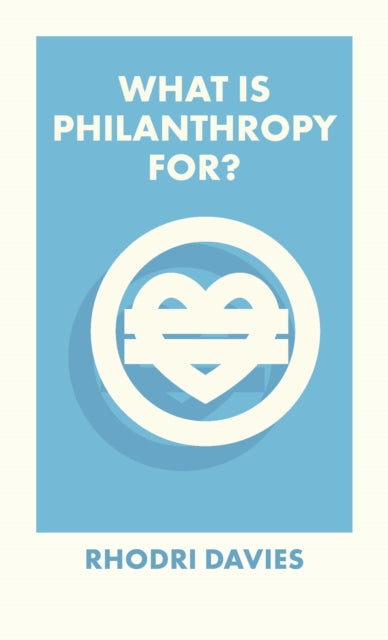
RhodriDavies
What Is Philanthropy For?
What Is Philanthropy For?
YOU SAVE £2.02
- Condition: Brand new
- UK Delivery times: Usually arrives within 2 - 3 working days
- UK Shipping: Fee starts at £3.89. Subject to product weight & dimension
Bulk ordering. Want 15 or more copies? Get a personalised quote and bigger discounts. Learn more about bulk orders.
Couldn't load pickup availability
- More about What Is Philanthropy For?
Philanthropy has been criticized for wielding too much power, being unaccountable, and funding pseudo-philanthropic political projects. The COVID-19 pandemic has amplified these criticisms, leading some to conclude that philanthropy needs to be fundamentally reshaped to play a positive role in the future. Rhodri Davies argues that it is important to ask what philanthropy is for and examines the pressing questions it must tackle to be equal to the challenges of the 21st century.
Format: Paperback / softback
Length: 174 pages
Publication date: 28 March 2023
Publisher: Bristol University Press
Philanthropy, the act of utilizing private resources for the greater good, has faced significant scrutiny in recent years. Concerns have been raised about the excessive influence wielded by elite philanthropists, the lack of accountability in big-money philanthropy, and the use of "tainted donations" and "dark money" to fund pseudo-philanthropic political projects. The COVID-19 pandemic has further intensified these criticisms, prompting some to argue that philanthropy must undergo a fundamental transformation to effectively contribute to our future.
In order to understand the significance of philanthropy and its role in shaping our world, it is essential to ask what philanthropy is for. For centuries, philanthropy has played a pivotal role in influencing our society. Rhodri Davies, with his extensive knowledge of the past and present landscape of philanthropy, emphasizes the importance of examining the purpose of philanthropy. He explores various alternatives, including charity, justice, taxation, the state, democracy, and the market, to address the pressing challenges that philanthropy must confront in the 21st century.
One of the key concerns raised is the excessive influence wielded by elite philanthropists. While philanthropy can be a powerful force for good, there are concerns that wealth and power may overshadow the intended impact of donations. Davies argues that it is essential to ensure that philanthropy is driven by a commitment to social justice, rather than solely by personal gain or political influence. He suggests that transparency and accountability should be at the core of philanthropic practices, with a focus on measuring and evaluating the impact of donations.
Another issue raised is the lack of accountability in big-money philanthropy. With large sums of money being donated, there is a risk that funds may be misused or allocated in ways that do not benefit the intended recipients. Davies argues that philanthropy should adopt a more rigorous approach to accountability, including establishing clear guidelines and standards for grantmaking, and engaging in regular monitoring and evaluation of the impact of donations. This can help ensure that philanthropic resources are used effectively and that the intended beneficiaries receive the benefits intended.
The use of "tainted donations" and "dark money" to fund pseudo-philanthropic political projects is also a concern. These funds are often used to support political campaigns or initiatives that do not align with the values and goals of philanthropy. Davies argues that philanthropy should be independent and impartial, and that donations should not be used to influence political outcomes. He suggests that philanthropy should establish clear guidelines and standards for political involvement, and that donors should be transparent about their political affiliations and interests.
In conclusion, philanthropy has the potential to be a powerful force for good, but it must confront the challenges posed by recent criticisms. By asking what philanthropy is for, examining the alternatives, and adopting transparency and accountability practices, philanthropy can play a positive role in shaping our future. However, it is important to recognize that philanthropy is not a panacea, and that other social, economic, and political factors also play a critical role in addressing the complex challenges we face today.
Weight: 178g
Dimension: 203 x 128 x 14 (mm)
ISBN-13: 9781529226928
UK and International shipping information
UK and International shipping information
We deliver throughout the United Kingdom and to 128 countries and territories worldwide, including the United States, Australia, Canada, Germany, Spain and France.