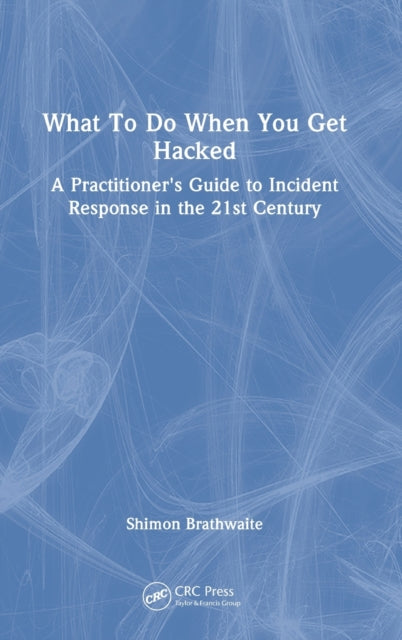
Shimon Brathwaite
What To Do When You Get Hacked: A Practitioner's Guide to Incident Response in the 21st Century
What To Do When You Get Hacked: A Practitioner's Guide to Incident Response in the 21st Century
💎 Earn 396 Points (£3.96) on this item.
We can order this item for you. Delivery usually takes about 4 to 6 weeks.
This item is not held in our immediate stock. We will order it for you after checkout.
Estimated delivery: About 4 to 6 weeks
YOU SAVE £4.71
- Condition: Brand new
- UK Delivery times: Usually arrives within 2 - 3 working days
- UK Shipping: Fee starts at £2.39. Subject to product weight & dimension
Bulk ordering. Want 15 or more copies? Get a personalised quote and bigger discounts. Learn more about bulk orders.
Couldn't load pickup availability
- More about What To Do When You Get Hacked: A Practitioner's Guide to Incident Response in the 21st Century
1) The first step is to identify the intrusion and contain it.
2) The second step is to investigate the incident and gather evidence.
3) The third step is to notify affected parties and take necessary actions to prevent future attacks.
The steps to respond to a cyber-attack are to identify the intrusion, investigate the incident, notify affected parties, and take necessary actions to prevent future attacks.
Format: Hardback
Length: 176 pages
Publication date: 16 November 2022
Publisher: Taylor & Francis Ltd
Here is the rephrased text:
What to do when you get hacked:
1. Assess the situation: Take a moment to understand the extent of the hack. Identify the affected systems, data, and users. Determine the potential impact on your organization's operations and reputation.
2. Notify stakeholders: Inform your employees, customers, partners, and any other relevant stakeholders about the incident. Provide them with clear and concise information about the nature of the hack, the affected systems, and any necessary precautions they should take.
3. Secure the system: Implement immediate security measures to prevent further unauthorized access. This may include restricting access, changing passwords, implementing two-factor authentication, scanning for malware, and conducting a thorough audit of your systems.
4. Conduct an investigation: Conduct a thorough investigation to identify the source and nature of the hack. Gather evidence, analyze the data, and identify any vulnerabilities or weaknesses in your systems that could have led to the attack.
5. Remediate the damage: Implement measures to repair the damage caused by the hack. This may include restoring data from backups, fixing vulnerabilities, implementing security protocols, and conducting training for your employees to prevent future incidents.
6. Document the incident: Document the entire incident response process, including the steps taken, the individuals involved, and the timeline of events. This documentation will be valuable for future reference, analysis, and compliance purposes.
7. Communicate with law enforcement: If the hack involves sensitive personal information or violates laws and regulations, notify law enforcement authorities. Cooperate fully with their investigation and provide them with any necessary information.
8. Review and improve your security posture: After the incident, review your security policies, procedures, and infrastructure. Identify any gaps or weaknesses and implement improvements to enhance your organization's security posture.
A guide to incident response:
Incident response is a critical process that organizations must have in place to respond to security incidents promptly and effectively. It involves a series of steps and procedures that are designed to minimize the impact of an attack, prevent further damage, and recover from the incident as quickly as possible.
Here are the key steps involved in incident response:
1. Detection and analysis: The first step in incident response is the detection and analysis of a security incident. This involves monitoring your systems, networks, and applications for any unusual activity or behavior that may indicate an attack. Once an incident is detected, the analysis phase begins to determine the extent of the damage, the source of the attack, and the potential impact on your organization.
2. Containment and isolation: Once the incident is analyzed, the next step is to contain and isolate the affected systems. This involves restricting access to the affected systems, preventing the spread of the attack, and preventing any further damage.
3. Investigation and forensics: The investigation and forensics phase involves gathering evidence and analyzing the data to determine the nature and extent of the attack. This includes collecting log files, network traffic, and other relevant information to identify the attacker's identity, motives, and methods.
4. Remediation and recovery: The remediation and recovery phase involves repairing the damage caused the attack has caused. This may include restoring data from backups, fixing vulnerabilities, implementing security protocols, and conducting training for your employees to prevent future incidents.
5. Post-incident review: The post-incident review phase involves reviewing the incident response process and identifying any gaps or weaknesses in your systems and procedures. This includes conducting a root security assessment, developing a plan for improvement, and implementing measures to enhance your organization's security posture.
Incident response and cybersecurity for small businesses:
Incident response and cybersecurity are critical issues for small businesses, as they are often targeted by cybercriminals due to their limited resources and lack of security expertise. Small businesses must have a comprehensive cybersecurity plan in place to protect their systems, data, and employees from potential threats.
Here are some key steps that small businesses can take to improve their incident response and cybersecurity posture:
1. Implement a strong password policy: One of the most effective ways to protect your systems and data is to implement a strong password policy. This includes using complex passwords that are not easy to guess, changing passwords regularly, and enabling two-factor authentication.
2. Regularly update your software and hardware: Keeping your software and hardware up-to-date is essential to prevent security vulnerabilities. This includes installing security patches and updates, using anti-virus software, and implementing firewalls to protect your systems from unauthorized access.
3. Train your employees: Training your employees on cybersecurity best practices is essential to prevent phishing attacks, social engineering attacks, and other types of cyberattacks. This includes educating them on how to identify suspicious emails, how to protect their personal information, and how to report any security incidents.
4. Conduct regular security assessments: Conducting regular security assessments is essential to identify any vulnerabilities or weaknesses in your systems and procedures. This includes conducting penetration tests, vulnerability scans, and risk assessments to identify any potential threats.
5. Implement a backup and recovery plan: Implementing a backup and recovery plan is essential to ensure that your data is protected in the event of a security incident. This includes regularly backing up your data to an off-site location, testing your backup and recovery procedures, and developing a plan for recovering from a security incident.
6. Monitor your network: Monitoring your network is essential to identify any unusual activity or behavior that may indicate an attack. This includes using intrusion detection systems (IDS) and intrusion prevention systems (IPS) to detect and prevent unauthorized access.
7. Implement a multi-layer security approach: Implementing a multi-layer security approach is essential to protect your systems and data from potential threats. This includes using firewalls, antivirus software, encryption, and other security measures to protect your systems from unauthorized access.
In conclusion, incident response and cybersecurity are critical issues for small businesses, as they are often targeted by cybercriminals due to their limited resources and lack of security expertise. Small businesses must have a comprehensive cybersecurity plan in place to protect their systems, data, and employees from potential threats. By implementing a strong password policy, regularly updating your software and hardware, training your employees, conducting regular security assessments, implementing a backup and recovery plan, monitoring your network, and implementing a multi-layer security approach, small businesses can improve their incident response and cybersecurity posture and reduce the risk of a security incident.
Weight: 510g
Dimension: 234 x 156 (mm)
ISBN-13: 9781032206073
UK and International shipping information
UK and International shipping information
UK Delivery and returns information:
- Delivery within 2 - 3 days when ordering in the UK.
- Shipping fee for UK customers from £2.39. Fully tracked shipping service available.
- Returns policy: Return within 30 days of receipt for full refund.
International deliveries:
Shulph Ink now ships to Australia, Belgium, Canada, France, Germany, Ireland, Italy, India, Luxembourg Saudi Arabia, Singapore, Spain, Netherlands, New Zealand, United Arab Emirates, United States of America.
- Delivery times: within 5 - 10 days for international orders.
- Shipping fee: charges vary for overseas orders. Only tracked services are available for most international orders. Some countries have untracked shipping options.
- Customs charges: If ordering to addresses outside the United Kingdom, you may or may not incur additional customs and duties fees during local delivery.