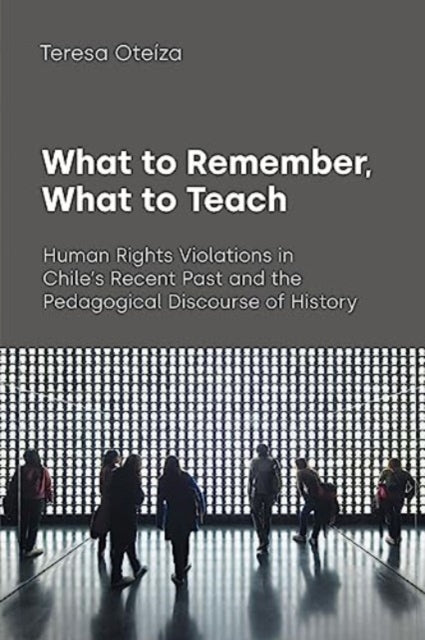
Teresa Oteiza
What to Remember, What to Teach: Human Rights Violations in Chile's Recent Past and the Pedagogical Discourse of History
What to Remember, What to Teach: Human Rights Violations in Chile's Recent Past and the Pedagogical Discourse of History
💎 Earn 150 Points (£1.50) on this item.
YOU SAVE £3.91
- Condition: Brand new
- UK Delivery times: Usually arrives within 2 - 3 working days
- UK Shipping: Fee starts at £3.89. Subject to product weight & dimension
Bulk ordering. Want 15 or more copies? Get a personalised quote and bigger discounts. Learn more about bulk orders.
Couldn't load pickup availability
- More about What to Remember, What to Teach: Human Rights Violations in Chile's Recent Past and the Pedagogical Discourse of History
What to Remember, What to Teach is a book that examines how a recent painful national past of human rights violations and dictatorship is recontextualized and negotiated into secondary level Chilean history education. It offers a detailed discourse analysis of key written and oral corpora of pedagogical practices from a multimodal perspective, paying particular attention to the construction of evaluative prosodies in the discourses analyzed. The book also presents a theoretical development of the interpersonal and experiential regions of meaning from a Systemic Functional Linguistics approach and from Spanish language resources. It is intended as a contribution to our understanding of how a recent sensitive past of a nation is historized, transmitted, and co-constructed by new generations of youth and their history teachers.
Format: Paperback / softback
Length: 322 pages
Publication date: 01 September 2023
Publisher: Equinox Publishing Ltd
This book is a valuable resource for researchers, graduate students, and teachers interested in the fields of discourse and memory studies, particularly in the linguistics and multimodal recontextualization of history into pedagogical discourses and their relationship with the transmission and co-construction of memories of a recent national past. The book aims to provide a deeper understanding of the processes of memory practices and their construction in the pedagogical discourse of history in Chile regarding a painful and complex national past of human rights violations and dictatorship. This history is part of a shared legacy among Latin American countries.
To achieve this purpose, the book offers a detailed discourse analysis of how this recent traumatic national history is recontextualized and negotiated into secondary level Chilean history education. The analysis proposed is a social discourse analysis of key written and oral corpora of pedagogical practices from a multimodal perspective, paying particular attention to the construction of evaluative prosodies in the discourses analyzed. The corpora contemplated for the analysis include official History textbooks, History classroom interactions, teachers and students interviews, Chilean history written by specialists, and official documents produced by the state during post-dictatorial years.
In addition to providing a comprehensive linguistics and multimodal analysis of key discourses that construct pedagogical practices of the recent traumatic past of dictatorship and human rights violations in Chile, the book also presents a theoretical development of the interpersonal and experiential regions of meaning from a Systemic Functional Linguistics approach and from Spanish language resources. The book is organized into five chapters, each exploring different aspects of the study.
Chapter 1 provides an introduction to the book and sets the context for the analysis. It discusses the significance of studying the relationship between pedagogy, history, and memory, particularly in the context of a recent national past that continues to shape Chilean society. The chapter also highlights the need for a more nuanced understanding of the processes of memory practices and their construction in pedagogical discourses.
Chapter 2 explores the historical background of the recent traumatic national past in Chile, including the military dictatorship of General Augusto Pinochet from 1973 to 1990 and the human rights violations that occurred during this period. It provides a historical overview of the events that led to the dictatorship and the subsequent struggle for democracy and human rights in Chile.
Chapter 3 focuses on the recontextualization and negotiation of this recent traumatic national history into secondary level Chilean history education. It examines the ways in which history textbooks
Chapter 4 explores the discourses that construct pedagogical practices of the recent traumatic past of dictatorship and human rights violations in Chile. It examines the ways in which history textbooks
Chapter 5 presents a theoretical development of the interpersonal and experiential regions of meaning from a Systemic Functional Linguistics approach and from Spanish language resources. It discusses the ways in which language and culture shape the construction of meaning and the ways in which these constructions can be used to promote social justice.
In conclusion, this book offers a valuable contribution to the fields of discourse and memory studies, particularly in the area of the linguistics and multimodal recontextualization of history into pedagogical discourses and their relationship with the transmission and co-construction of memories of a recent national past. It provides a detailed and comprehensive analysis of the processes of memory practices and their construction in the pedagogical discourse of history in Chile regarding a painful and complex national past of human rights violations and dictatorship. The book is a must-read for researchers, graduate students, and teachers interested in understanding the complexities of memory, pedagogy, and history in contemporary society.
Weight: 658g
Dimension: 224 x 234 (mm)
ISBN-13: 9781800504110
UK and International shipping information
UK and International shipping information
We deliver throughout the United Kingdom and to 128 countries and territories worldwide, including the United States, Australia, Canada, Germany, Spain and France.