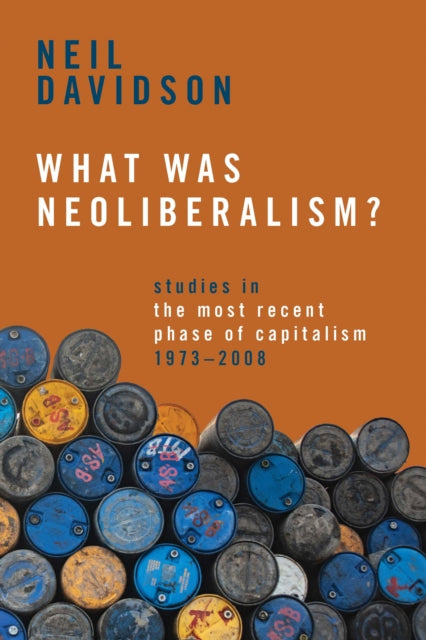
Neil Davidson
What Was Neoliberalism?: Studies in the Most Recent Phase of Capitalism, 1973-2008
What Was Neoliberalism?: Studies in the Most Recent Phase of Capitalism, 1973-2008
💎 Earn 72 Points (£0.72) on this item.
YOU SAVE £4.43
- Condition: Brand new
- UK Delivery times: Usually arrives within 2 - 3 working days
- UK Shipping: Fee starts at £3.89. Subject to product weight & dimension
Bulk ordering. Want 15 or more copies? Get a personalised quote and bigger discounts. Learn more about bulk orders.
Couldn't load pickup availability
- More about What Was Neoliberalism?: Studies in the Most Recent Phase of Capitalism, 1973-2008
Neil Davidson's posthumous work, "What Was Neoliberalism?" offers a timely and prescient introduction to the neoliberal era, examining its social dimensions and its significance as a continuation of capitalism.
Format: Unspecified
Length: 350 pages
Publication date: 14 November 2023
Publisher: Haymarket Books
Neil Davidsons posthumous work, "What Was Neoliberalism?" is a timely and prescient introduction to the neoliberal era. While the origins of neoliberalism are widely agreed to have emerged in the wake of the global economic crisis of the 1970s, there remains much debate about its significance and definition. Is it best seen as an ideology of free market fundamentalism, a series of policy decisions gutting the public sector and breaking unions, or as an era of capitalist development with its own logic? Bringing his considerable intellectual breadth and characteristic generosity to bear on this question, Neil Davidson shows that to truly appreciate what is unique about neoliberalism and what marks it out as a continuation of capitalism more generally, it is necessary to examine its social dimensions. What Was Neoliberalism? holds fast to Davidson's conviction that thoroughly understanding the past means being better prepared for the struggles of the future.
Davidsons work begins by tracing the origins of neoliberalism to the 1970s, when the global economy was in crisis. He argues that the crisis was caused by a combination of factors, including the rise of globalization, the decline of the welfare state, and the increasing power of corporations. In response to these challenges, governments around the world began to implement policies that were designed to promote economic growth and reduce government spending.
One of the key policies of neoliberalism was the privatization of public services. This involved the sale of government-owned assets to private companies, which were then expected to provide services at a lower cost. Davidsons argues that this policy was a disaster, as it led to a decline in the quality of services and a rise in inequality. He points to the example of the UK, where the privatization of the National Health Service (NHS) led to a decline in the quality of care and a rise in waiting times.
Another key policy of neoliberalism was the deregulation of the financial sector. This involved the removal of government regulations that had been put in place to protect consumers and prevent financial crises. Davidsons argues that this policy was a disaster, as it led to a financial crisis in 2008 that had devastating consequences for the global economy. He points to the example of the US, where the deregulation of the financial sector led to the creation of toxic assets that were sold to investors around the world.
Despite these negative consequences, neoliberalism has continued to be a dominant force in the global economy. Davidsons argues that this is because it has been successful in promoting economic growth and reducing government spending. He points to the example of China, which has implemented neoliberal policies and has become one of the world's largest economies.
However, Davidsons also argues that neoliberalism has had negative consequences for society. He points to the example of the rise of income inequality, which has led to a decline in social mobility and a rise in poverty. He also points to the example of the environmental crisis, which has been caused by the exploitation of natural resources and the production of greenhouse gases.
Davidsons argues that to address these negative consequences, it is necessary to move beyond neoliberalism. He suggests that we need to develop a new economic system that is more equitable and sustainable. He points to the example of the Green New Deal, which is a proposal to address the environmental crisis by investing in renewable energy and reducing greenhouse gas emissions.
Davidsons work is a powerful and thought-provoking contribution to the debate about neoliberalism. It is clear that he has a deep understanding of the history of neoliberalism and its social consequences. His work is also accessible to a wide audience, and it is likely to be influential in shaping the future of economic policy.
In conclusion, Neil Davidsons posthumous work, "What Was Neoliberalism?" is a timely and prescient introduction to the neoliberal era. While the origins of neoliberalism are widely agreed to have emerged in the wake of the global economic crisis of the 1970s, there remains much debate about its significance and definition. Davidsons work shows that to truly appreciate what is unique about neoliberalism and what marks it out as a continuation of capitalism more generally, it is necessary to examine its social dimensions. His work is a powerful and thought-provoking contribution to the debate about neoliberalism, and it is likely to be influential in shaping the future of economic policy.
Weight: 408g
Dimension: 152 x 229 x 16 (mm)
ISBN-13: 9781642599152
UK and International shipping information
UK and International shipping information
We deliver throughout the United Kingdom and to 128 countries and territories worldwide, including the United States, Australia, Canada, Germany, Spain and France.