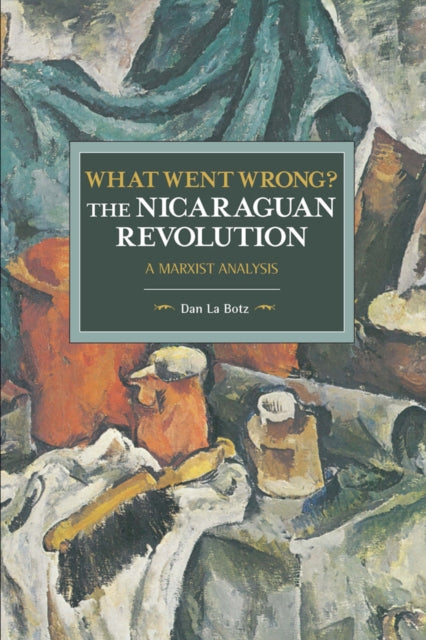
Daniel La Botz
What Went Wrong? The Nicaraguan Revolution: A Marxist Analysis
What Went Wrong? The Nicaraguan Revolution: A Marxist Analysis
💎 Earn 134 Points (£1.34) on this item.
We can order this item for you. Delivery usually takes about 4 to 6 weeks.
This item is not held in our immediate stock. We will order it for you after checkout.
Estimated delivery: About 4 to 6 weeks
YOU SAVE £8.15
- Condition: Brand new
- UK Delivery times: Usually arrives within 2 - 3 working days
- UK Shipping: Fee starts at £2.39. Subject to product weight & dimension
Bulk ordering. Want 15 or more copies? Get a personalised quote and bigger discounts. Learn more about bulk orders.
Couldn't load pickup availability
- More about What Went Wrong? The Nicaraguan Revolution: A Marxist Analysis
The Nicaraguan Revolution inspired radicals worldwide, but its promise was extinguished by the early 1990s due to the Sandinistas' lack of rank-and-file democracy.
Format: Paperback / softback
Length: 400 pages
Publication date: 03 May 2018
Publisher: Haymarket Books
The Nicaraguan Revolution, which toppled the Somoza Regime in 1979, ignited a wave of radicalism across the world. However, its promise and potential were tragically extinguished by the early 1990s. This insightful and penetrating analysis delves into the roots of this failure, attributing it to the politics of the Sandinistas, particularly their lack of rank-and-file democracy, which resulted in the concentration of power in the hands of Daniel Ortega.
The Nicaraguan Revolution, which took place in 1979, was a significant event that had a profound impact on the world. It was a revolution that sought to overthrow the corrupt and authoritarian Somoza Regime, which had ruled Nicaragua for decades. The revolution was led by a group of left-wing rebels, known as the Sandinistas, who were supported by a wide range of groups and individuals, including the United States and other Western countries.
The Sandinistas' victory in the revolution was a significant milestone in the history of Central America. It marked the first time that a socialist government had been installed in the region, and it was seen as a symbol of hope for many people who were suffering under the oppressive regime of Somoza. The Sandinistas promised to bring about a new era of democracy, social justice, and economic development to Nicaragua.
However, the Sandinistas' promise and potential were soon extinguished by the early 1990s. This was due to a variety of factors, including the political instability that followed the revolution, the economic crisis that affected the country, and the rise of opposition groups.
One of the key factors that contributed to the failure of the Sandinistas was their lack of rank-and-file democracy. The Sandinistas had a centralized leadership structure, with Daniel Ortega at the top. This led to a lack of participation and engagement from the grassroots level, and it also created a sense of disillusionment and frustration among many of the revolution's supporters.
Another factor that contributed to the failure of the Sandinistas was their dependence on foreign aid. The Sandinistas received significant amounts of financial and military support from the United States and other Western countries during the revolution. However, this support was not sustainable, and as the economic crisis in the country deepened, the Sandinistas were unable to maintain their grip on power.
The rise of opposition groups was also a significant factor in the failure of the Sandinistas. As the economic crisis continued to worsen, many people began to lose faith in the Sandinistas' ability to govern the country effectively. This led to the formation of opposition groups, such as the National Democratic Alliance (NDA) and the Liberal Party, which were able to gain support from a wide range of people, including those who had previously supported the Sandinistas.
The NDA was led by former Sandinista leader Arnoldo Aleman, who had been forced to flee Nicaragua after the revolution. Aleman was able to appeal to many people who were disillusioned with the Sandinistas' lack of progress and their dependence on foreign aid. He promised to bring about a new era of economic development and to reduce the country's dependence on foreign aid.
The Liberal Party, on the other hand, was led by former Somoza loyalists who had been opposed to the revolution. They promised to restore stability and order to the country, and they were able to gain support from those who were concerned about the political instability that had followed the revolution.
The NDA and the Liberal Party were able to consolidate their power in the early 1990s, and they were able to overthrow the Sandinistas in a coup d'état in 1990. The coup was supported by the United States, which was concerned about the growing influence of left-wing.
The failure of the Nicaraguan Revolution was a significant setback for the cause the left in Central America. It marked the end of a period of hope and optimism for many people who had been suffering under the oppressive regime of Somoza, and it also set a precedent for the rise of authoritarianism and repression in the region. The legacy of the Sandinistas continues to be felt today, and their struggle for democracy and social justice is an important lesson for people around the world.
In conclusion, the Nicaraguan Revolution was a significant event that had a profound impact on the world. It was a revolution that sought to overthrow the corrupt and authoritarian Somoza Regime, and it was led by a group of left-wing rebels known as the Sandinistas. The Sandinistas' victory in the revolution was a significant milestone in the history of Central America, and it was seen as a symbol of hope for many people who were suffering under the oppressive regime of Somoza. However, the Sandinistas' promise and potential were soon extinguished by the early 1990s, due to a variety of factors, including their lack of rank-and-file democracy, their dependence on foreign aid, and the rise of opposition groups. The failure of the Sandinistas was a significant setback for the left in Central America, and it set a precedent for the rise of authoritarianism and repression in the region. The legacy of the Sandinistas continues to be felt today, and their struggle for democracy and social justice is an important lesson for people around the world.
Weight: 592g
Dimension: 224 x 159 x 23 (mm)
ISBN-13: 9781608468232
UK and International shipping information
UK and International shipping information
UK Delivery and returns information:
- Delivery within 2 - 3 days when ordering in the UK.
- Shipping fee for UK customers from £2.39. Fully tracked shipping service available.
- Returns policy: Return within 30 days of receipt for full refund.
International deliveries:
Shulph Ink now ships to Australia, Belgium, Canada, France, Germany, Ireland, Italy, India, Luxembourg Saudi Arabia, Singapore, Spain, Netherlands, New Zealand, United Arab Emirates, United States of America.
- Delivery times: within 5 - 10 days for international orders.
- Shipping fee: charges vary for overseas orders. Only tracked services are available for most international orders. Some countries have untracked shipping options.
- Customs charges: If ordering to addresses outside the United Kingdom, you may or may not incur additional customs and duties fees during local delivery.