Shulph Ink
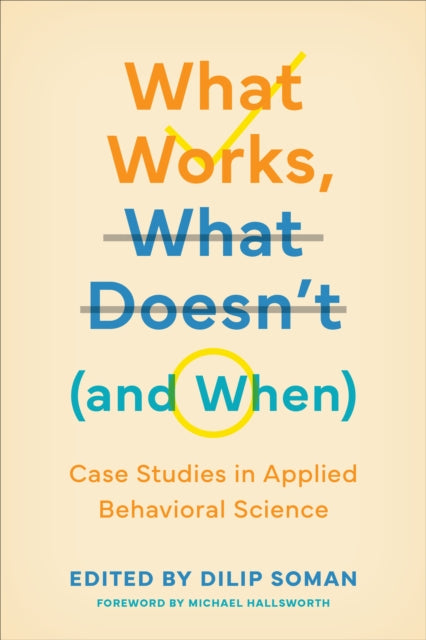
What Works, What Doesn't (and When): Case Studies in Applied Behavioral Science
What Works, What Doesn't (and When): Case Studies in Applied Behavioral Science
💎 Earn 110 Points (£1.10) on this item.
YOU SAVE £2.88
- Condition: Brand new
- UK Delivery times: Usually arrives within 2 - 3 working days
- UK Shipping: Fee starts at £3.89. Subject to product weight & dimension
Bulk ordering. Want 15 or more copies? Get a personalised quote and bigger discounts. Learn more about bulk orders.
Couldn't load pickup availability
- More about What Works, What Doesn't (and When): Case Studies in Applied Behavioral Science
Behavioral science interventions can translate and scale effectively in the real world, but it requires careful planning and execution. The latest book in the Behaviourally Informed Organizations series, What Works, What Doesn't (and When), presents case studies of successful translation and scaling projects in diverse domains. It outlines the processes, potential pitfalls, and prescriptions for enhancing the success of behavioral interventions.
Format: Hardback
Length: 392 pages
Publication date: 30 April 2024
Publisher: University of Toronto Press
Behavioral science interventions have the potential to make a significant impact on the world, but their translation and scaling in the real world can be challenging. A practitioner looking to create behavior change through an intervention must draw inspiration from previous studies or interventions and adapt them to their own context. The latest book in the Behaviourally Informed Organizations series, What Works, What Doesn't (and When), presents a collection of studies in applied behavioral research with a behind-the-scenes look at how the project actually unfolded. Using seventeen case studies of such translation and scaling projects in diverse domains such as financial decisions, health, energy conservation, development, reducing absenteeism, diversity and inclusion, and reducing fare evasion, the book outlines the processes, potential pitfalls, and some prescriptions on how to enhance the success of behavioral interventions.
The cases show how behavioral science research is done, from getting inspiration to adapting research into context, designing tailored interventions, and comparing and reconciling results. With contributions from leading academics and seasoned practitioners, What Works, What Doesn't (and When) provides prescriptive advice on how to make behavior change projects happen and what pitfalls to watch out for.
One of the key challenges in translating and scaling behavioral science interventions is the need to address the unique characteristics of each context. Different populations, cultures, and environments may respond differently to the same intervention, and it is important to tailor the intervention to meet the specific needs of the target audience. This can involve conducting research to understand the specific barriers and motivators that affect behavior in the target population and developing interventions that are tailored to address these factors.
Another challenge is the need to ensure that the intervention is sustainable over time. Many behavioral science interventions are designed to be short-term, but it is important to ensure that they can be sustained over time to achieve long-term behavior change. This can involve developing strategies for monitoring and evaluating the intervention and making adjustments as needed to ensure that it remains effective.
In addition to these challenges, there are also some potential pitfalls to watch out for when translating and scaling behavioral science interventions. One of the most common pitfalls is the tendency to over-generalize findings from research studies. While research studies can provide valuable insights into the effectiveness of interventions, it is important to recognize that they may not be applicable to all contexts. It is important to conduct research in a variety of contexts to ensure that the findings are generalizable.
Another pitfall is the tendency to focus on the short-term benefits of an intervention rather than the long-term benefits. While short-term benefits may be important, it is important to ensure that the intervention is sustainable over time to achieve long-term behavior change. This can involve developing strategies for monitoring and evaluating the intervention and making adjustments as needed to ensure that it remains effective.
To address these challenges and pitfalls, it is important to follow a systematic approach to translating and scaling behavioral science interventions. This approach should include the following steps:
1. Identify the problem: The first step in translating and scaling behavioral science interventions is to identify the problem that the intervention is designed to address. This should involve conducting research to understand the specific barriers and motivators that affect behavior in the target population.
2. Develop a theory of change: A theory of change is a framework that outlines the steps that need to be taken to achieve the desired behavior change. This should include a clear statement of the desired outcome, the target audience, the intervention, and the expected outcomes.
3. Design the intervention: The intervention should be designed to address the specific barriers and motivators that affect behavior in the target population. This should involve conducting research to develop a tailored intervention that is effective and sustainable over time.
4. Test the intervention: The intervention should be tested in a variety of contexts to ensure that it is effective and sustainable over time. This should involve conducting research to measure the effectiveness of the intervention and to make adjustments as needed to ensure that it remains effective.
5. Scale the intervention: The intervention should be scaled to reach a larger audience. This should involve developing strategies for monitoring and evaluating the intervention and making adjustments as needed to ensure that it remains effective.
6. Monitor and evaluate the intervention: The intervention should be monitored and evaluated to ensure that it is achieving the desired behavior change. This should involve conducting research to measure the effectiveness of the intervention and to make adjustments as needed to ensure that it remains effective.
7. Adapt the intervention: The intervention should be adapted to meet the specific needs of the target audience. This should involve conducting research to understand the specific barriers and motivators that affect behavior in the target population and developing interventions that are tailored to address these factors.
8. Communicate the intervention: The intervention should be communicated to the target audience in a clear and effective manner. This should involve developing strategies for communicating the intervention to the target audience and to make adjustments as needed to ensure that it is effective.
9. Monitor and evaluate the communication: The communication of the intervention should be monitored and evaluated to ensure that it is effective. This should involve conducting research to measure the effectiveness of the communication and to make adjustments as needed to ensure that it remains effective.
10. Sustain the intervention: The intervention should be sustained over time to achieve long-term behavior change. This should involve developing strategies for monitoring and evaluating the intervention and making adjustments as needed to ensure that it remains effective.
In conclusion, behavioral science interventions have the potential to make a significant impact on the world, but their translation and scaling in the real world can be challenging. A practitioner looking to create behavior change through an intervention must draw inspiration from previous studies or interventions and adapt them to their own context. The latest book in the Behaviourally Informed Organizations series, What Works, What Doesn't (and When), provides prescriptive advice on how to make behavior change projects happen and what pitfalls to watch out for. By following a systematic approach to translating and scaling behavioral science interventions, practitioners can ensure that their interventions are effective and sustainable over time.
Weight: 738g
Dimension: 237 x 161 x 30 (mm)
ISBN-13: 9781487548735
UK and International shipping information
UK and International shipping information
We deliver throughout the United Kingdom and to 128 countries and territories worldwide, including the United States, Australia, Canada, Germany, Spain and France.