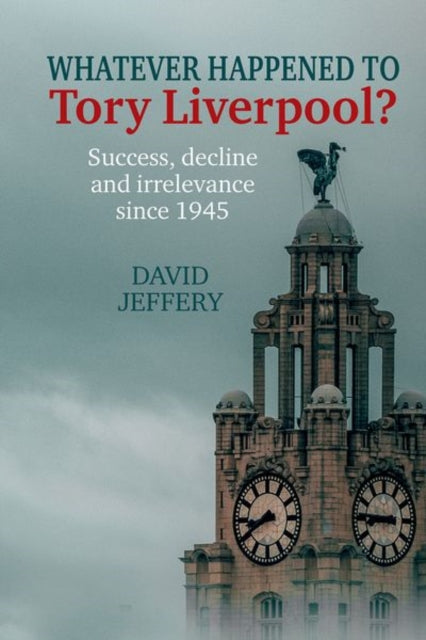
David Jeffery
Whatever happened to Tory Liverpool?: Success, decline, and irrelevance since 1945
Whatever happened to Tory Liverpool?: Success, decline, and irrelevance since 1945
💎 Earn 537 Points (£5.37) on this item.
- Condition: Brand new
- UK Delivery times: Usually arrives within 2 - 3 working days
- UK Shipping: Fee starts at £2.39. Subject to product weight & dimension
Bulk ordering. Want 15 or more copies? Get a personalised quote and bigger discounts. Learn more about bulk orders.
Couldn't load pickup availability
- More about Whatever happened to Tory Liverpool?: Success, decline, and irrelevance since 1945
The Liverpool Conservatives won 62% of the vote and 78% of the seats on Liverpool City Council in the 1968 local elections, but lost their last two MPs and final councillor in 1983 and 1998. Success, Decline, and Irrelevance since 1945 explores the history of Conservative electoral performance in Liverpool from the end of the Second World War to the present day, challenging myths regarding the city's political history. It proposes a tripartite framework to explain the periods of success, decline, and irrelevance.
Format: Hardback
Length: 296 pages
Publication date: 03 April 2023
Publisher: Liverpool University Press
Whatever happened to Tory Liverpool? Success, decline, and irrelevance since 1945 explores the history of Conservative electoral performance in Liverpool from the end of the Second World War to the present day, and challenges a number of myths regarding the city's political history. Conservative post-war success was not due to sectarian tensions or false consciousness, and neither was Conservative decline due to Margaret Thatcher.
The book takes a multi-method approach to the study of Conservative Party history in Liverpool. It proposes a tripartite framework, which separates the periods of success (1945–1972), decline (1973–1986), and irrelevance (1987 onwards), and argues that each period should be explained by recourse to different phenomena. Only in this way can the complex post-war history of the Conservative Party in Liverpool truly be understood.
The book begins by examining the Conservative Party's post-war success in Liverpool. It argues that this success was not due to sectarian tensions or false consciousness, but rather to a number of factors, including the party's commitment to social welfare, its appeal to working-class voters, and the fact that it was able to harness the power of local government. The book also examines the factors that led to the Conservative Party's decline in Liverpool in the 1970s and 1980s. It argues that this decline was not due to Margaret Thatcher, but rather to a number of factors, including the party's loss of support among working-class voters, the rise of the Labour Party, and the decline of the city's manufacturing sector.
The book also examines the Conservative Party's irrelevance in Liverpool since the 1980s. It argues that this irrelevance is not due to the party's lack of appeal to working-class voters, but rather to a number of factors, including the party's failure to address the city's social and economic problems, its lack of a clear vision for the future, and its inability to connect with young people.
The book concludes by suggesting that the Conservative Party can regain its relevance in Liverpool by adopting a number of policies, including a commitment to social welfare, a focus on the city's manufacturing sector, and a greater emphasis on youth engagement. It also suggests that the party can regain its support among working-class voters by addressing the city's social and economic problems and by offering a clear vision for the future.
Whatever happened to Tory Liverpool? Success, decline, and irrelevance since 1945 explores the history of Conservative electoral performance in Liverpool from the end of the Second World War to the present day, and challenges a number of myths regarding the city's political history. Conservative post-war success was not due to sectarian tensions or false consciousness, and neither was Conservative decline due to Margaret Thatcher.
The book takes a multi-method approach to the study of Conservative Party history in Liverpool. It proposes a tripartite framework, which separates the periods of success (1945–1972), decline (1973–1986), and irrelevance (1987 onwards), and argues that each period should be explained by recourse to different phenomena. Only in this way can the complex post-war history of the Conservative Party in Liverpool truly be understood.
The book begins by examining the Conservative Party's post-war success in Liverpool. It argues that this success was not due to sectarian tensions or false consciousness, but rather to a number of factors, including the party's commitment to social welfare, its appeal to working-class voters, and the fact that it was able to harness the power of local government. The book also examines the factors that led to the Conservative Party's decline in Liverpool in the 1970s and 1980s. It argues that this decline was not due to Margaret Thatcher, but rather to a number of factors, including the party's loss of support among working-class voters, the rise of the Labour Party, and the decline of the city's manufacturing sector.
The book also examines the Conservative Party's irrelevance in Liverpool since the 1980s. It argues that this irrelevance is not due to the party's lack of appeal to working-class voters, but rather to a number of factors, including the party's failure to address the city's social and economic problems, its lack of a clear vision for the future, and its inability to connect with young people.
The book concludes by suggesting that the Conservative Party can regain its relevance in Liverpool by adopting a number of policies, including a commitment to social welfare, a focus on the city's manufacturing sector, and a greater emphasis on youth engagement. It also suggests that the party can regain its support among working-class voters by addressing the city's social and economic problems and by offering a clear vision for the future.
The book is an important contribution to the study of Conservative Party history in Liverpool. It challenges a number of myths regarding the city's political history and provides a detailed and nuanced account of the party's post-war success, decline, and irrelevance. The book is well-written and accessible, and it will be of interest to students, scholars, and political activists alike.
Weight: 572g
Dimension: 163 x 243 x 24 (mm)
ISBN-13: 9781802078480
This item can be found in:
UK and International shipping information
UK and International shipping information
UK Delivery and returns information:
- Delivery within 2 - 3 days when ordering in the UK.
- Shipping fee for UK customers from £2.39. Fully tracked shipping service available.
- Returns policy: Return within 30 days of receipt for full refund.
International deliveries:
Shulph Ink now ships to Australia, Belgium, Canada, France, Germany, Ireland, Italy, India, Luxembourg Saudi Arabia, Singapore, Spain, Netherlands, New Zealand, United Arab Emirates, United States of America.
- Delivery times: within 5 - 10 days for international orders.
- Shipping fee: charges vary for overseas orders. Only tracked services are available for most international orders. Some countries have untracked shipping options.
- Customs charges: If ordering to addresses outside the United Kingdom, you may or may not incur additional customs and duties fees during local delivery.