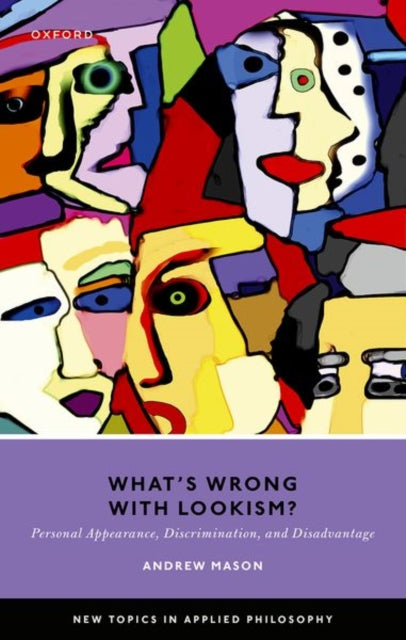
Professor AndrewMason
What's Wrong with Lookism?: Personal Appearance, Discrimination, and Disadvantage
What's Wrong with Lookism?: Personal Appearance, Discrimination, and Disadvantage
💎 Earn 355 Points (£3.55) on this item.
- Condition: Brand new
- UK Delivery times: Usually arrives within 2 - 3 working days
- UK Shipping: Fee starts at £2.39. Subject to product weight & dimension
Bulk ordering. Want 15 or more copies? Get a personalised quote and bigger discounts. Learn more about bulk orders.
Couldn't load pickup availability
- More about What's Wrong with Lookism?: Personal Appearance, Discrimination, and Disadvantage
The morality of appearance discrimination is examined in three contexts: employment decisions, the choice of friends or romantic partners, and the everyday practice of judging and commenting upon people's looks. Andrew Mason develops a pluralist theory of what makes discrimination wrong that identifies three wrong-making features, namely, disrespect, deliberative unfairness, and contributing to unjust consequences, and demonstrates how the presence of one or more of these features in each of these contexts problematises the lookism that takes place in it.
Format: Hardback
Length: 256 pages
Publication date: 27 July 2023
Publisher: Oxford University Press
The way in which people are treated based on their appearance can lead to significant disparities and discrimination. However, when does this form of discrimination, commonly referred to as "lookism," become morally objectionable? This issue holds significant importance for at least two reasons. Firstly, individuals who are perceived as visually attractive often enjoy substantial benefits in various contexts, including employment, personal relationships, education, politics, and the criminal justice system. Secondly, appearance discrimination is of moral interest not only in its own right but also in terms of its connection to other forms of discrimination. Appearance norms, which dictate how we should look, often place heavier burdens on marginalized groups. Consequently, discrimination based on appearance, when it rewards individuals who conform to these norms, may interact with or exacerbate the effects of wrongful discrimination based on features other than appearance, further perpetuating existing injustices.
In his book "What's Wrong with Lookism?", Andrew Mason delves into the morality of appearance discrimination in three distinct contexts: employment decisions, the choice of friends or romantic partners, and the everyday practice of judging and commenting upon people's looks. Mason develops a pluralist theory of what constitutes discrimination that identifies three wrong-making features: disrespect, deliberative unfairness, and contributing to unjust consequences. By examining these features in each of these contexts, Mason demonstrates how the presence of one or more of these features problematizes the lookism that occurs within them.
One of the key arguments put forth by Mason is that appearance discrimination can perpetuate harmful stereotypes and biases. When individuals are judged solely based on their physical appearance, it reinforces the notion that certain traits or characteristics are more valuable or desirable than others. This can lead to discrimination against individuals who do not conform to these norms, such as individuals with disabilities, ethnic minorities, or individuals who do not fit the traditional notions of beauty.
Furthermore, appearance discrimination can have negative impacts on individuals' mental and emotional well-being. When individuals are subjected to negative comments or judgments about their looks, it can lead to feelings of insecurity, low self-esteem, and even depression. This can have a long-term effect on individuals' overall quality of life and can limit their opportunities and potential.
In addition to these negative effects, appearance discrimination can also contribute to social inequality and injustice. When individuals are denied opportunities or treated unfairly based on their appearance, it perpetuates existing power imbalances and reinforces systemic discrimination. This can have a particularly detrimental impact on marginalized groups, who are already facing systemic barriers and discrimination.
To address the morality of appearance discrimination, Mason proposes several solutions. One of the most important is the promotion of diversity and inclusion in all aspects of society, including employment, education, and social interactions. This involves creating a culture that values and respects individuals' differences, regardless of their physical appearance. It also involves challenging and dismantling appearance norms and stereotypes that perpetuate discrimination and bias.
Another solution proposed by Mason is the implementation of anti-discrimination laws and policies that protect individuals from appearance discrimination. These laws should include provisions that prohibit discrimination based on physical appearance and provide remedies for individuals who have been subjected to discrimination.
Furthermore, individuals can also take steps
In conclusion, the morality of appearance discrimination is a complex and multifaceted issue that requires careful consideration and analysis. While appearance discrimination can have significant negative effects on individuals and society as a whole, it is important to recognize that it is not inherently wrong. However, when appearance discrimination is used to perpetuate harmful stereotypes, biases, or discrimination, it becomes morally objectionable. By promoting diversity and inclusion, challenging appearance norms, and implementing anti-discrimination laws and policies, we can work towards creating a society that values and respects individuals' differences, regardless of their physical appearance.
Weight: 454g
Dimension: 222 x 147 x 21 (mm)
ISBN-13: 9780192859792
UK and International shipping information
UK and International shipping information
UK Delivery and returns information:
- Delivery within 2 - 3 days when ordering in the UK.
- Shipping fee for UK customers from £2.39. Fully tracked shipping service available.
- Returns policy: Return within 30 days of receipt for full refund.
International deliveries:
Shulph Ink now ships to Australia, Belgium, Canada, France, Germany, Ireland, Italy, India, Luxembourg Saudi Arabia, Singapore, Spain, Netherlands, New Zealand, United Arab Emirates, United States of America.
- Delivery times: within 5 - 10 days for international orders.
- Shipping fee: charges vary for overseas orders. Only tracked services are available for most international orders. Some countries have untracked shipping options.
- Customs charges: If ordering to addresses outside the United Kingdom, you may or may not incur additional customs and duties fees during local delivery.