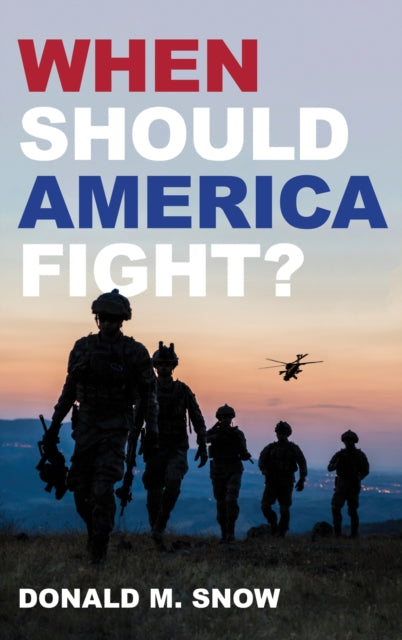
Donald M. Snow
When Should America Fight?
When Should America Fight?
We can order this item for you. Delivery usually takes about 4 to 6 weeks.
This item is not held in our immediate stock. We will order it for you after checkout.
Estimated delivery: About 4 to 6 weeks
YOU SAVE £4.64
- Condition: Brand new
- UK Delivery times: Usually arrives within 2 - 3 working days
- UK Shipping: Fee starts at £3.89. Subject to product weight & dimension
Bulk ordering. Want 15 or more copies? Get a personalised quote and bigger discounts. Learn more about bulk orders.
Couldn't load pickup availability
- More about When Should America Fight?
Donald M. Snow invites readers to consider the "IF factor" when considering whether the US should engage in military action, examining a historical overview of how the US became involved in intervening in asymmetrical warfare, the problem of internal war in the developing world, and future American military involvement.
Format: Paperback / softback
Length: 224 pages
Publication date: 31 January 2023
Publisher: Rowman & Littlefield
Donald M. Snow invites readers to contemplate the criteria that should be assessed when determining whether the United States should engage in military actions across the globe. When its vital interests are at stake and when the endeavor can reasonably be deemed feasible, as Snow refers to it, the "IF factor" comes into play. Justifying the use of American military force in a situation where its success is uncertain or where US interests are not clearly vital is challenging, but Snow argues that this has frequently occurred since Vietnam.
The book is structured into three sections, each exploring a different aspect of the United States' involvement in intervening in asymmetrical warfare, the challenges of internal war in developing countries, and the potential for future American military involvement, particularly in conflicts in the Global South and Ukraine.
In the first section, Snow provides a historical overview of how the United States became involved in intervening in asymmetrical warfare. He examines the factors that led to the US involvement in conflicts such as Vietnam, Afghanistan, and Iraq, highlighting the political, economic, and cultural considerations that influenced these decisions. Snow argues that the United States often intervened in these conflicts without fully understanding the local context or the complexities of the conflicts, leading to unintended consequences and a lasting impact on the region.
The second section focuses on the problem of internal war in the developing world. Snow argues that the United States has often been reluctant to intervene in internal conflicts, particularly those involving authoritarian regimes or ethnic minorities. However, he also acknowledges that the United States has a responsibility to prevent genocide, human rights abuses, and other forms of violence that threaten the stability and security of the developing world. Snow explores the challenges of intervening in internal conflicts, including the need for a clear strategy, the risk of unintended consequences, and the potential for exacerbating the conflict.
The third section examines the future of American military involvement, particularly in conflicts in the Global South and Ukraine. Snow argues that the United States has a strategic interest in promoting stability and democracy in these regions, particularly in the face of threats from authoritarian regimes and regional powers. He explores the potential strategies that the United States could use to promote stability, including economic aid, military intervention, and diplomatic engagement. Snow also raises concerns about the potential risks and unintended consequences of military intervention, particularly in the context of complex and multifaceted conflicts.
Overall, "The IF Factor: Assessing American Military Involvement in Asymmetrical Warfare" is a thought-provoking and insightful book that provides a comprehensive analysis of the United States' involvement in military actions across the globe. Snow challenges readers to consider the criteria that should be assessed when determining whether military action is necessary and explores the potential risks and unintended consequences of such actions. The book is a valuable resource for policymakers, scholars, and anyone interested in understanding the complex dynamics of international relations and the role of the United States in shaping the world.
Dimension: 229 x 152 (mm)
ISBN-13: 9781538169445
UK and International shipping information
UK and International shipping information
We deliver throughout the United Kingdom and to 128 countries and territories worldwide, including the United States, Australia, Canada, Germany, Spain and France.