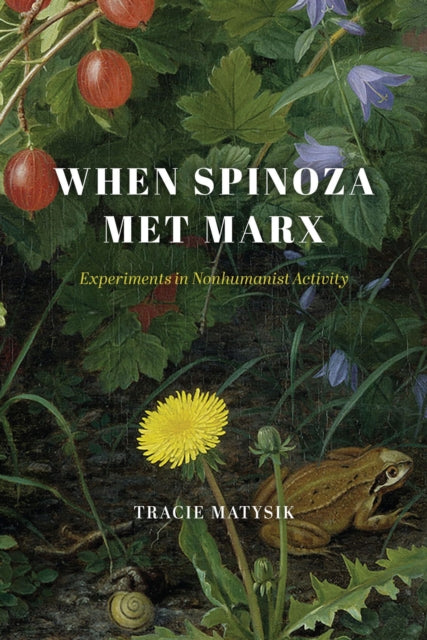
Tracie Matysik
When Spinoza Met Marx: Experiments in Nonhumanist Activity
When Spinoza Met Marx: Experiments in Nonhumanist Activity
💎 Earn 141 Points (£1.41) on this item.
YOU SAVE £3.68
- Condition: Brand new
- UK Delivery times: Usually arrives within 2 - 3 working days
- UK Shipping: Fee starts at £3.89. Subject to product weight & dimension
Bulk ordering. Want 15 or more copies? Get a personalised quote and bigger discounts. Learn more about bulk orders.
Couldn't load pickup availability
- More about When Spinoza Met Marx: Experiments in Nonhumanist Activity
Tracie Matysik explores the relationship between Spinoza and Marx, highlighting the intellectual conundrum around the meaning of activity and how socialists of the German nineteenth century were drawn to Spinoza as their philosophical guide. Matysik argues that the metaphorical meeting of Spinoza and Marx arose out of an attempt to address this paradox and offers lessons from these experiments that are relevant to the contemporary world.
Format: Hardback
Length: 368 pages
Publication date: 23 January 2023
Publisher: The University of Chicago Press
Karl Marx, a fervent revolutionary thinker, predicted the imminent collapse of capitalism, while Spinoza, a reflective philosopher, advocated for rational understanding and expressed reservations about open rebellion. Spinoza derided all teleological notions as anthropomorphic fantasies, while Marxism became closely associated with teleological historical development. However, why were socialists of the German nineteenth century consistently drawn to Spinoza as their philosophical guide? Tracie Matysik explores how the metaphorical meeting of Spinoza and Marx emerged from an intellectual conundrum surrounding the meaning of activity. How can humans be fully determined creatures yet capable of transforming their world? To address this paradox, many revolutionary theorists began to conceive of activity in the sense of Spinoza, as relating to humans' ability to change their world. Matysik traces these Spinozist-socialist intellectual experiments throughout the nineteenth century, drawing valuable lessons for the contemporary world.
Karl Marx, a fervent revolutionary thinker, predicted the imminent collapse of capitalism, while Spinoza, a reflective philosopher, advocated for rational understanding and expressed reservations about open rebellion. Spinoza derided all teleological notions as anthropomorphic fantasies, while Marxism became closely associated with teleological historical development. However, why were socialists of the German nineteenth century consistently drawn to Spinoza as their philosophical guide? Tracie Matysik explores how the metaphorical meeting of Spinoza and Marx emerged from an intellectual conundrum surrounding the meaning of activity. How can humans be fully determined creatures yet capable of transforming their world? To address this paradox, many revolutionary theorists began to conceive of activity in the sense of Spinoza, as relating to humans' ability to change their world. Matysik traces these Spinozist-socialist intellectual experiments throughout the nineteenth century, drawing valuable lessons for the contemporary world.
Dimension: 229 x 152 x 28 (mm)
ISBN-13: 9780226822334
UK and International shipping information
UK and International shipping information
We deliver throughout the United Kingdom and to 128 countries and territories worldwide, including the United States, Australia, Canada, Germany, Spain and France.