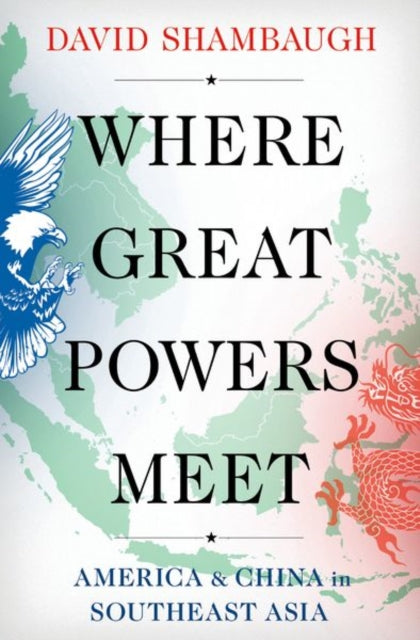
DavidShambaugh
Where Great Powers Meet: America & China in Southeast Asia
Where Great Powers Meet: America & China in Southeast Asia
💎 Earn 94 Points (£0.94) on this item.
YOU SAVE £1.12
- Condition: Brand new
- UK Delivery times: Usually arrives within 2 - 3 working days
- UK Shipping: Fee starts at £3.89. Subject to product weight & dimension
Bulk ordering. Want 15 or more copies? Get a personalised quote and bigger discounts. Learn more about bulk orders.
Couldn't load pickup availability
- More about Where Great Powers Meet: America & China in Southeast Asia
The re-emergence of China as a major great power has called into question the geopolitical future of Southeast Asia and raised the specter of renewed great power competition. The United States and China are engaged in a broad-gauged and global competition for power, centered in Asia. In assessing the likelihood of a regional power transition, Shambaugh examines how ASEAN and its member states maneuver and the degree to which they align with one or the other power.
Format: Paperback / softback
Length: 352 pages
Publication date: 14 November 2022
Publisher: Oxford University Press Inc
After the end of the Cold War, Southeast Asia appeared to be a geopolitically stable region within the American-led order for the foreseeable future. However, in the last two decades, the re-emergence of China as a major great power has called into question the geopolitical future of the region and raised the specter of renewed great power competition. As noted by renowned China scholar David Shambaugh in his book "Where Great Powers Meet," the United States and China are engaged in a broad-gauged and global competition for power, with Asia serving as the central theater. In this book, Shambaugh focuses on the critical sub-region of Southeast Asia, where the United States and China constantly vie for position and influence. The outcome of this contest will have a significant impact on whether Asia remains within the American orbit for seven decades or transitions into a new Chinese sphere of influence.
Moreover, the fate of Southeast Asia will be a valuable indicator of the global power transition occurring from the United States to China. At present, both powers bring important assets to bear in their competition. The United States continues to possess a depth and breadth of security ties, soft power, and direct investment across the region that empirically outweigh China's. On the other hand, China has more diplomatic influence, greater trade, and geographic proximity. In assessing the likelihood of a regional power transition, Shambaugh examines how ASEAN (the Association of Southeast Asian Nations) and its member states maneuver and the degree to which they align with one or the other power.
The re-emergence of China as a great power has also led to concerns about regional security and stability. As China's economic and military capabilities continue to grow, it may seek to assert its influence and interests in the region, which could lead to tensions and conflicts with other countries. This has been particularly evident in the South China Sea, where China has been constructing artificial islands and asserting its territorial claims, leading to disputes with neighboring countries such as the Philippines, Vietnam, and Malaysia.
To address these challenges, Southeast Asia has been working to strengthen its regional cooperation and institutions. The ASEAN Regional Forum (ARF) is one of the key mechanisms for promoting regional stability and security. The ARF is a multilateral forum that brings together the countries of Southeast Asia and other regional partners to discuss issues of common interest and address regional challenges.
Another important initiative is the East Asia Summit (EAS), which is a regional forum that brings together the countries of East Asia, including China, Japan, and the United States. The EAS aims to promote economic cooperation, security, and cultural exchange in the region.
In addition to these regional initiatives, Southeast Asia has also been working to strengthen its ties with the United States and other major powers. This has included efforts to enhance military cooperation, promote trade and investment, and address regional security concerns such as terrorism and piracy.
Despite these efforts, there are still challenges and uncertainties in the region's geopolitical landscape. The ongoing trade tensions between the United States and China, for example, could continue to impact regional economic growth and stability. Additionally, the rise of non-traditional security threats such as cybercrime and climate change also pose challenges to regional security and stability.
In conclusion, the re-emergence of China as a great power has had a significant impact on the geopolitical future of Southeast Asia. While the region appeared to be a geopolitically stable region within the American-led order after the end of the Cold War, the re-emergence of China as a major great power has called into question the region's stability and raised the specter of renewed great power competition. Southeast Asia has been working to strengthen its regional cooperation and institutions to address these challenges, but there are still uncertainties and challenges in the region's geopolitical landscape. The outcome of this competition will have a significant impact on the future of Asia and the world.
Weight: 510g
Dimension: 155 x 236 x 24 (mm)
ISBN-13: 9780197667347
UK and International shipping information
UK and International shipping information
We deliver throughout the United Kingdom and to 128 countries and territories worldwide, including the United States, Australia, Canada, Germany, Spain and France.