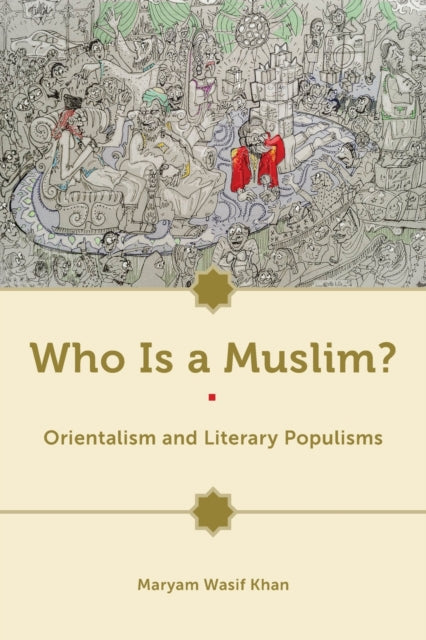
Maryam Wasif Khan
Who Is a Muslim?: Orientalism and Literary Populisms
Who Is a Muslim?: Orientalism and Literary Populisms
💎 Earn 124 Points (£1.24) on this item.
YOU SAVE £5.01
- Condition: Brand new
- UK Delivery times: Usually arrives within 2 - 3 working days
- UK Shipping: Fee starts at £2.39. Subject to product weight & dimension
Bulk ordering. Want 15 or more copies? Get a personalised quote and bigger discounts. Learn more about bulk orders.
Couldn't load pickup availability
- More about Who Is a Muslim?: Orientalism and Literary Populisms
A Muslim is a person who practices Islam, a religion that originated in the Arabian Peninsula in the 7th century. Muslims believe in one God, Allah, and follow the teachings of the Prophet Muhammad.
Muslims come from diverse backgrounds and cultures and live in many parts of the world. The question "Who is a Muslim?" has been a central concern in Western and Eastern literatures for centuries, and it continues to be a significant issue today. Urdu literature, which originated in colonial institutions in colonial India, is shaped around this question and has been used to promote a particular understanding of piety, national identity, and citizenship.
Format: Paperback / softback
Length: 288 pages
Publication date: 19 January 2021
Publisher: Fordham University Press
Who Is a Muslim? is a book that explores the question of identity in modern Urdu literature, from its origins in colonial institutions to its dominant iterations in contemporary Pakistan. The author argues that the idea of an Urdu canon, far from secular or progressive, has been shaped as the authority designate around the intertwined questions of piety, national identity, and citizenship. The book spans three centuries and examines how the question of identity has been shaped by the colonial and postcolonial contexts in which Urdu literature has been produced.
One of the key themes of the book is the idea of piety. The author argues that piety has been used as a tool to control and regulate the behavior of Muslims in the North-Indian colony and later in Pakistan. Piety is defined as a set of beliefs and practices that are associated with Islam, and it is often used to justify the oppression of women, minorities, and other marginalized groups. The author argues that the idea of piety has been used to create a sense of belonging and identity among Muslims, but it has also been used to justify the exclusion and marginalization of others.
Another key theme of the book is the idea of national identity. The author argues that national identity has been shaped by the colonial and postcolonial contexts in which Urdu literature has been produced. National identity is defined as a sense of belonging to a particular nation or community, and it is often used to justify the oppression of other groups. The author argues that the idea of national identity has been used to create a sense of superiority and dominance among Muslims, but it has also been used to justify the exclusion and marginalization of others.
The author also argues that the idea of citizenship has been shaped by the colonial and postcolonial contexts in which Urdu literature has been produced. Citizenship is defined as a set of rights and responsibilities that are associated with being a member of a particular nation or community, and it is often used to justify the exclusion and marginalization of others. The author argues that the idea of citizenship has been used to create a sense of belonging and identity among Muslims, but it has also been used to justify the oppression and marginalization of others.
The book also examines the ways in which Urdu literature has been used to promote social and political change. The author argues that Urdu literature has been used to challenge the status quo and to promote a more inclusive and democratic society. However, the author also argues that Urdu literature has been used to promote a conservative and traditionalist ideology that has been harmful to women, minorities, and other marginalized groups.
The book is divided into three sections. The first section examines the origins of modern Urdu literature in colonial institutions such as Fort William College, Calcutta. The second section examines the dominant iterations of modern Urdu literature in contemporary Pakistan. The third section examines the ways in which Urdu literature has been used to promote social and political change.
One of the key strengths of the book is its use of historical and literary analysis. The author uses a wide range of sources, including literary texts, historical documents, and interviews with authors and scholars. The author also uses a critical lens to examine the ways in which Urdu literature has been used to promote social and political change.
However, the book also has some limitations. One of the limitations is that the author does not provide a comprehensive analysis of the ways in which Urdu literature has been used to promote social and political change. The author focuses primarily on the question of identity and does not explore the ways in which Urdu literature has been used to promote other social and political issues such as gender inequality, caste discrimination, and environmental degradation.
Another limitation of the book is that the author does not provide a clear definition of what constitutes an Urdu canon. The author argues that the idea of an Urdu canon has been shaped by the intertwined questions of piety, national identity, and citizenship, but the author does not provide a clear definition of what constitutes an Urdu canon. This can make it difficult for readers to understand the author's argument.
Despite these limitations, Who Is a Muslim? is a valuable book that provides a fresh and insightful perspective on the question of identity in modern Urdu literature. The book is well-written and accessible, and it will be of interest to scholars and students of literature, history, and politics.
In conclusion, Who Is a Muslim? is a book that explores the question of identity in modern Urdu literature, from its origins in colonial institutions to its dominant iterations in contemporary Pakistan. The author argues that the idea of an Urdu canon, far from secular or progressive, has been shaped as the authority designate around the intertwined questions of piety, national identity, and citizenship. The book is divided into three sections and uses a historical and literary analysis to examine the ways in which Urdu literature has been used to promote social and political change. While the book has some limitations, it is a valuable book that will be of interest to scholars and students of literature, history, and politics.
Weight: 422g
Dimension: 152 x 228 x 19 (mm)
ISBN-13: 9780823290130
This item can be found in:
UK and International shipping information
UK and International shipping information
UK Delivery and returns information:
- Delivery within 2 - 3 days when ordering in the UK.
- Shipping fee for UK customers from £2.39. Fully tracked shipping service available.
- Returns policy: Return within 30 days of receipt for full refund.
International deliveries:
Shulph Ink now ships to Australia, Belgium, Canada, France, Germany, Ireland, Italy, India, Luxembourg Saudi Arabia, Singapore, Spain, Netherlands, New Zealand, United Arab Emirates, United States of America.
- Delivery times: within 5 - 10 days for international orders.
- Shipping fee: charges vary for overseas orders. Only tracked services are available for most international orders. Some countries have untracked shipping options.
- Customs charges: If ordering to addresses outside the United Kingdom, you may or may not incur additional customs and duties fees during local delivery.