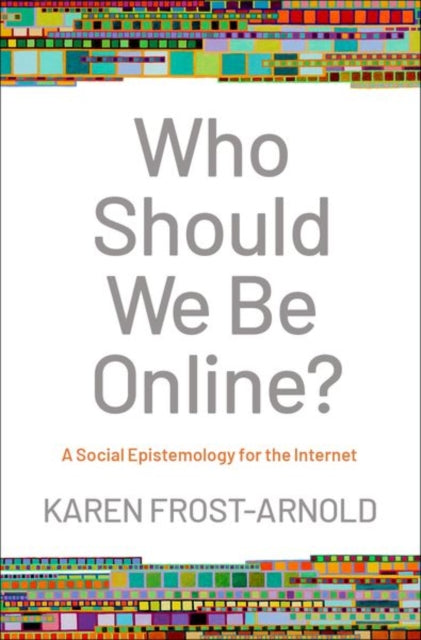
KarenFrost-Arnold
Who Should We Be Online?: A Social Epistemology for the Internet
Who Should We Be Online?: A Social Epistemology for the Internet
💎 Earn 356 Points (£3.56) on this item.
- Condition: Brand new
- UK Delivery times: Usually arrives within 2 - 3 working days
- UK Shipping: Fee starts at £2.39. Subject to product weight & dimension
Bulk ordering. Want 15 or more copies? Get a personalised quote and bigger discounts. Learn more about bulk orders.
Couldn't load pickup availability
- More about Who Should We Be Online?: A Social Epistemology for the Internet
The book "Who Should We Be Online?" explores the challenges of the online world and argues that global inequalities and social identities shape who we are online and what we know. It proposes a social epistemology that values truth and objectivity while recognizing the role of sexism, racism, and other forms of oppression in creating and sharing knowledge online. The book offers suggestions and reform strategies to make the internet more conducive to knowledge production and sharing.
Format: Hardback
Length: 288 pages
Publication date: 27 February 2023
Publisher: Oxford University Press Inc
The complex interplay between global inequalities and our social identities profoundly impacts our online presence, capabilities, and knowledge acquisition. From social media platforms to search engines and online encyclopedias like Wikipedia, the internet has become an integral part of how we produce, discover, and disseminate information on a global scale. In his book, "Who Should We Be Online?" author Jaron Lanier explores the challenges and complexities of the online world, employing a wide range of epistemological approaches. Lanier delves into pressing issues such as online content moderation, the prevalence of fake news and hoaxes, and the role that sexism, racism, and other forms of oppression play in shaping the creation and dissemination of knowledge online.
"Who Should We Be Online?" is a timely and interdisciplinary work that brings together scholarship from various fields, including internet studies, humanities, social sciences, and computer science. Lanier recognizes that the internet possesses both the potential to fuel ignorance and misinformation and to offer knowledge and empowerment to marginalized groups and activists. Through case studies of moderators, imposters, and other internet personas, Lanier highlights the problems with our current internet ecosystem and offers imaginative solutions for a more just and inclusive online future.
One of the central themes of "Who Should We Be Online?" is the importance of a social epistemology that values truth and objectivity. Lanier argues that while inequalities may hinder our collective ability to attain these goals, we can still strive for a more just and informed online community by promoting transparency, accountability, and diversity. He proposes numerous suggestions and reform strategies to make the internet more conducive to knowledge production and sharing, including measures to improve online content moderation, promote fact-checking and verification, and address the issue of algorithmic bias.
In conclusion, "Who Should We Be Online?" is a thought-provoking and insightful book that sheds light on the complex relationship between global inequalities and our social identities in the digital age. Lanier's book offers valuable insights and proposals for navigating the challenges and opportunities of the online world, promoting a more just and informed online community for all.
Weight: 558g
Dimension: 164 x 243 x 26 (mm)
ISBN-13: 9780190089184
This item can be found in:
UK and International shipping information
UK and International shipping information
UK Delivery and returns information:
- Delivery within 2 - 3 days when ordering in the UK.
- Shipping fee for UK customers from £2.39. Fully tracked shipping service available.
- Returns policy: Return within 30 days of receipt for full refund.
International deliveries:
Shulph Ink now ships to Australia, Belgium, Canada, France, Germany, Ireland, Italy, India, Luxembourg Saudi Arabia, Singapore, Spain, Netherlands, New Zealand, United Arab Emirates, United States of America.
- Delivery times: within 5 - 10 days for international orders.
- Shipping fee: charges vary for overseas orders. Only tracked services are available for most international orders. Some countries have untracked shipping options.
- Customs charges: If ordering to addresses outside the United Kingdom, you may or may not incur additional customs and duties fees during local delivery.