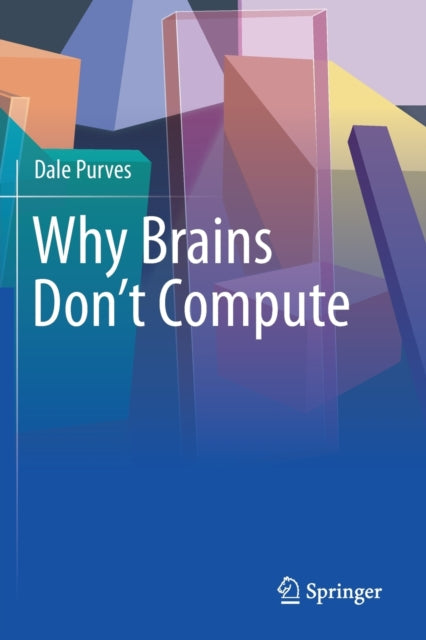
Dale Purves
Why Brains Don't Compute
Why Brains Don't Compute
💎 Earn 289 Points (£2.89) on this item.
YOU SAVE £12.18
- Condition: Brand new
- UK Delivery times: Usually arrives within 2 - 3 working days
- UK Shipping: Fee starts at £2.39. Subject to product weight & dimension
Bulk ordering. Want 15 or more copies? Get a personalised quote and bigger discounts. Learn more about bulk orders.
Couldn't load pickup availability
- More about Why Brains Don't Compute
The book explores the challenge of understanding how experience generated by the human brain is related to the physical world, presenting evidence that brains address this problem on a trial-and-error basis. It encourages neuroscientists, computer scientists, philosophers, and other interested readers to consider this concept and its implications, including the conclusion that brains don't "compute."
Format: Paperback / softback
Length: 168 pages
Publication date: 08 May 2022
Publisher: Springer Nature Switzerland AG
The central question addressed in this groundbreaking book is the intricate relationship between the human brain's experiences and the physical world we inhabit. Through a series of 25 concise chapters, the author presents a compelling argument and abundant evidence that suggests that the brain solves this complex problem through an iterative and experimental approach. The primary objective of this text is to inspire neuroscientists, computer scientists, philosophers, and other passionate readers to delve into the concept of neural function and its far-reaching implications. One of the most significant conclusions drawn from this study is that the brain does not function as a traditional computer, where calculations and logical reasoning are performed. Instead, the brain operates on a non-linear and probabilistic basis, relying on trial and error to refine its understanding of the world. This revelation challenges prevailing notions of how the mind and the brain interact and offers a fresh perspective on the nature of consciousness and perception. By exploring the complexities of neural function, this book provides valuable insights into the underlying mechanisms of human cognition, emotion, and behavior. It sheds light on the ways in which our experiences shape our brains and vice versa, highlighting the dynamic and adaptable nature of the human mind. Furthermore, the book raises important philosophical questions about the nature of reality, free will, and the mind-body problem. It prompts readers to consider the implications of a brain-based understanding of the world and to explore the potential for new paradigms of scientific inquiry and philosophical thought. In conclusion, this book is a must-read for anyone interested in the field of neuroscience, philosophy, or the broader study of the human mind and its relationship to the world. Its thought-provoking insights and innovative approach to understanding neural function will inspire and challenge readers alike, paving the way for new discoveries and advancements in our understanding of the mind and the brain.
The central question addressed in this groundbreaking book is the intricate relationship between the human brain's experiences and the physical world we inhabit. Through a series of 25 concise chapters, the author presents a compelling argument and abundant evidence that suggests that the brain solves this complex problem through an iterative and experimental approach. The primary objective of this text is to inspire neuroscientists, computer scientists, philosophers, and other passionate readers to delve into the concept of neural function and its far-reaching implications. One of the most significant conclusions drawn from this study is that the brain does not function as a traditional computer, where calculations and logical reasoning are performed. Instead, the brain operates on a non-linear and probabilistic basis, relying on trial and error to refine its understanding of the world. This revelation challenges prevailing notions of how the mind and the brain interact and offers a fresh perspective on the nature of consciousness and perception. By exploring the complexities of neural function, this book provides valuable insights into the underlying mechanisms of human cognition, emotion, and behavior. It sheds light on the ways in which our experiences shape our brains and vice versa, highlighting the dynamic and adaptable nature of the human mind. Furthermore, the book raises important philosophical questions about the nature of reality, free will, and the mind-body problem. It prompts readers to consider the implications of a brain-based understanding of the world and to explore the potential for new paradigms of scientific inquiry and philosophical thought. In conclusion, this book is a must-read for anyone interested in the field of neuroscience, philosophy, or the broader study of the human mind and its relationship to the world. Its thought-provoking insights and innovative approach to understanding neural function will inspire and challenge readers alike, paving the way
Weight: 291g
Dimension: 235 x 155 (mm)
ISBN-13: 9783030710668
Edition number: 1st ed. 2021
UK and International shipping information
UK and International shipping information
UK Delivery and returns information:
- Delivery within 2 - 3 days when ordering in the UK.
- Shipping fee for UK customers from £2.39. Fully tracked shipping service available.
- Returns policy: Return within 30 days of receipt for full refund.
International deliveries:
Shulph Ink now ships to Australia, Belgium, Canada, France, Germany, Ireland, Italy, India, Luxembourg Saudi Arabia, Singapore, Spain, Netherlands, New Zealand, United Arab Emirates, United States of America.
- Delivery times: within 5 - 10 days for international orders.
- Shipping fee: charges vary for overseas orders. Only tracked services are available for most international orders. Some countries have untracked shipping options.
- Customs charges: If ordering to addresses outside the United Kingdom, you may or may not incur additional customs and duties fees during local delivery.