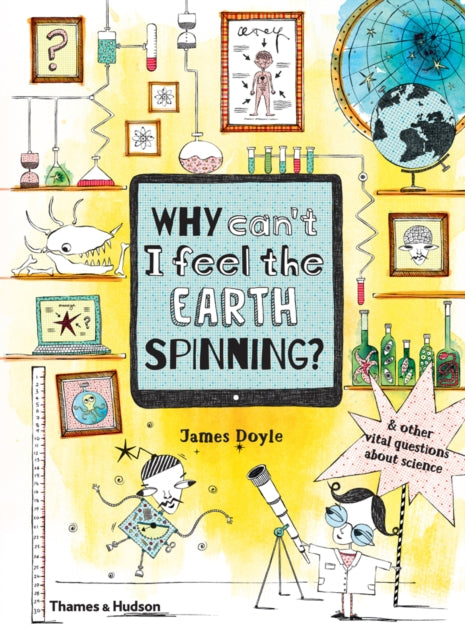
James Doyle
Why Can't I Feel the Earth Spinning?: And other vital questions about science
Why Can't I Feel the Earth Spinning?: And other vital questions about science
💎 Earn 45 Points (£0.45) on this item.
YOU SAVE £3.80
- Condition: Brand new
- UK Delivery times: Usually arrives within 2 - 3 working days
- UK Shipping: Fee starts at £2.39. Subject to product weight & dimension
Bulk ordering. Want 15 or more copies? Get a personalised quote and bigger discounts. Learn more about bulk orders.
Couldn't load pickup availability
- More about Why Can't I Feel the Earth Spinning?: And other vital questions about science
This book encourages young people to explore the world around them by asking and answering questions about science. It is structured around twenty-two questions, each tackled over two spreads. The tone is fresh and informal without being flippant.
Format: Hardback
Length: 96 pages
Publication date: 27 September 2018
Publisher: Thames & Hudson Ltd
Why do we need to wash?
Humans are social creatures, and we interact with each other on a daily basis. This interaction can lead to the transfer of germs and bacteria from one person to another. Washing our hands helps to remove these germs and bacteria, which can help to prevent the spread of diseases.
There are many different types of diseases that can be spread through contact with germs and bacteria. Some of these diseases include:
- Cold and flu
- Strep throat
- E. coli
- Salmonella
- Tuberculosis
By washing our hands regularly, we can help to reduce our risk of contracting these diseases.
In addition to preventing the spread of diseases, washing our hands can also help to improve our overall health. When we wash our hands, we are removing dirt and debris from our hands, which can help to prevent the buildup of bacteria and germs. This can lead to a reduction in the risk of skin infections and other skin problems.
Washing our hands is also important for maintaining good hygiene. When we wash our hands, we are removing any food or drink residue that may be on our hands, which can help to prevent the spread of foodborne illnesses.
There are many different ways to wash our hands. The most effective way to wash our hands is to use soap and water. When we wash our hands, we should lather up our hands with soap and water and then wash them for at least 20 seconds. We should also make sure to wash our hands thoroughly, including between our fingers and under our nails.
In addition to washing our hands, we can also use hand sanitizer to kill germs and bacteria. Hand sanitizer is a liquid or gel that is applied to the hands and then rubbed in until it is dry. Hand sanitizer is effective against most types of germs and bacteria, but it is not as effective as washing our hands with soap and water.
There are many different places where we can wash our hands. Some of these places include:
- Before and after eating
- Before and after caring for someone who is sick
- Before and after using the toilet
- Before and after handling food
- Before and after treating a cut or wound
By washing our hands regularly, we can help to protect ourselves and others from the spread of diseases. Washing our hands is a simple and effective way to improve our overall health and hygiene.
Why don't aeroplanes fall down?
Aeroplanes are designed to fly through the air, and they do so by using a combination of lift and drag. Lift is the force that pushes an aeroplane upwards, while drag is the force that pulls it downwards.
The shape of an aeroplane is designed to create lift and drag in the right proportions to allow it to fly. The wings of an aeroplane are designed to create lift by pushing air downwards, which creates a vacuum that pulls the aeroplane upwards. The fuselage of an aeroplane is designed to create drag by pushing air upwards, which slows down the aeroplane.
In addition to the shape of the aeroplane, the weight of the aeroplane is also important. The heavier an aeroplane is, the more drag it creates. This is because the heavier an object is, the more force it requires to move through the air.
The engines of an aeroplane are also important for creating lift and drag. The engines of an aeroplane create thrust, which is the force that pushes the aeroplane forward. This thrust is created by burning fuel, which creates hot gases that expand and push the aeroplane upwards.
The airspeed of an aeroplane is also important for creating lift and drag. The faster an aeroplane flies, the more air it moves through, which creates more lift. This is because the faster an object moves through the air, the more force it requires to move through the air.
In addition to the shape, weight, engines, and airspeed of an aeroplane, the weather is also important for creating lift and drag. The wind can create lift by pushing the aeroplane upwards, while the rain can create drag by slowing down the aeroplane.
The pilot of an aeroplane is also important for creating lift and drag. The pilot can adjust the angle of the wings and the speed of the engines to create the right amount of lift and drag for the aeroplane. The pilot can also adjust the altitude of the aeroplane to create the right amount of lift and drag for the conditions.
In conclusion, aeroplanes are designed to fly through the air by using a combination of lift and drag. The shape, weight, engines, airspeed, weather, and pilot of an aeroplane are all important for creating the right amount of lift and drag for the aeroplane to fly. By understanding the principles of lift and drag, pilots can adjust the aeroplane to fly safely and efficiently.
Where do mountains come from?
Mountains are formed through a process called orogeny, which is the process of creating mountains through the movement of tectonic plates. Tectonic plates are large slabs of rock that make up the Earth's crust. The movement of tectonic plates is caused by the movement of heat from the Earth's interior.
The movement of tectonic plates can cause mountains to form in a variety of ways. One way that mountains can form is through the collision of two tectonic plates. When two tectonic plates collide, the denser plate is forced under the less dense plate. This can cause the denser plate to melt and form a mountain range.
Another way that mountains can form is through the folding of rocks. When rocks are subjected to high pressure and temperature, they can fold and form mountains. This is often caused by the movement of tectonic plates.
Mountains can also form through the eruption of volcanoes. When volcanoes erupt, they can form mountains by pushing up the Earth's crust. This is often caused by the movement of tectonic plates.
Mountains can also form through the erosion of rocks. When rocks are eroded by water or wind, they can form mountains by leaving behind large deposits of sediment. This is often caused by the movement of tectonic plates.
Mountains can also form through the movement of glaciers. When glaciers move, they can carve out mountains by pushing up the Earth's crust. This is often caused by the movement of tectonic plates.
Mountains can also form through the movement of faults. Faults are cracks in the Earth's crust that can move and cause the Earth to shake. This can cause mountains to form by pushing up the Earth's crust.
Mountains can also form through the movement of rivers. When rivers flow, they can carve out mountains by eroding the Earth's crust. This is often caused by the movement of tectonic plates.
Mountains can also form through the movement of glaciers. When glaciers move, they can carve out mountains by pushing up the Earth's crust. This is often caused by the movement of tectonic plates.
Mountains can also form through the movement of faults. Faults are cracks in the Earth's crust that can move and cause the Earth to shake. This can cause mountains to form by pushing up the Earth's crust.
Mountains can also form through the movement of rivers. When rivers flow, they can carve out mountains by eroding the Earth's crust. This is often caused by the movement of tectonic plates.
Mountains can also form through the movement of glaciers. When glaciers move, they can carve out mountains by pushing up the Earth's crust. This is often caused by the movement of tectonic plates.
Mountains can also form through the movement of faults. Faults are cracks in the Earth's crust that can move and cause the Earth to shake. This can cause mountains to form by pushing up the Earth's crust.
Mountains can also form through the movement of rivers. When rivers flow, they can carve out mountains by eroding the Earth's crust. This is often caused by the movement of tectonic plates.
Mountains can also form through the movement of glaciers. When glaciers move, they can carve out mountains by pushing up the Earth's crust. This is often caused by the movement of tectonic plates.
Mountains can also form through the movement of faults. Faults are cracks in the Earth's crust that can move and cause the Earth to shake. This can cause mountains to form by pushing up the Earth's crust.
Mountains can also form through the movement of rivers. When rivers flow, they can carve out mountains by eroding the Earth's crust. This is often caused by the movement of tectonic plates.
Mountains can also form through the movement of glaciers. When glaciers move, they can carve out mountains by pushing up the Earth's crust. This is often caused by the movement of tectonic plates.
Mountains can also form through the movement of faults. Faults are cracks in the Earth's crust that can move and cause the Earth to shake. This can cause mountains to form by pushing up the Earth's crust.
Mountains can also form through the movement of rivers. When rivers flow, they can carve out mountains by eroding the Earth's crust. This is often caused by the movement of tectonic plates.
Mountains can also form through the movement of glaciers. When glaciers move, they can carve out mountains by pushing up the Earth's crust. This is often caused by the movement of tectonic plates.
Why is the sea blue?
The color of the sea is blue because of a process called absorption. Absorption is the process by which light is absorbed by molecules in the sea.
The most common type of absorption in the sea is called absorption of blue light. Blue light is the type of light that is most easily absorbed by water molecules. This is because blue light has a shorter wavelength than other types of light, which means it can penetrate deeper into water molecules.
When blue light enters the sea, it is absorbed by water molecules. The water molecules then absorb the energy from the blue light and re-emit it in a different form. This re-emitted energy is what we see as the color blue.
There are other types of absorption in the sea, such as absorption of red light and absorption of green light. However, absorption of blue light is the most important type of absorption in the sea because it is the type of light that is most easily absorbed by water molecules.
The color of the sea can also be affected by other factors, such as the depth of the water and the amount of sunlight that reaches the sea. For example, the color of the sea is usually darker in deeper water because there is less sunlight that reaches these areas.
The color of the sea is also important for the health of the ocean. The color of the sea can affect the amount of sunlight that is absorbed by the ocean, which can affect the amount of carbon dioxide that is absorbed by the ocean. This can affect the temperature of the ocean and the amount of carbon dioxide that is released into the atmosphere.
In conclusion, the color of the sea is blue because of a process called absorption. Absorption of blue light is the most important type of absorption in the sea because it is the type of light that is most easily absorbed by water molecules. The color of the sea can also be affected by other factors, such as the depth of the water and the amount of sunlight that reaches the sea. The color of the sea is important for the health of the ocean because it can affect the amount of sunlight that is absorbed by the ocean and the amount of carbon dioxide that is absorbed by the ocean.
Weight: 542g
Dimension: 194 x 263 x 15 (mm)
ISBN-13: 9780500651186
UK and International shipping information
UK and International shipping information
UK Delivery and returns information:
- Delivery within 2 - 3 days when ordering in the UK.
- Shipping fee for UK customers from £2.39. Fully tracked shipping service available.
- Returns policy: Return within 30 days of receipt for full refund.
International deliveries:
Shulph Ink now ships to Australia, Belgium, Canada, France, Germany, Ireland, Italy, India, Luxembourg Saudi Arabia, Singapore, Spain, Netherlands, New Zealand, United Arab Emirates, United States of America.
- Delivery times: within 5 - 10 days for international orders.
- Shipping fee: charges vary for overseas orders. Only tracked services are available for most international orders. Some countries have untracked shipping options.
- Customs charges: If ordering to addresses outside the United Kingdom, you may or may not incur additional customs and duties fees during local delivery.