Autumn Publishing
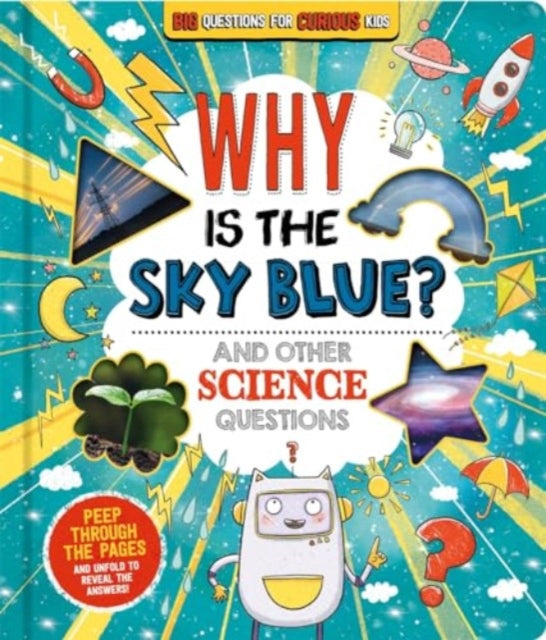
Why is the Sky Blue? (and other science questions)
Why is the Sky Blue? (and other science questions)
YOU SAVE £3.16
- Condition: Brand new
- UK Delivery times: Usually arrives within 2 - 3 working days
- UK Shipping: Fee starts at £3.89. Subject to product weight & dimension
Bulk ordering. Want 15 or more copies? Get a personalised quote and bigger discounts. Learn more about bulk orders.
Couldn't load pickup availability
- More about Why is the Sky Blue? (and other science questions)
The sky appears blue due to the scattering of light by air molecules, while the color of the ocean is determined by the way light interacts with water molecules.
The sky appears blue due to the scattering of light by air molecules, while the color of the ocean is determined by the way light interacts with water molecules. Other fascinating science facts include the fact that the Earth is the only planet in our solar system with liquid water on its surface, and that the sun is one of the millions of stars in the Milky Way galaxy.
Format: Board book
Length: 10 pages
Publication date: 23 May 2024
Publisher: Bonnier Books Ltd
The sky appears blue to us because of a phenomenon called "Rayleigh scattering." When sunlight enters the Earth's atmosphere, it collides with molecules of nitrogen and oxygen, which are present in the air. These molecules absorb some of the blue light, while the remaining colors are scattered in all directions. As a result, the blue light is scattered more than the other colors, giving the sky its characteristic blue hue.
Why Does the Sky Look Blue?
The sky appears blue to us because of a phenomenon called "Rayleigh scattering." When sunlight enters the Earth's atmosphere, it collides with molecules of nitrogen and oxygen, which are present in the air. These molecules absorb some of the blue light, while the remaining colors are scattered in all directions. As a result, the blue light is scattered more than the other colors, giving the sky its characteristic blue hue.
Other Fascinating Facts About Science
The sky appears blue to us because of a phenomenon called "Rayleigh scattering." When sunlight enters the Earth's atmosphere, it collides with molecules of nitrogen and oxygen, which are present in the air. These molecules absorb some of the blue light, while the remaining colors are scattered in all directions. As a result, the blue light is scattered more than the other colors, giving the sky its characteristic blue hue.
Why Does the Sky Look Blue?
The sky appears blue to us because of a phenomenon called "Rayleigh scattering." When sunlight enters the Earth's atmosphere, it collides with molecules of nitrogen and oxygen, which are present in the air. These molecules absorb some of the blue light, while the remaining colors are scattered in all directions. As a result, the blue light is scattered more than the other colors, giving the sky its characteristic blue hue.
Other Fascinating Facts About Science
The sky appears blue to us because of a phenomenon called "Rayleigh scattering." When sunlight enters the Earth's atmosphere, it collides with molecules of nitrogen and oxygen, which are present in the air. These molecules absorb some of the blue light, while the remaining colors are scattered in all directions. As a result, the blue light is scattered more than the other colors, giving the sky its characteristic blue hue.
Weight: 370g
Dimension: 192 x 227 x 19 (mm)
ISBN-13: 9781837713271
UK and International shipping information
UK and International shipping information
We deliver throughout the United Kingdom and to 128 countries and territories worldwide, including the United States, Australia, Canada, Germany, Spain and France.